







Question: U.S. Dollar/British Pound. Assuming the same initial values for the dollar/pound cross rate in this table how much more would a call option on pounds
U.S. Dollar/British Pound. Assuming the same initial values for the dollar/pound cross rate in this table how much more would a call option on pounds be if the maturity increases from 90 to 365 days? What percentage increase is this for the length ofmaturity?
1. If the maturity increases from 90 to 365 days, a call option on pounds would be $ ______. (Round to 6 decimal places)
2. Therefore, the 365-day call option would be $______ , more? or less? than the 90-day call option. (Round to 6 decimal places and select either more or less)
3. The percentage increase for the length of maturity is _____%. (Round to 4 decimal places)
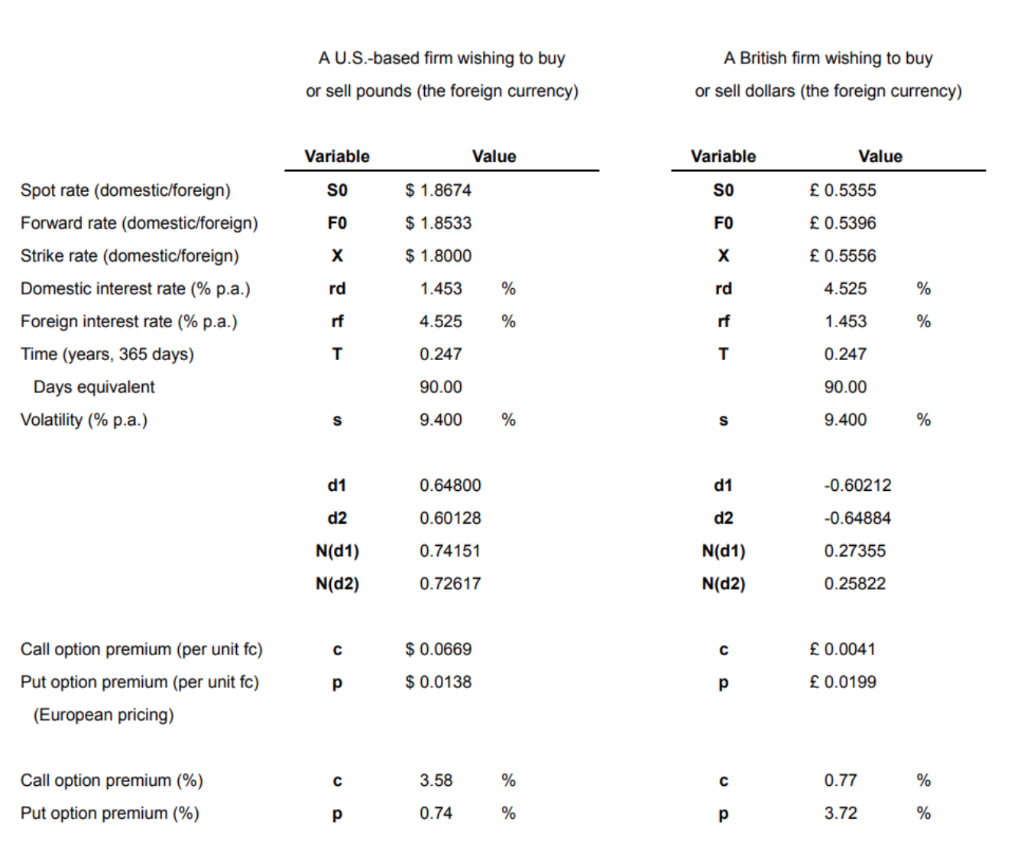
A U.S.-based firm wishing to buy or sell pounds (the foreign currency) A British firm wishing to buy or sell dollars (the foreign currency) Variable Value Variable Value SO $ 1.8674 so 0.5355 FO $ 1.8533 FO 0.5396 $ 1.8000 0.5556 rd 1.453 % rd 4.525 % Spot rate (domestic/foreign) Forward rate (domestic/foreign) Strike rate (domestic/foreign) Domestic interest rate (% p.a.) Foreign interest rate (% p.a.) Time (years, 365 days) Days equivalent Volatility (% p.a.) rf 4.525 % rf 1.453 % T 0.247 T 0.247 90.00 90.00 s 9.400 % S 9.400 % d1 0.64800 d1 -0.60212 d2 0.60128 d2 -0.64884 0.74151 0.27355 N(1) N(D2) N(1) N(D2) 0.72617 0.25822 $ 0.0669 0.0041 Call option premium (per unit fc) Put option premium (per unit fc) (European pricing) $ 0.0138 0.0199 3.58 % 0.77 % Call option premium (%) Put option premium (%) 0.74 % 3.72 %
Step by Step Solution
There are 3 Steps involved in it

Get step-by-step solutions from verified subject matter experts
 Study Help