







Question: * USE A LINE GRAPH WITH POINTS TO MAKE THE TIMES SERIES PLOT OF THE DATA PLEASE COMPLETE ALL CALCULATIONS AND GRAPHS WITH DETAILED EXPLANATIONS.
 * USE A LINE GRAPH WITH POINTS TO MAKE THE TIMES SERIES PLOT OF THE DATA
PLEASE COMPLETE ALL CALCULATIONS AND GRAPHS WITH DETAILED EXPLANATIONS. Thank you so much!
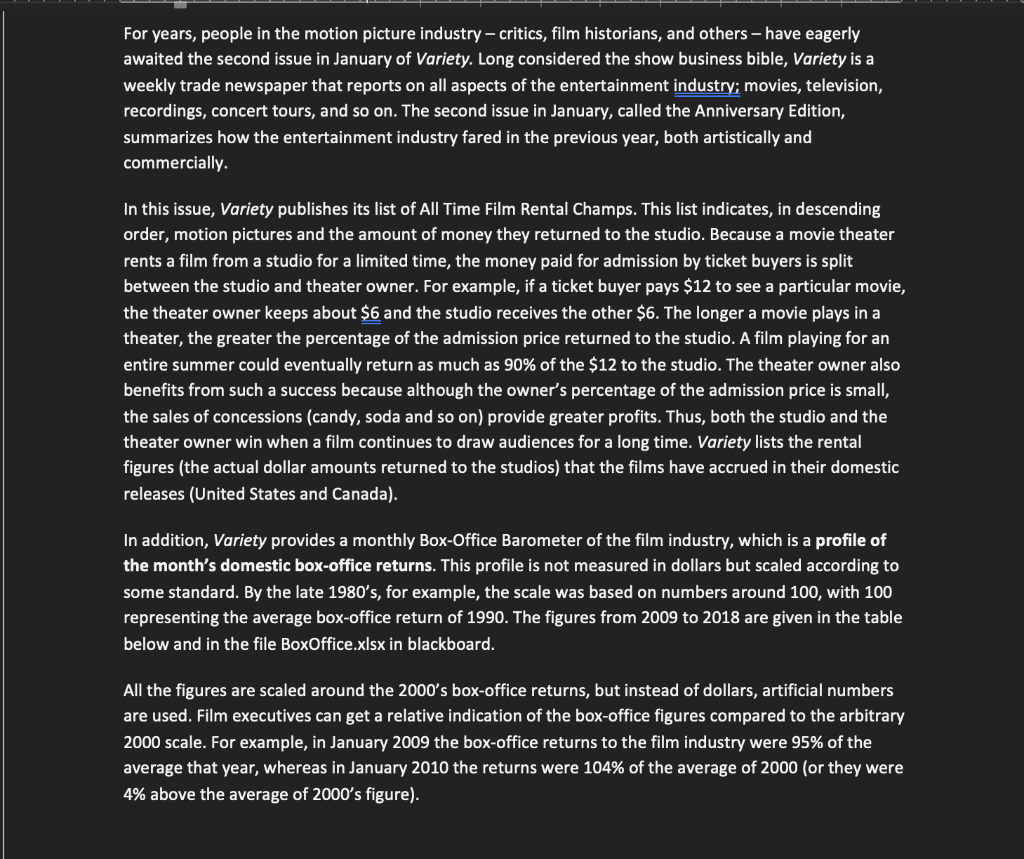
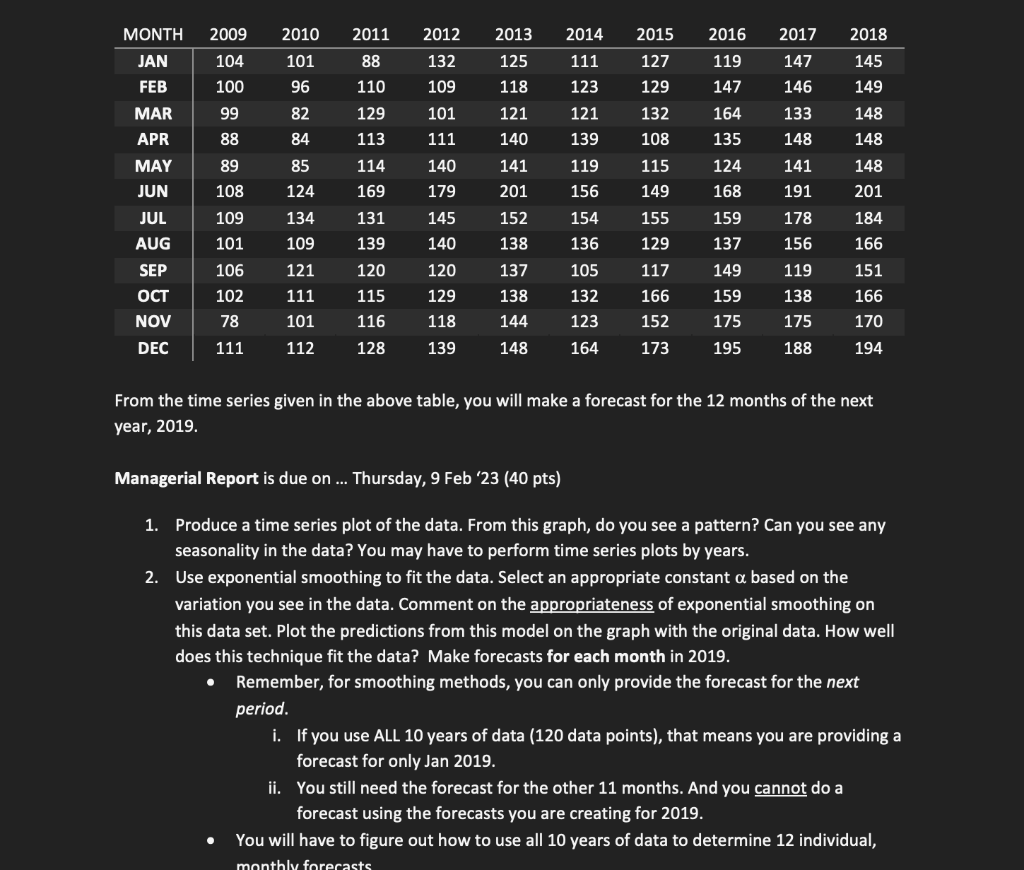
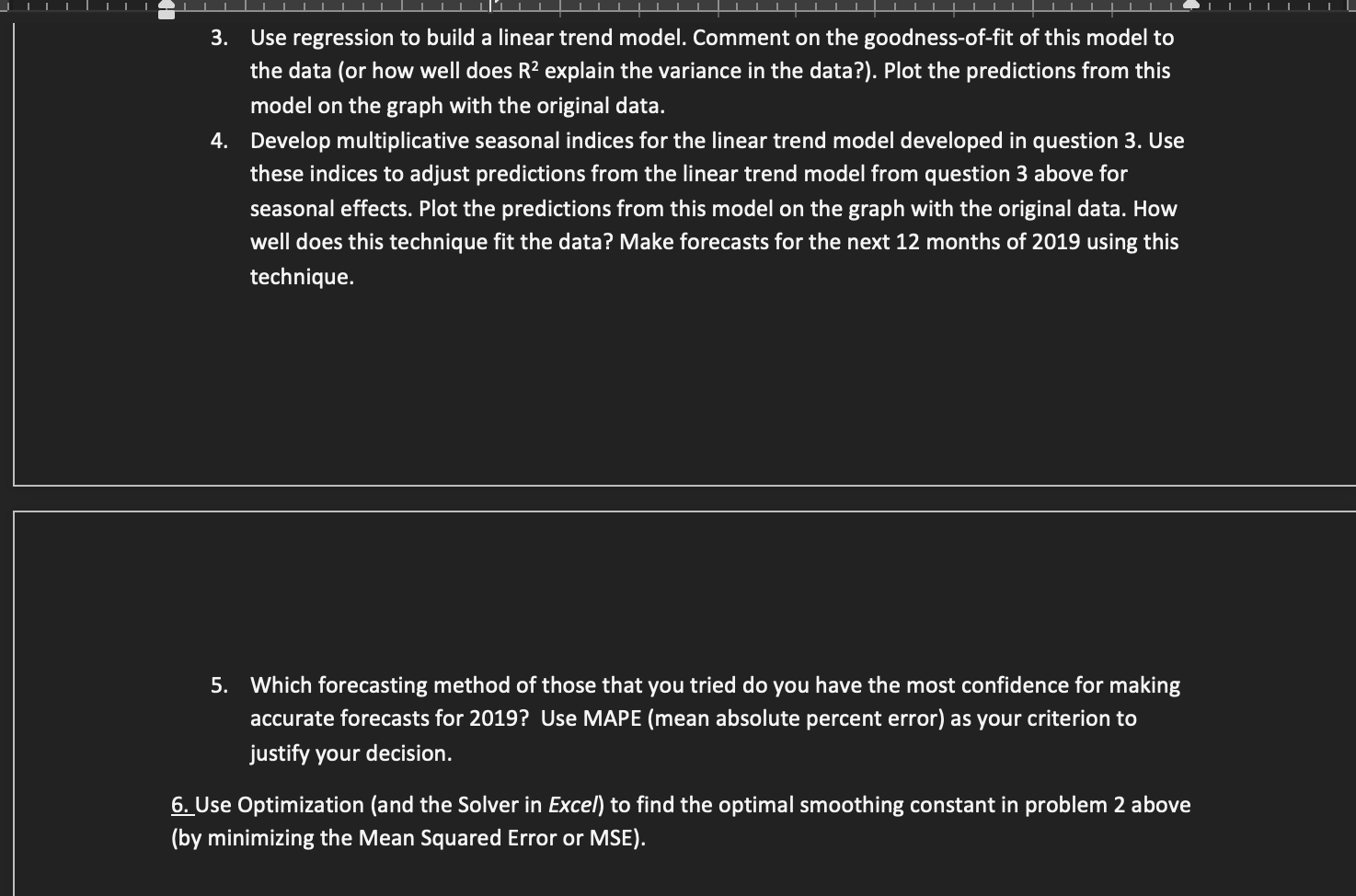
For years, people in the motion picture industry - critics, film historians, and others - have eagerly awaited the second issue in January of Variety. Long considered the show business bible, Variety is a weekly trade newspaper that reports on all aspects of the entertainment industry; movies, television, recordings, concert tours, and so on. The second issue in January, called the Anniversary Edition, summarizes how the entertainment industry fared in the previous year, both artistically and commercially. In this issue, Variety publishes its list of All Time Film Rental Champs. This list indicates, in descending order, motion pictures and the amount of money they returned to the studio. Because a movie theater rents a film from a studio for a limited time, the money paid for admission by ticket buyers is split between the studio and theater owner. For example, if a ticket buyer pays $12 to see a particular movie, the theater owner keeps about $6 and the studio receives the other $6. The longer a movie plays in a theater, the greater the percentage of the admission price returned to the studio. A film playing for an entire summer could eventually return as much as 90% of the $12 to the studio. The theater owner also benefits from such a success because although the owner's percentage of the admission price is small, the sales of concessions (candy, soda and so on) provide greater profits. Thus, both the studio and the theater owner win when a film continues to draw audiences for a long time. Variety lists the rental figures (the actual dollar amounts returned to the studios) that the films have accrued in their domestic releases (United States and Canada). In addition, Variety provides a monthly Box-Office Barometer of the film industry, which is a profile of the month's domestic box-office returns. This profile is not measured in dollars but scaled according to some standard. By the late 1980's, for example, the scale was based on numbers around 100 , with 100 representing the average box-office return of 1990. The figures from 2009 to 2018 are given in the table below and in the file BoxOffice.xlsx in blackboard. All the figures are scaled around the 2000's box-office returns, but instead of dollars, artificial numbers are used. Film executives can get a relative indication of the box-office figures compared to the arbitrary 2000 scale. For example, in January 2009 the box-office returns to the film industry were 95% of the average that year, whereas in January 2010 the returns were 104% of the average of 2000 (or they were 4% above the average of 2000 's figure). om the time series given in the above table, you will make a forecast for the 12 months of the next ar, 2019. anagerial Report is due on ... Thursday, 9 Feb ' 23 (40 pts) 1. Produce a time series plot of the data. From this graph, do you see a pattern? Can you see any seasonality in the data? You may have to perform time series plots by years. 2. Use exponential smoothing to fit the data. Select an appropriate constant based on the variation you see in the data. Comment on the appropriateness of exponential smoothing on this data set. Plot the predictions from this model on the graph with the original data. How well does this technique fit the data? Make forecasts for each month in 2019. - Remember, for smoothing methods, you can only provide the forecast for the next period. i. If you use ALL 10 years of data (120 data points), that means you are providing a forecast for only Jan 2019. ii. You still need the forecast for the other 11 months. And you cannot do a forecast using the forecasts you are creating for 2019. - You will have to figure out how to use all 10 years of data to determine 12 individual, 3. Use regression to build a linear trend model. Comment on the goodness-of-fit of this model to the data (or how well does R2 explain the variance in the data?). Plot the predictions from this model on the graph with the original data. 4. Develop multiplicative seasonal indices for the linear trend model developed in question 3. Use these indices to adjust predictions from the linear trend model from question 3 above for seasonal effects. Plot the predictions from this model on the graph with the original data. How well does this technique fit the data? Make forecasts for the next 12 months of 2019 using this technique. 5. Which forecasting method of those that you tried do you have the most confidence for making accurate forecasts for 2019 ? Use MAPE (mean absolute percent error) as your criterion to justify your decision. Use Optimization (and the Solver in Excel) to find the optimal smoothing constant in problem 2 above minimizing the Mean Squared Error or MSE). For years, people in the motion picture industry - critics, film historians, and others - have eagerly awaited the second issue in January of Variety. Long considered the show business bible, Variety is a weekly trade newspaper that reports on all aspects of the entertainment industry; movies, television, recordings, concert tours, and so on. The second issue in January, called the Anniversary Edition, summarizes how the entertainment industry fared in the previous year, both artistically and commercially. In this issue, Variety publishes its list of All Time Film Rental Champs. This list indicates, in descending order, motion pictures and the amount of money they returned to the studio. Because a movie theater rents a film from a studio for a limited time, the money paid for admission by ticket buyers is split between the studio and theater owner. For example, if a ticket buyer pays $12 to see a particular movie, the theater owner keeps about $6 and the studio receives the other $6. The longer a movie plays in a theater, the greater the percentage of the admission price returned to the studio. A film playing for an entire summer could eventually return as much as 90% of the $12 to the studio. The theater owner also benefits from such a success because although the owner's percentage of the admission price is small, the sales of concessions (candy, soda and so on) provide greater profits. Thus, both the studio and the theater owner win when a film continues to draw audiences for a long time. Variety lists the rental figures (the actual dollar amounts returned to the studios) that the films have accrued in their domestic releases (United States and Canada). In addition, Variety provides a monthly Box-Office Barometer of the film industry, which is a profile of the month's domestic box-office returns. This profile is not measured in dollars but scaled according to some standard. By the late 1980's, for example, the scale was based on numbers around 100 , with 100 representing the average box-office return of 1990. The figures from 2009 to 2018 are given in the table below and in the file BoxOffice.xlsx in blackboard. All the figures are scaled around the 2000's box-office returns, but instead of dollars, artificial numbers are used. Film executives can get a relative indication of the box-office figures compared to the arbitrary 2000 scale. For example, in January 2009 the box-office returns to the film industry were 95% of the average that year, whereas in January 2010 the returns were 104% of the average of 2000 (or they were 4% above the average of 2000 's figure). om the time series given in the above table, you will make a forecast for the 12 months of the next ar, 2019. anagerial Report is due on ... Thursday, 9 Feb ' 23 (40 pts) 1. Produce a time series plot of the data. From this graph, do you see a pattern? Can you see any seasonality in the data? You may have to perform time series plots by years. 2. Use exponential smoothing to fit the data. Select an appropriate constant based on the variation you see in the data. Comment on the appropriateness of exponential smoothing on this data set. Plot the predictions from this model on the graph with the original data. How well does this technique fit the data? Make forecasts for each month in 2019. - Remember, for smoothing methods, you can only provide the forecast for the next period. i. If you use ALL 10 years of data (120 data points), that means you are providing a forecast for only Jan 2019. ii. You still need the forecast for the other 11 months. And you cannot do a forecast using the forecasts you are creating for 2019. - You will have to figure out how to use all 10 years of data to determine 12 individual, 3. Use regression to build a linear trend model. Comment on the goodness-of-fit of this model to the data (or how well does R2 explain the variance in the data?). Plot the predictions from this model on the graph with the original data. 4. Develop multiplicative seasonal indices for the linear trend model developed in question 3. Use these indices to adjust predictions from the linear trend model from question 3 above for seasonal effects. Plot the predictions from this model on the graph with the original data. How well does this technique fit the data? Make forecasts for the next 12 months of 2019 using this technique. 5. Which forecasting method of those that you tried do you have the most confidence for making accurate forecasts for 2019 ? Use MAPE (mean absolute percent error) as your criterion to justify your decision. Use Optimization (and the Solver in Excel) to find the optimal smoothing constant in problem 2 above minimizing the Mean Squared Error or MSE)
Step by Step Solution
There are 3 Steps involved in it

Get step-by-step solutions from verified subject matter experts
 Study Help