







Question: Use a spreadsheet to solve the question. 8. Are Registered Retirement Savings Plans (RRSP's) all that they are cracked up to be? RRSP's are a
 Use a spreadsheet to solve the question.
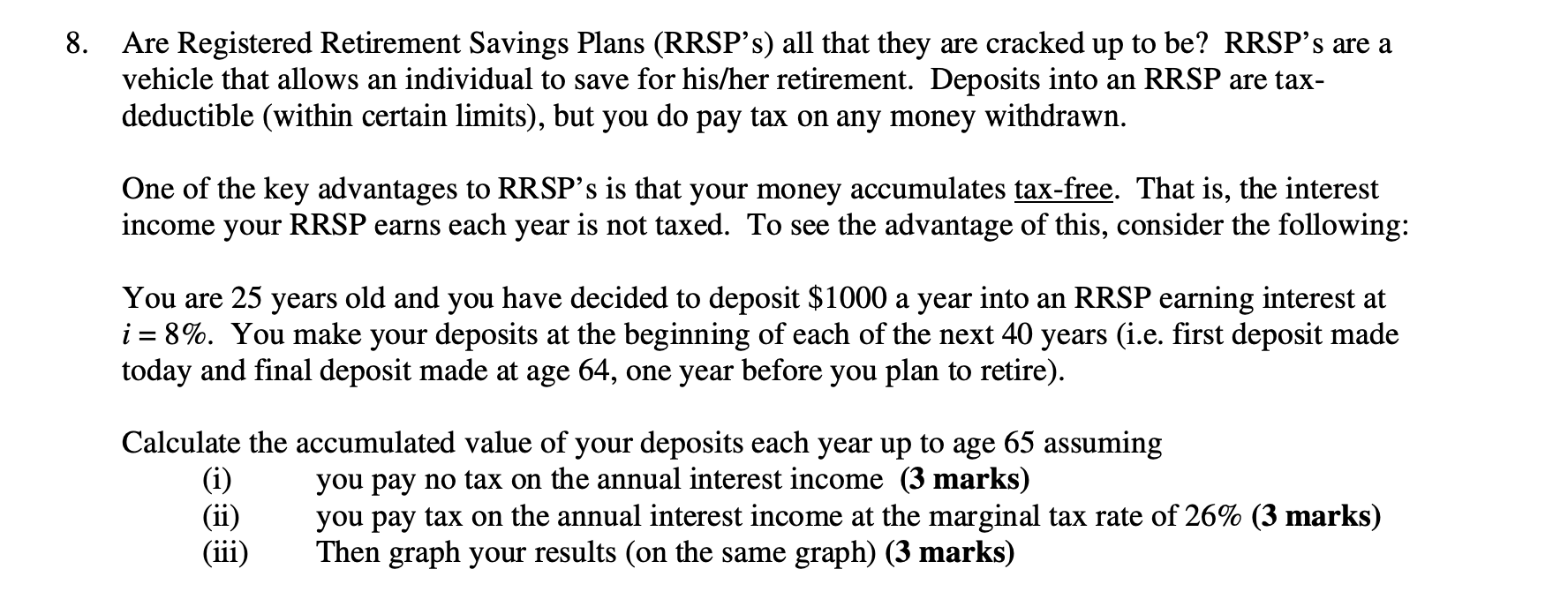
8. Are Registered Retirement Savings Plans (RRSP's) all that they are cracked up to be? RRSP's are a vehicle that allows an individual to save for his/her retirement. Deposits into an RRSP are tax- deductible (within certain limits), but you do pay tax on any money withdrawn. One of the key advantages to RRSP's is that your money accumulates tax-free. That is, the interest income your RRSP earns each year is not taxed. To see the advantage of this, consider the following: You are 25 years old and you have decided to deposit $1000 a year into an RRSP earning interest at i = 8%. You make your deposits at the beginning of each of the next 40 years (i.e. first deposit made today and final deposit made at age 64, one year before you plan to retire). Calculate the accumulated value of your deposits each year up to age 65 assuming (i) you pay no tax on the annual interest income (3 marks) you pay tax on the annual interest income at the marginal tax rate of 26% (3 marks) (iii) Then graph your results (on the same graph) (3 marks) 8. Are Registered Retirement Savings Plans (RRSP's) all that they are cracked up to be? RRSP's are a vehicle that allows an individual to save for his/her retirement. Deposits into an RRSP are tax- deductible (within certain limits), but you do pay tax on any money withdrawn. One of the key advantages to RRSP's is that your money accumulates tax-free. That is, the interest income your RRSP earns each year is not taxed. To see the advantage of this, consider the following: You are 25 years old and you have decided to deposit $1000 a year into an RRSP earning interest at i = 8%. You make your deposits at the beginning of each of the next 40 years (i.e. first deposit made today and final deposit made at age 64, one year before you plan to retire). Calculate the accumulated value of your deposits each year up to age 65 assuming (i) you pay no tax on the annual interest income (3 marks) you pay tax on the annual interest income at the marginal tax rate of 26% (3 marks) (iii) Then graph your results (on the same graph)
Step by Step Solution
There are 3 Steps involved in it

Get step-by-step solutions from verified subject matter experts
 Study Help