







Question: Use a truth table to determine whether the argument is valid. ( pq)^(qor) r .... O Valid O Invalid The argument has a true conclusion.
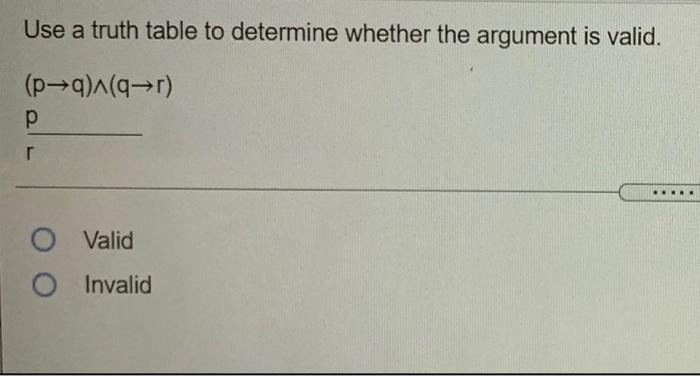
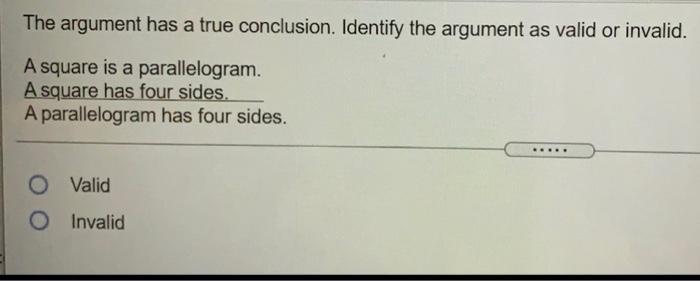
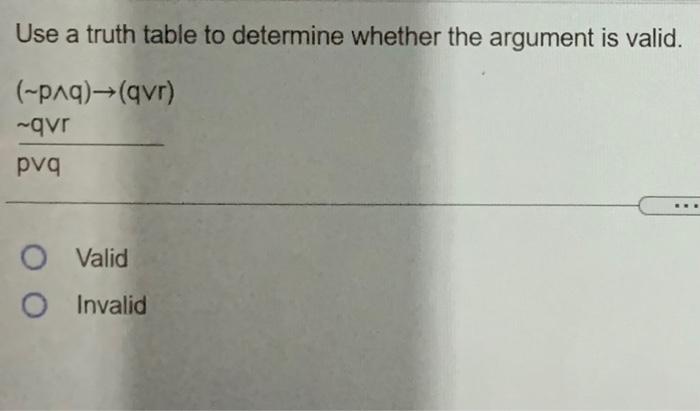
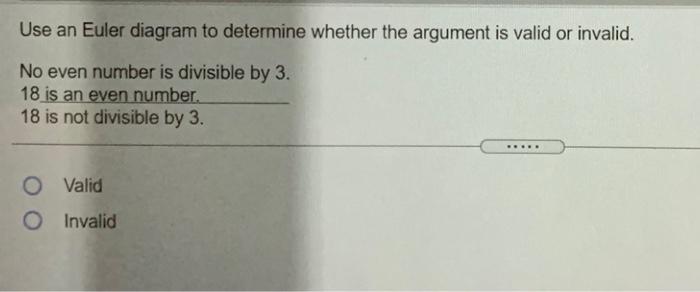
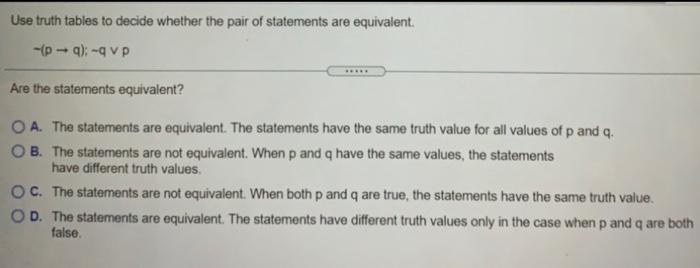
Use a truth table to determine whether the argument is valid. ( pq)^(qor) r .... O Valid O Invalid The argument has a true conclusion. Identify the argument as valid or invalid. A square is a parallelogram. A square has four sides. A parallelogram has four sides. ..... Valid O Invalid Use a truth table to determine whether the argument is valid. (~paq)-(qv) ~qvr pva O Valid O Invalid Use an Euler diagram to determine whether the argument is valid or invalid. No even number is divisible by 3. 18 is an even number. 18 is not divisible by 3. O Valid O Invalid Use truth tables to decide whether the pair of statements are equivalent. -(-9);-Vp Are the statements equivalent? O A. The statements are equivalent. The statements have the same truth value for all values of p and q. O B. The statements are not equivalent. When p and q have the same values, the statements have different truth values. OC. The statements are not equivalent. When both p and q are true, the statements have the same truth value. OD. The statements are equivalent. The statements have different truth values only in the case when p and q are both false
Step by Step Solution
There are 3 Steps involved in it

Get step-by-step solutions from verified subject matter experts
 Study Help