



Question: USE ANALYTICAL METHOD OF VECTOR fGiven the following value, determine the Percent of Error {96), Weight W, and Resultant Force {FR} in Newton using ANALYTICAL
USE ANALYTICAL METHOD OF VECTOR
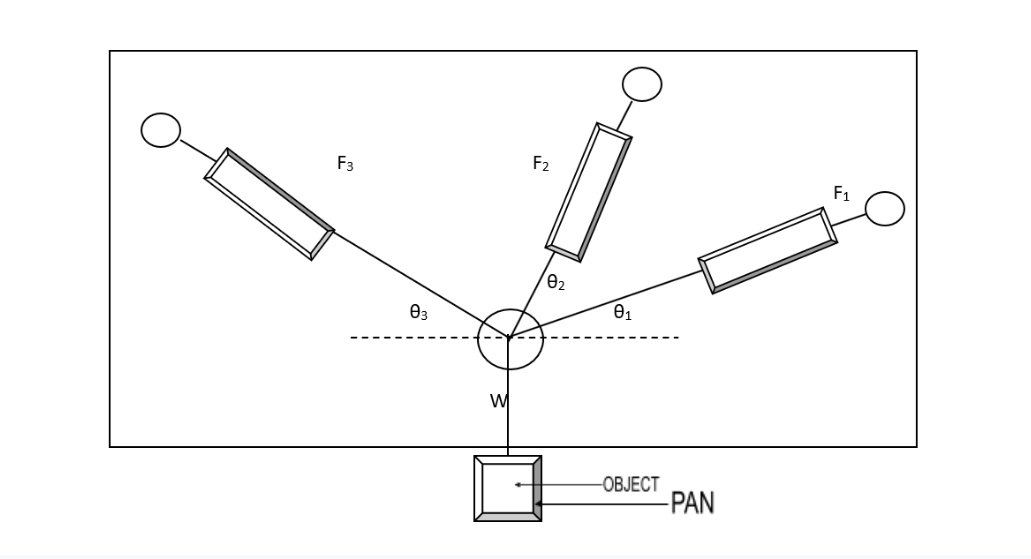
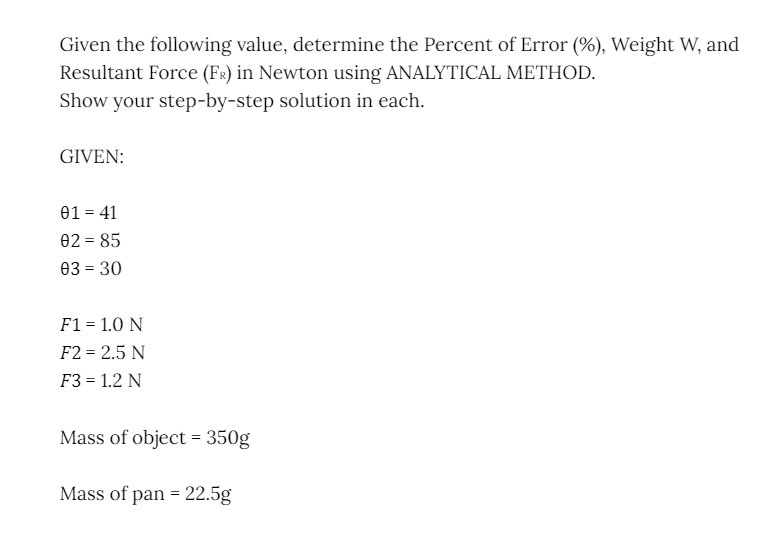
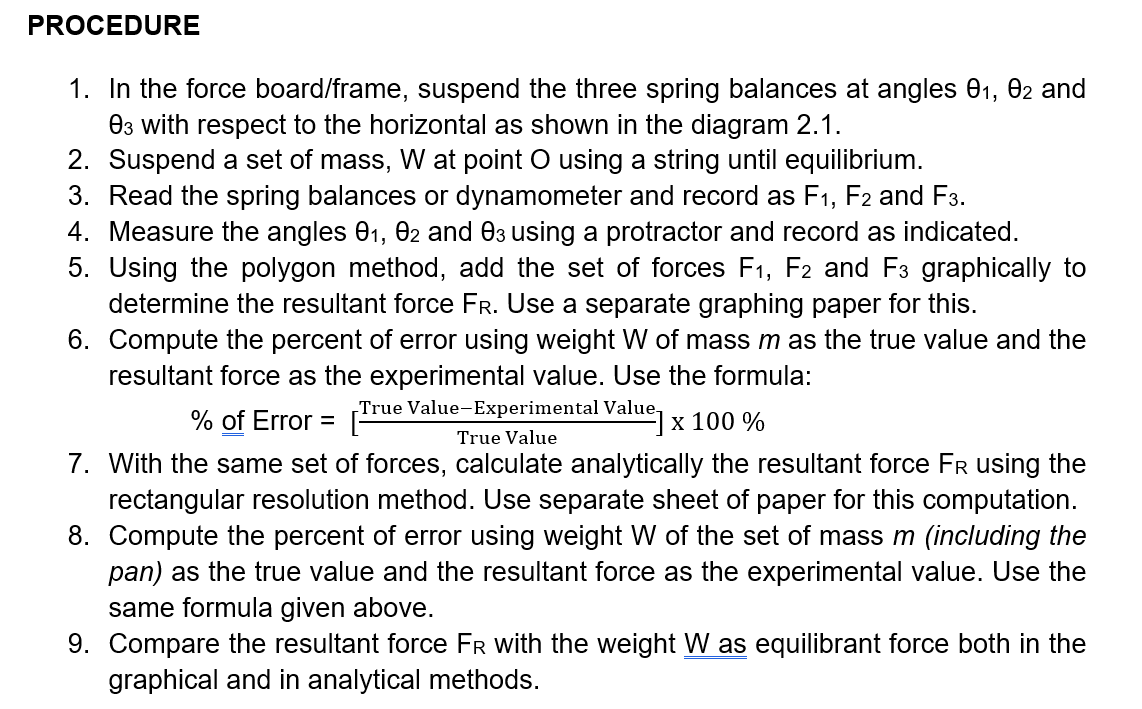
\fGiven the following value, determine the Percent of Error {96), Weight W, and Resultant Force {FR} in Newton using ANALYTICAL METHOD. Showr your step-by-step solution in each. GIVEN: Ell = 41 E12 = 85 83 = 30 F1 = 1.0 N F2=2.5 N F3=1.2 N Mass of object = 350g Mass of pan = 22.5g PROCEDURE 1. f-"PWN 9' In the force board/frame, suspend the three spring balances at angles 61, G2 and 93 with respect to the horizontal as shown in the diagram 2.1. Suspend a set of mass, W at point 0 using a string until equilibrium. Read the spring balances or dynamometer and record as F1, F2 and F3. Measure the angles 81, 02 and 93 using a protractor and record as indicated. Using the polygon method, add the set of forces F1, F2 and F3 graphically to determine the resultant force FR. Use a separate graphing paper for this. Compute the percent of error using weight W of mass m as the true value and the resultant force as the experimental value. Use the formula: DA] 01: Error : [True ValuegEXpsrimental Value] X 100 % rue a ue With the same set of forces, calculate analytically the resultant force FR using the rectangular resolution method. Use separate sheet of paper for this computation. Compute the percent of error using weight W of the set of mass m (including the pan) as the true value and the resultant force as the experimental value. Use the same formula given above. Compare the resultant force FR with the weight W as equilibrant force both in the graphical and in analytical methods
Step by Step Solution
There are 3 Steps involved in it

Get step-by-step solutions from verified subject matter experts