







Question: Use assembler directives to create a data segment and define the variables: X 0x1234 YOxABCD Z1 0x12 Z2 0x0F You may also define whatever constants
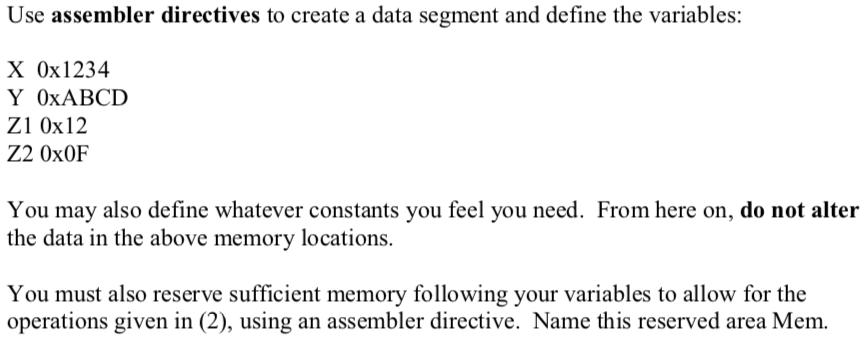
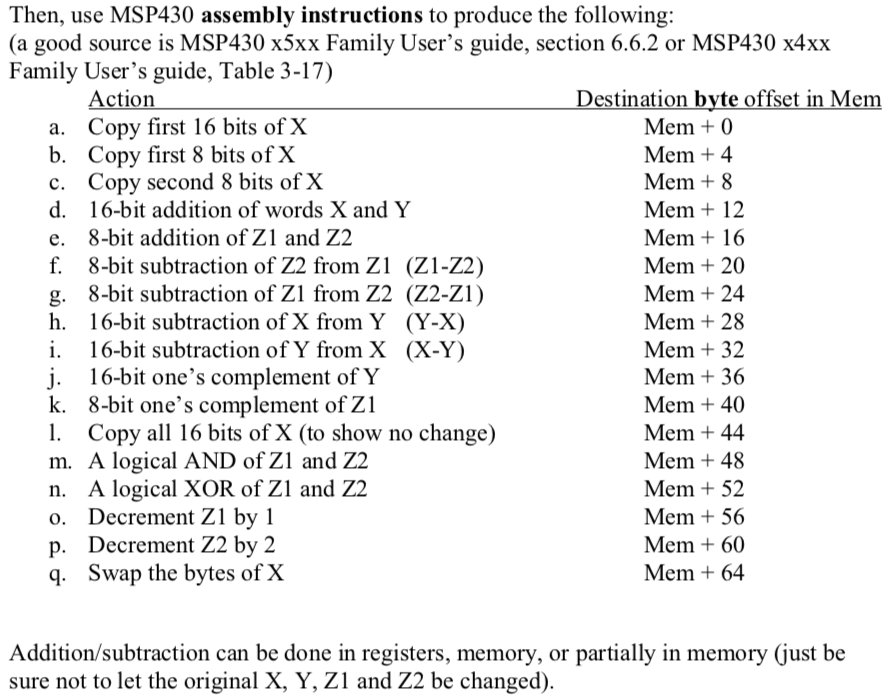
Use assembler directives to create a data segment and define the variables: X 0x1234 YOxABCD Z1 0x12 Z2 0x0F You may also define whatever constants you feel you need. From here on, do not alter the data in the above memory locations. You must also reserve sufficient memory following your variables to allow for the operations given in (2), using an assembler directive. Name this reserved area Mem. Then, use MSP430 assembly instructions to produce the following: (a good source is MSP430 x5xx Family User's guide, section 6.6.2 or MSP430 x4xx Family User's guide, Table 3-17) Action Destination byte offset in Mem a. Copy first 16 bits of X Mem+ 0 b. Copy first 8 bits of X Mem+4 c. Copy second 8 bits of X Mem +8 d. 16-bit addition of words X and Y Mem+ 12 e. 8-bit addition of Z1 and Z2 Mem + 16 f. 8-bit subtraction of Z2 from Z1 (Z1-Z2) Mem + 20 g. 8-bit subtraction of Z1 from Z2 (Z2-Z1) Mem+ 24 h. 16-bit subtraction of X from Y (Y-X) Mem + 28 i. 16-bit subtraction of Y from X (X-Y) Mem+ 32 j. 16-bit one's complement of Y Mem+ 36 k. 8-bit one's complement of Z1 Mem+ 40 1. Copy all 16 bits of X (to show no change) Mem+44 m. A logical AND of Z1 and Z2 Mem+ 48 n. A logical XOR of Z1 and 22 Mem + 52 0. Decrement Z1 by 1 Mem+ 56 p. Decrement Z2 by 2 Mem+ 60 q. Swap the bytes of X Mem+ 64 Addition/subtraction can be done in registers, memory, or partially in memory (just be sure not to let the original X, Y, Z1 and Z2 be changed). Use assembler directives to create a data segment and define the variables: X 0x1234 YOxABCD Z1 0x12 Z2 0x0F You may also define whatever constants you feel you need. From here on, do not alter the data in the above memory locations. You must also reserve sufficient memory following your variables to allow for the operations given in (2), using an assembler directive. Name this reserved area Mem. Then, use MSP430 assembly instructions to produce the following: (a good source is MSP430 x5xx Family User's guide, section 6.6.2 or MSP430 x4xx Family User's guide, Table 3-17) Action Destination byte offset in Mem a. Copy first 16 bits of X Mem+ 0 b. Copy first 8 bits of X Mem+4 c. Copy second 8 bits of X Mem +8 d. 16-bit addition of words X and Y Mem+ 12 e. 8-bit addition of Z1 and Z2 Mem + 16 f. 8-bit subtraction of Z2 from Z1 (Z1-Z2) Mem + 20 g. 8-bit subtraction of Z1 from Z2 (Z2-Z1) Mem+ 24 h. 16-bit subtraction of X from Y (Y-X) Mem + 28 i. 16-bit subtraction of Y from X (X-Y) Mem+ 32 j. 16-bit one's complement of Y Mem+ 36 k. 8-bit one's complement of Z1 Mem+ 40 1. Copy all 16 bits of X (to show no change) Mem+44 m. A logical AND of Z1 and Z2 Mem+ 48 n. A logical XOR of Z1 and 22 Mem + 52 0. Decrement Z1 by 1 Mem+ 56 p. Decrement Z2 by 2 Mem+ 60 q. Swap the bytes of X Mem+ 64 Addition/subtraction can be done in registers, memory, or partially in memory (just be sure not to let the original X, Y, Z1 and Z2 be changed)
Step by Step Solution
There are 3 Steps involved in it

Get step-by-step solutions from verified subject matter experts
 Study Help