







Question: use c++ language The combinations function C(n,k) described in this chapter determines the number of ways you can choose k values from a set of
use c++ language
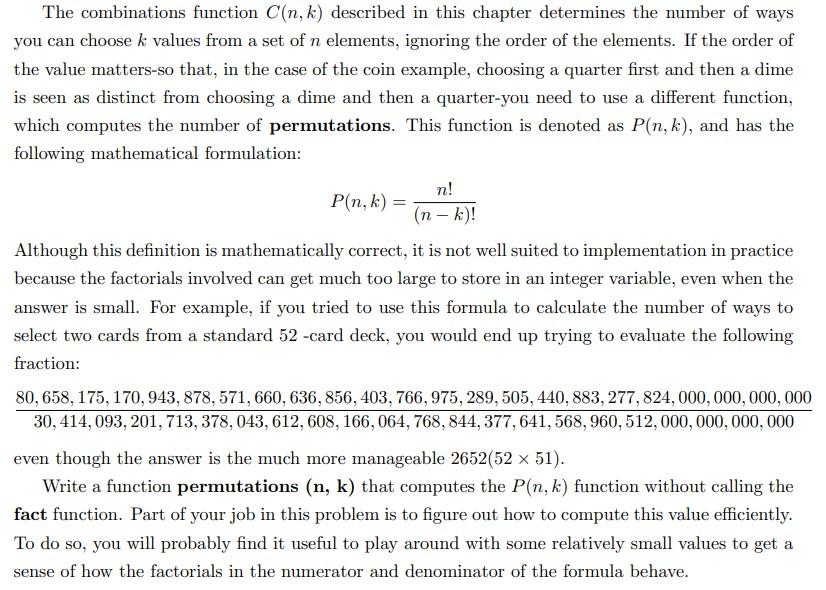
The combinations function C(n,k) described in this chapter determines the number of ways you can choose k values from a set of n elements, ignoring the order of the elements. If the order of the value matters-so that, in the case of the coin example, choosing a quarter first and then a dime is seen as distinct from choosing a dime and then a quarter-you need to use a different function, which computes the number of permutations. This function is denoted as P(n,k), and has the following mathematical formulation: P(n, k) = (n - k)! Although this definition is mathematically correct, it is not well suited to implementation in practice because the factorials involved can get much too large to store in an integer variable, even when the answer is small. For example, if you tried to use this formula to calculate the number of ways to select two cards from a standard 52 -card deck, you would end up trying to evaluate the following fraction: 80,658, 175, 170,943, 878,571, 660, 636,856, 403,766,975, 289,505, 440, 883, 277, 824,000,000,000,000 30,414,093, 201, 713, 378,043,612, 608, 166,064, 768, 844, 377,641,568,960, 512,000,000,000,000 even though the answer is the much more manageable 2652(52 x 51). Write a function permutations (n, k) that computes the P(n,k) function without calling the fact function. Part of your job in this problem is to figure out how to compute this value efficiently. To do so, you will probably find it useful to play around with some relatively small values to get a sense of how the factorials in the numerator and denominator of the formula behave
Step by Step Solution
There are 3 Steps involved in it

Get step-by-step solutions from verified subject matter experts
 Study Help