







Question: Use C++ to solve: I got the solution, but don't understand how it works. My question is how can the program count the ways? And
Use C++ to solve: I got the solution, but don't understand how it works.
My question is how can the program count the ways?
And what does " return number_of_ways(value, N, number + 1) + number_of_ways(X, N, number + 1);" mean in this function?
#include
using namespace std;
int number_of_ways(int X, int N, int number)
{
/* While calling the function from the main, we have to initialize num=1 */
int value = (X - pow(number, N));
/*If X is itself the nth power of num, the we count 1*/
if (value == 0)
return 1;
/*If X is lesser than nth power of num, the we discard thet*/
if (value
return 0;
/*Now recurssively call the function with two possibilities, one in which num is included and the other in which num is not included.*/
return number_of_ways(value, N, number + 1) +
number_of_ways(X, N, number + 1);
}
int main()
{
int X, N;
cin>>X>>N;
cout
return 0;
}
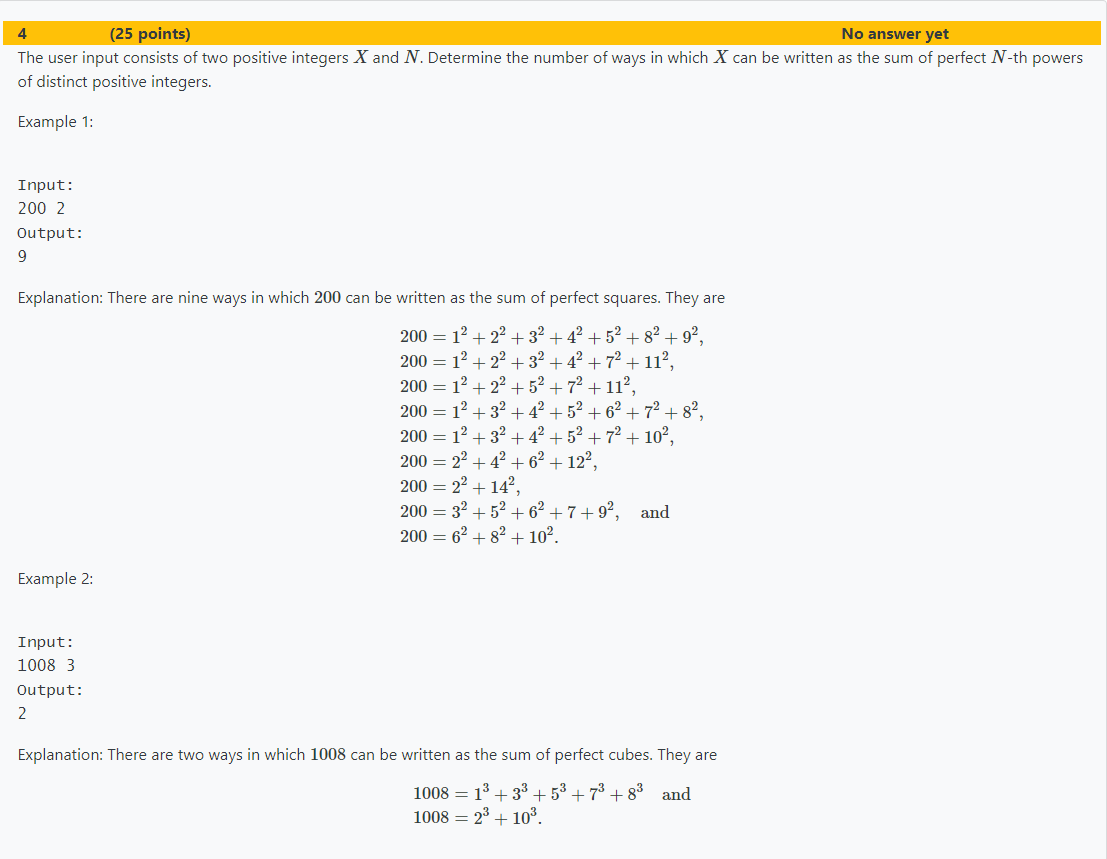
4 No answer yet (25 points) The user input consists of two positive integers X and N. Determine the number of ways in which X can be written as the sum of perfect N-th powers of distinct positive integers. Example 1: Input: 200 2 Output: 9 Explanation: There are nine ways in which 200 can be written as the sum of perfect squares. They are 200 = 12 +22 + 32 +42 +52 +82 +92, 200 = 12 +22 + 32 +42 +72 +112, 200 = 12 +22+52 + 72 +112, 200 = 12 + 32 +42 +52 +62 +72 +82, 200 = 12 + 32 +42 +52 + 72 +102, 200 = 22 +42 +62 +122, 200 = 22 +14, 200 = 32 +52 +62 +7+92, and 200 = 62 +82 + 10%. Example 2: Input: 1008 3 Output: 2 Explanation: There are two ways in which 1008 can be written as the sum of perfect cubes. They are 1008 = 12 +33 +53 + 7 + 83 and 1008 = 23 + 10%
Step by Step Solution
There are 3 Steps involved in it

Get step-by-step solutions from verified subject matter experts
 Study Help