



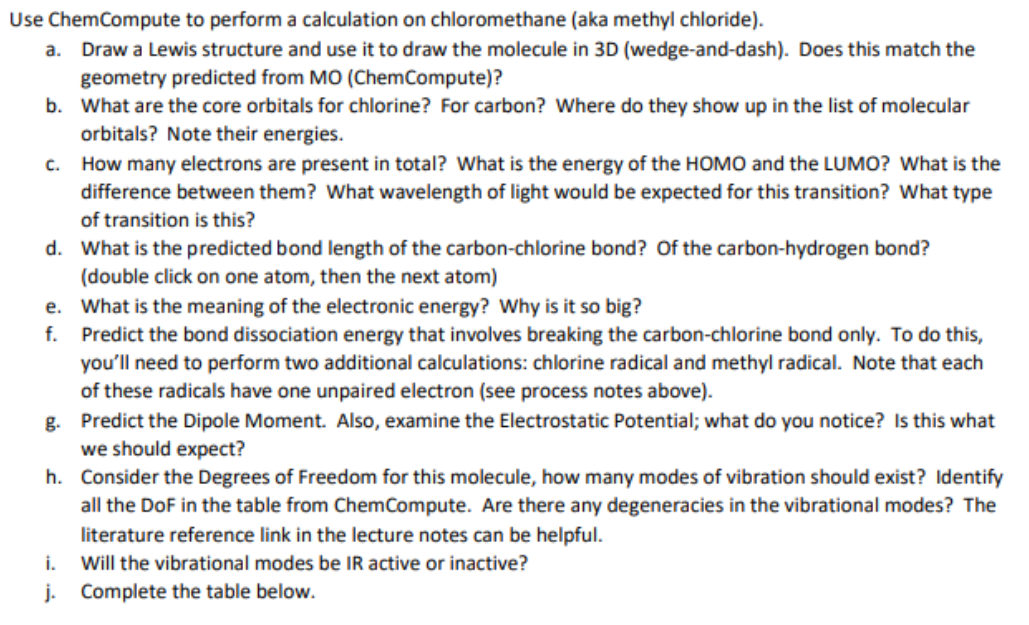
Question: Use ChemCompute to perform a calculation on chloromethane ( aka methyl chloride ) . a . Draw a Lewis structure and use it to draw
Use ChemCompute to perform a calculation on chloromethane aka methyl chloride
a Draw a Lewis structure and use it to draw the molecule in D wedgeanddash Does this match the
geometry predicted from MO ChemCompute
b What are the core orbitals for chlorine? For carbon? Where do they show up in the list of molecular
orbitals? Note their energies.
c How many electrons are present in total? What is the energy of the HOMO and the LUMO? What is the
difference between them? What wavelength of light would be expected for this transition? What type
of transition is this?
d What is the predicted bond length of the carbonchlorine bond? Of the carbonhydrogen bond?
double click on one atom, then the next atom
e What is the meaning of the electronic energy? Why is it so big?
f Predict the bond dissociation energy that involves breaking the carbonchlorine bond only. To do this,
you'll need to perform two additional calculations: chlorine radical and methyl radical. Note that each
of these radicals have one unpaired electron see process notes above
g Predict the Dipole Moment. Also, examine the Electrostatic Potential; what do you notice? Is this what
we should expect?
h Consider the Degrees of Freedom for this molecule, how many modes of vibration should exist? Identify
all the DoF in the table from ChemCompute. Are there any degeneracies in the vibrational modes? The
literature reference link in the lecture notes can be helpful.
i Will the vibrational modes be IR active or inactive?
j Complete the table below.
Step by Step Solution
There are 3 Steps involved in it
1 Expert Approved Answer
Step: 1 Unlock

Question Has Been Solved by an Expert!
Get step-by-step solutions from verified subject matter experts
Step: 2 Unlock
Step: 3 Unlock