







Question: Use counting principles to establish that we always have (when n is a non-negative integer while r and y are real numbers): (x +
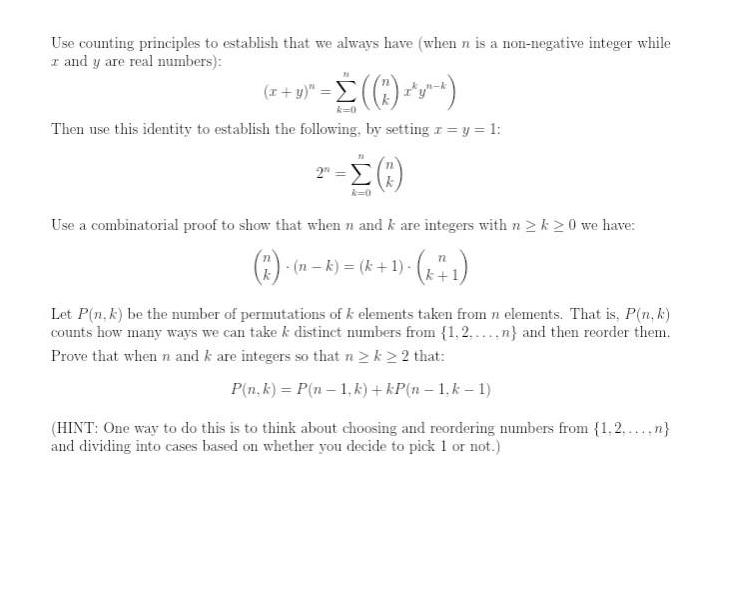
Use counting principles to establish that we always have (when n is a non-negative integer while r and y are real numbers): (x + y) = ((^) ~*^*^*^*) k=0 Then use this identity to establish the following, by setting z = y = 1: = () k=0 Use a combinatorial proof to show that when n and k are integers with n>k>0 we have: () - (n k) = (k+ 1) - (x + 1) Let P(n. k) be the number of permutations of k elements taken from n elements. That is. P(n. k) counts how many ways we can take & distinct numbers from {1,2.....n) and then reorder them. Prove that when n and k are integers so that n>k>2 that: P(n. k) = P(n-1,k) + kP(n 1. k 1) (HINT: One way to do this is to think about choosing and reordering numbers from {1.2.....n} and dividing into cases based on whether you decide to pick 1 or not.)
Step by Step Solution
3.44 Rating (154 Votes )
There are 3 Steps involved in it
To establish the identity 3 we can use the counting principle Lets break down the steps 1 Consider the lefthand side LHS of the equation 3 This represents choosing 3 elements from a set of z y element... View full answer

Get step-by-step solutions from verified subject matter experts
 Study Help