







Question: Use draw.io to create the ER diagrams please. you may use any other ER diagram maker but draw.io is free and probably the easiest to
Use draw.io to create the ER diagrams please. you may use any other ER diagram maker but draw.io is free and probably the easiest to use
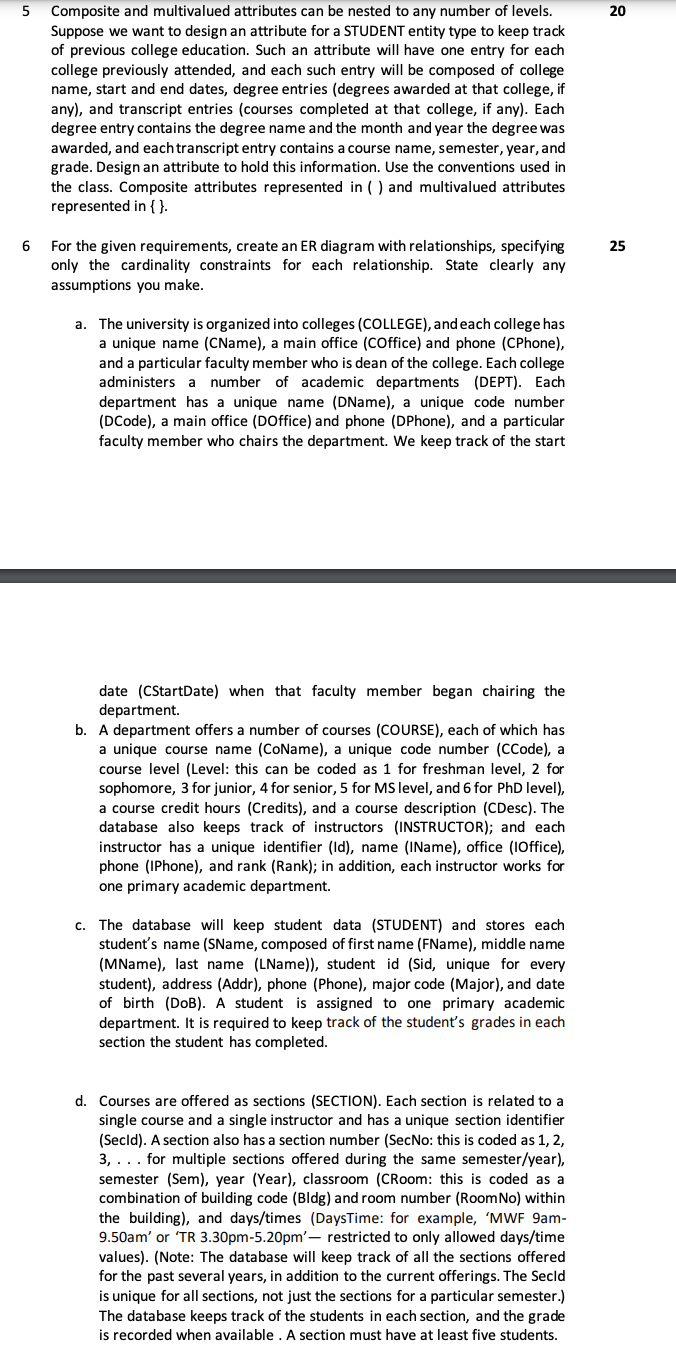
part Composite and multivalued attributes can be nested to any number of levels.
Suppose we want to design an attribute for a STUDENT entity type to keep track
of previous college education. Such an attribute will have one entry for each
college previously attended, and each such entry will be composed of college
name, start and end dates, degree entries degrees awarded at that college, if
any and transcript entries courses completed at that college, if any Each
degree entry contains the degree name and the month and year the degree was
awarded, and each transcript entry contains a course name, semester, year, and
grade. Design an attribute to hold this information. Use the conventions used in
the class. Composite attributes represented in and multivalued attributes
represented in
part For the given requirements, create an ER diagram with relationships, specifying
only the cardinality constraints for each relationship. State clearly any
assumptions you make.
a The university is organized into colleges COLLEGE and each college has
a unique name CName a main office COffice and phone CPhone
and a particular faculty member who is dean of the college. Each college
administers a number of academic departments DEPT Each
department has a unique name DName a unique code number
DCode a main office DOffice and phone DPhone and a particular
faculty member who chairs the department. We keep track of the start
date CStartDate when that faculty member began chairing the
department.
b A department offers a number of courses COURSE each of which has
a unique course name CoName a unique code number CCode a
course level Level: this can be coded as for freshman level, for
sophomore, for junior, for senior, for MS level, and for PhD level
a course credit hours Credits and a course description CDesc The
database also keeps track of instructors INSTRUCTOR; and each
instructor has a unique identifier Id name IName office IOffice
phone IPhone and rank Rank; in addition, each instructor works for
one primary academic department.
c The database will keep student data STUDENT and stores each
student's name SName composed of first name FName middle name
MName last name LName student id Sid unique for every
student address Addr phone Phone major code Major and date
of birth DoB A student is assigned to one primary academic
department. It is required to keep track of the student's grades in each
section the student has completed.
d Courses are offered as sections SECTION Each section is related to a
single course and a single instructor and has a unique section identifier
Secld A section also has a section number SecNo: this is coded as
for multiple sections offered during the same semesteryear
semester Sem year Year classroom CRoom: this is coded as a
combination of building code Bldg and room number RoomNo within
the building and daystimes DaysTime: for example, MWF am
am or TR pmpm restricted to only allowed daystime
valuesNote: The database will keep track of all the sections offered
for the past several years, in addition to the current offerings. The Secld
is unique for all sections, not just the sections for a particular semester.
The database keeps track of the students in each section, and the grade
is recorded when available. A section must have at least five students.ourses are offered as sections SECTION Each section is related to a single course and a single instructor and has a unique section identifier SecId A section also has a section number SecNo: this is coded as for multiple sections offered during the same semesteryear semester Sem year Year classroom CRoom: this is coded as a combination of building code Bldg and room number RoomNo within the building and daystimes DaysTime: for example, MWF amam or TR pmpm restricted to only allowed daystime valuesNote: The database will keep track of all the sections offered for the past several years, in addition to the current offerings. The SecId is unique for all sections, not just the sections for a particular semester. The database keeps track of the students in each section, and the grade is recorded when available A section must have at least five students.
Step by Step Solution
There are 3 Steps involved in it
1 Expert Approved Answer
Step: 1 Unlock

Question Has Been Solved by an Expert!
Get step-by-step solutions from verified subject matter experts
Step: 2 Unlock
Step: 3 Unlock
 Study Help