







Question: Use either indirect proof or conditional proof (or both) and the eighteen rules of inference to derive the conclusion of the following symbolized argument. Step
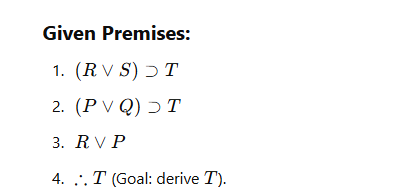
Use either indirect proof or conditional proof (or both) and the eighteen rules of inference to derive the conclusion of the following symbolized argument.
| Step | Argument | Justification |
|---|---|---|
| 1. | (R ? S) ? T | |
| 2. | (P ? Q) ? T | |
| 3. | R ? P | / T |
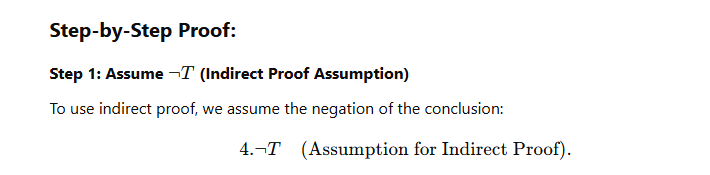
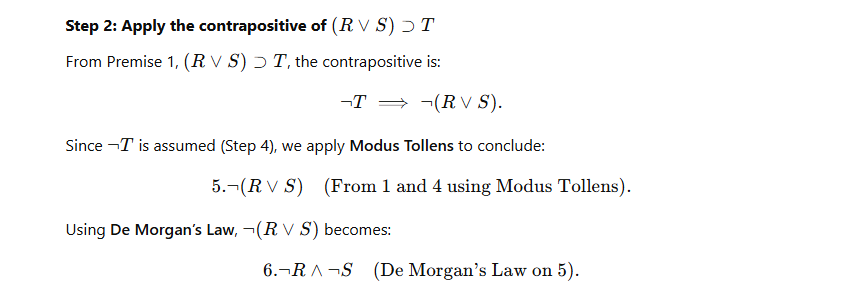
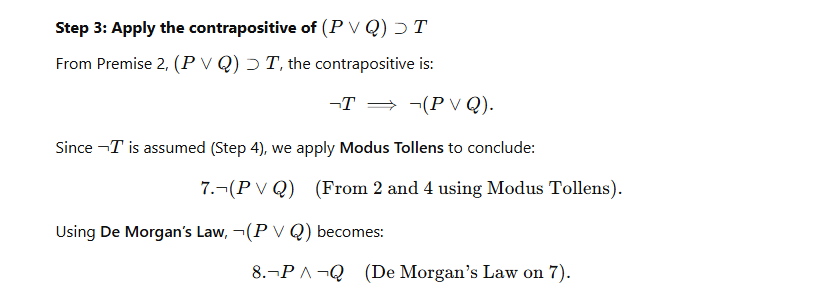
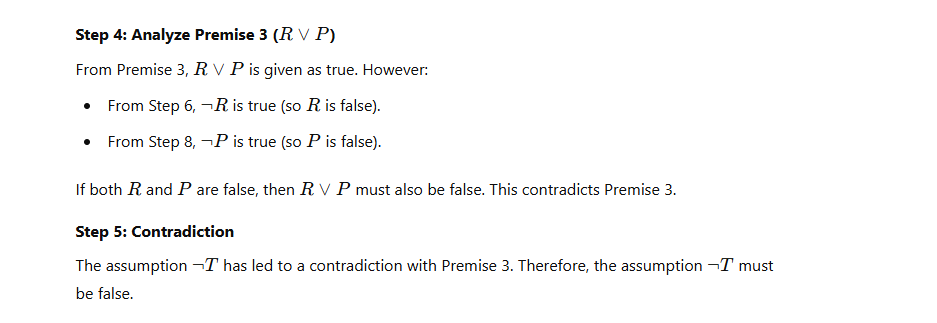
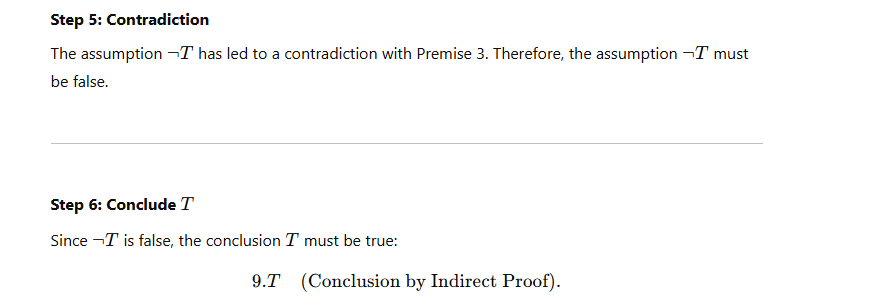
 \fStep-by-Step Proof: Step 1: Assume 71 (Indirect Proof Assumption) To use indirect proof, we assume the negation of the conclusion: 4.-T (Assumption for Indirect Proof). \f\fStep 4: Analyze Premise 3 (R v P) From Premise 3, R 'V P is given as true. However: s From Step 6, ~ R is true (so R is false). s From Step 8, =P is true (so P is false). If both R and P are false, then R v P must also be false. This contradicts Premise 3. Step 5: Contradiction The assumption =T has led to a contradiction with Premise 3. Therefore, the assumption =1" must be false. Step 5: Contradiction The assumption =7 has led to a contradiction with Premise 3. Therefore, the assumption =T must be false. Step 6: Conclude T Since =7 is false, the conclusion T" must be true: 9.7 (Conclusion by Indirect Proof). Final Answer T (Derived using Indirect Proof and the eighteen rules of inference)
Step by Step Solution
There are 3 Steps involved in it
1 Expert Approved Answer
Step: 1 Unlock

Question Has Been Solved by an Expert!
Get step-by-step solutions from verified subject matter experts
Step: 2 Unlock
Step: 3 Unlock
 Study Help