



Question: Use F = b 2. 2 or 3-person project This project requires some programming. Use any language of your choice (suggestion: use Matlab, Python, Julia,
Use F = b
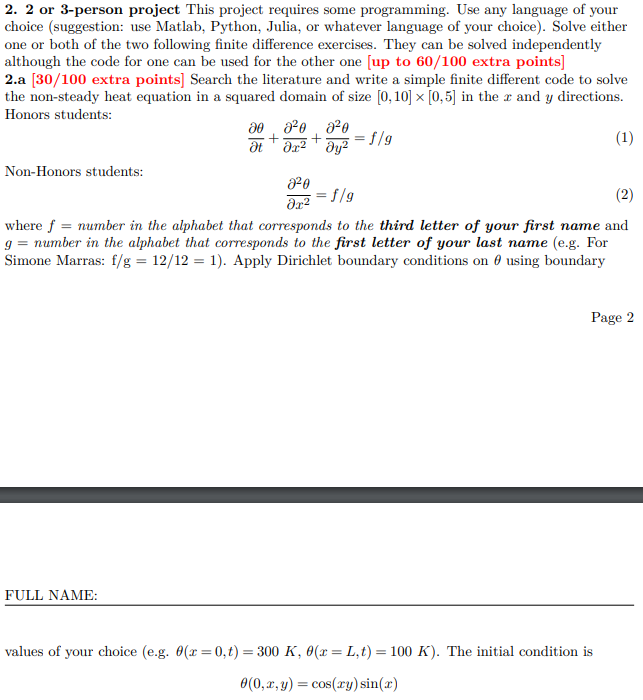
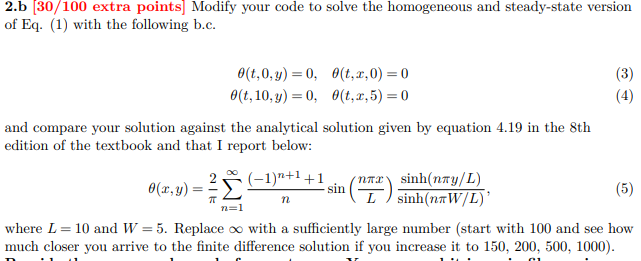
2. 2 or 3-person project This project requires some programming. Use any language of your choice (suggestion: use Matlab, Python, Julia, or whatever language of your choice). Solve either one or both of the two following finite difference exercises. They can be solved independently although the code for one can be used for the other one (up to 60/100 extra points] 2.a (30/100 extra points) Search the literature and write a simple finite different code to solve the non-steady heat equation in a squared domain of size (0,10] x [0,5) in the r and y directions. Honors students: ao 220 220 = f/9 xlay? (1) at Non-Honors students: 220 (2) = f/9 ax2 where f = number in the alphabet that corresponds to the third letter of your first name and g= number in the alphabet that corresponds to the first letter of your last name (e.g. For Simone Marras: f/g = 12/12 = 1). Apply Dirichlet boundary conditions on 0 using boundary + + Page 2 FULL NAME: values of your choice (e.g. 0(x=0,t) = 300 K, 0(x=L,t) = 100 K). The initial condition is 0(0,x,y) = cos(xy) sin(2) 2.b (30/100 extra points] Modify your code to solve the homogeneous and steady-state version of Eq. (1) with the following b.c. (3) 0(t,0,y) = 0, 0(t,0,0) = 0 0(t,10,y) = 0, 0(t,1,5) = 0 and compare your solution against the analytical solution given by equation 4.19 in the 8th edition of the textbook and that I report below: 0(x,y) 28-1)** +1 sinh(n77 g/L) *sin() sinh (new) (5) n n=1 where L = 10 and W = 5. Replace with a sufficiently large number (start with 100 and see how much closer you arrive to the finite difference solution if you increase it to 150, 200, 500, 1000). 2. 2 or 3-person project This project requires some programming. Use any language of your choice (suggestion: use Matlab, Python, Julia, or whatever language of your choice). Solve either one or both of the two following finite difference exercises. They can be solved independently although the code for one can be used for the other one (up to 60/100 extra points] 2.a (30/100 extra points) Search the literature and write a simple finite different code to solve the non-steady heat equation in a squared domain of size (0,10] x [0,5) in the r and y directions. Honors students: ao 220 220 = f/9 xlay? (1) at Non-Honors students: 220 (2) = f/9 ax2 where f = number in the alphabet that corresponds to the third letter of your first name and g= number in the alphabet that corresponds to the first letter of your last name (e.g. For Simone Marras: f/g = 12/12 = 1). Apply Dirichlet boundary conditions on 0 using boundary + + Page 2 FULL NAME: values of your choice (e.g. 0(x=0,t) = 300 K, 0(x=L,t) = 100 K). The initial condition is 0(0,x,y) = cos(xy) sin(2) 2.b (30/100 extra points] Modify your code to solve the homogeneous and steady-state version of Eq. (1) with the following b.c. (3) 0(t,0,y) = 0, 0(t,0,0) = 0 0(t,10,y) = 0, 0(t,1,5) = 0 and compare your solution against the analytical solution given by equation 4.19 in the 8th edition of the textbook and that I report below: 0(x,y) 28-1)** +1 sinh(n77 g/L) *sin() sinh (new) (5) n n=1 where L = 10 and W = 5. Replace with a sufficiently large number (start with 100 and see how much closer you arrive to the finite difference solution if you increase it to 150, 200, 500, 1000)
Step by Step Solution
There are 3 Steps involved in it

Get step-by-step solutions from verified subject matter experts