







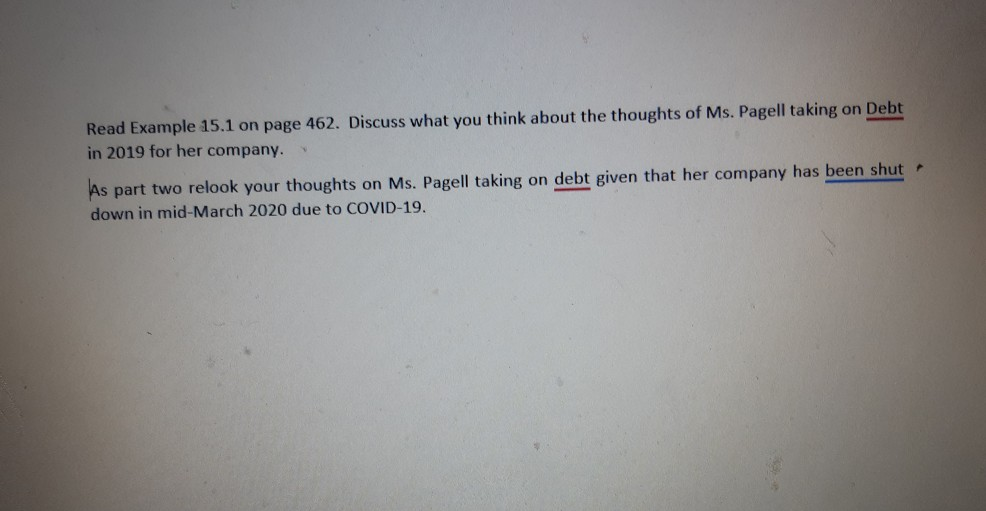
Question: Use figure 15.1 to answer the question Read Example 15.1 on page 462. Discuss what you think about the thoughts of Ms. Pagell taking on
Use figure 15.1 to answer the question
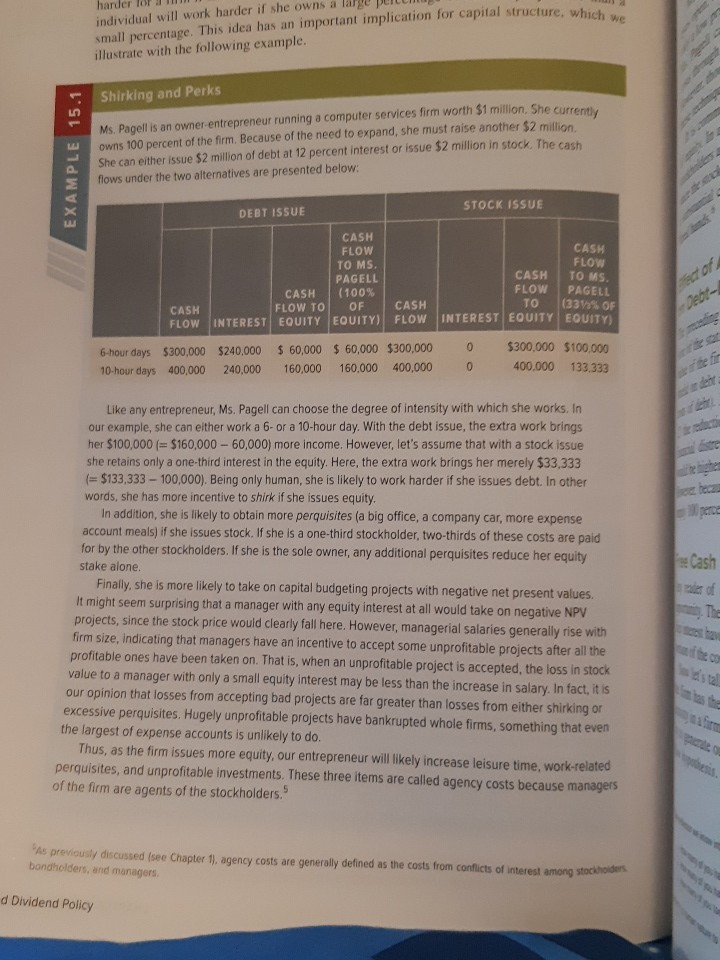
Read Example 15.1 on page 462. Discuss what you think about the thoughts of Ms. Pagell taking on Debt in 2019 for her company. As part two relook your thoughts on Ms. Pagell taking on debt given that her company has been shut down in mid-March 2020 due to COVID-19. sture, which we harder lo individual will work harder if she owns a large pell small percentage. This idea has an important implication for capital structure, whe illustrate with the following example. Shirking and Perks EXAMPLE Ms. Pagell is an owner-entrepreneur running a computer services firm worth $1 million. She curren owns 100 percent of the firm. Because of the need to expand, she must raise another $2 million She can either issue $2 million of debt at 12 percent interest or issue 32 million in stock. The cash flows under the two alternatives are presented below: STOCK ISSUE DEBT ISSUE CASH FLOW TO MS. PAGELL CASH (100% CASH FLOW TO OF CASH FLOW INTEREST EQUITY EQUITY) FLOW 6 hour days $300.000 $240,000 $60,000 $60,000 $300,000 10-hour days 400,000 240,000 160,000 160.000 400,000 CASH FLOW TOMS. FLOW PAGELL TO (331% OF INTEREST EQUITY EQUITY) 0 $300,000 $100.000 400.000 133.333 Like any entrepreneur, Ms. Pagell can choose the degree of intensity with which she works. In our example, she can either work a 6- or a 10-hour day. With the debt issue, the extra work brings her $100,000 = $160,000 - 60,000) more income. However, let's assume that with a stock issue she retains only a one-third interest in the equity. Here, the extra work brings her merely $33,333 (=$133,333 -100,000). Being only human, she is likely to work harder if she issues debt. In other words, she has more incentive to shirk if she issues equity. In addition, she is likely to obtain more perquisites (a big office, a company car, more expense account meals) if she issues stock. If she is a one-third stockholder, two-thirds of these costs are paid for by the other stockholders. If she is the sole owner, any additional perquisites reduce her equity stake alone. Finally, she is more likely to take on capital budgeting projects with negative net present values. It might seem surprising that a manager with any equity interest at all would take on negative NPV projects, since the stock price would clearly fall here. However, managerial salaries generally rise with firm size, indicating that managers have an incentive to accept some unprofitable projects after all the profitable ones have been taken on. That is, when an unprofitable project is accepted, the loss in stock value to a manager with only a small equity interest may be less than the increase in salary. In fact, it is our opinion that losses from accepting bad projects are far greater than losses from either shirking or excessive perquisites. Hugely unprofitable projects have bankrupted whole firms, something that even the largest of expense accounts is unlikely to do. 's Cash Thus, as the firm issues more equity, our entrepreneur will likely increase leisure time, work-related perquisites, and unprofitable investments. These three items are called agency costs because managers of the firm are agents of the stockholders. "As previously discussed (see Chapter 1), agency costs are generally defined as the costs from conflicts of interest among stoc bondholders, and managers, d Dividend Policy
Step by Step Solution
There are 3 Steps involved in it

Get step-by-step solutions from verified subject matter experts
 Study Help