







Question: USE FOLLOWING FORM %Iterates from Newton's Method format long e x = [0 3.333333333333333e-01 5.638629283489096e-01 7.149796966599469e-01 8.129364573345282e-01 8.766774291453736e-01 9.184158219337112e-01 9.458939368203871e-01 9.640558907888878e-01 9.760936750387497e-01 9.840875586951652e-01 9.894028741546604e-01 9.929402154950395e-01
USE FOLLOWING FORM
%Iterates from Newton's Method
format long e
x = [0
3.333333333333333e-01
5.638629283489096e-01
7.149796966599469e-01
8.129364573345282e-01
8.766774291453736e-01
9.184158219337112e-01
9.458939368203871e-01
9.640558907888878e-01
9.760936750387497e-01
9.840875586951652e-01
9.894028741546604e-01
9.929402154950395e-01
9.952956847700928e-01
9.968647712564510e-01
9.979102837344335e-01
9.986070497168466e-01
9.990714526505908e-01
9.993810066938522e-01
9.995873546499835e-01];
% add code here
order =
rate =
multiplicity =
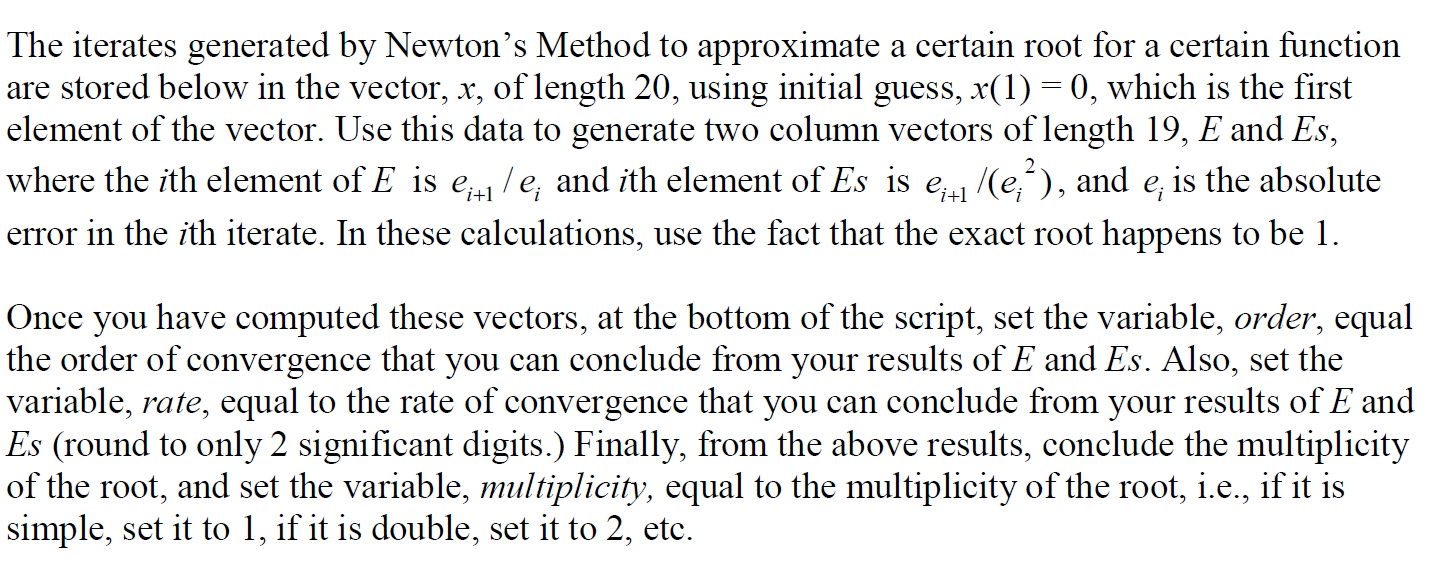
The iterates generated by Newton's Method to approximate a certain root for a certain function are stored below in the vector, x, of length 20, using initial guess, x(1) = 0, which is the first element of the vector. Use this data to generate two column vectors of length 19, E and Es, where the ith element of E is e le; and ith element of Es is ezu, (e;"), and e, is the absolute error in the ith iterate. In these calculations, use the fact that the exact root happens to be 1. Once you have computed these vectors, at the bottom of the script, set the variable, order, equal the order of convergence that you can conclude from your results of E and Es. Also, set the variable, rate, equal to the rate of convergence that you can conclude from your results of E and Es (round to only 2 significant digits.) Finally, from the above results, conclude the multiplicity of the root, and set the variable, multiplicity, equal to the multiplicity of the root, i.e., if it is simple, set it to 1, if it is double, set it to 2, etc. The iterates generated by Newton's Method to approximate a certain root for a certain function are stored below in the vector, x, of length 20, using initial guess, x(1) = 0, which is the first element of the vector. Use this data to generate two column vectors of length 19, E and Es, where the ith element of E is e le; and ith element of Es is ezu, (e;"), and e, is the absolute error in the ith iterate. In these calculations, use the fact that the exact root happens to be 1. Once you have computed these vectors, at the bottom of the script, set the variable, order, equal the order of convergence that you can conclude from your results of E and Es. Also, set the variable, rate, equal to the rate of convergence that you can conclude from your results of E and Es (round to only 2 significant digits.) Finally, from the above results, conclude the multiplicity of the root, and set the variable, multiplicity, equal to the multiplicity of the root, i.e., if it is simple, set it to 1, if it is double, set it to 2, etc
Step by Step Solution
There are 3 Steps involved in it

Get step-by-step solutions from verified subject matter experts
 Study Help