







Question: Use information below to answer questions 1. Exhibit 2 in the case presents monthly data of units produced and sold along with the actual costs
Use information below to answer questions
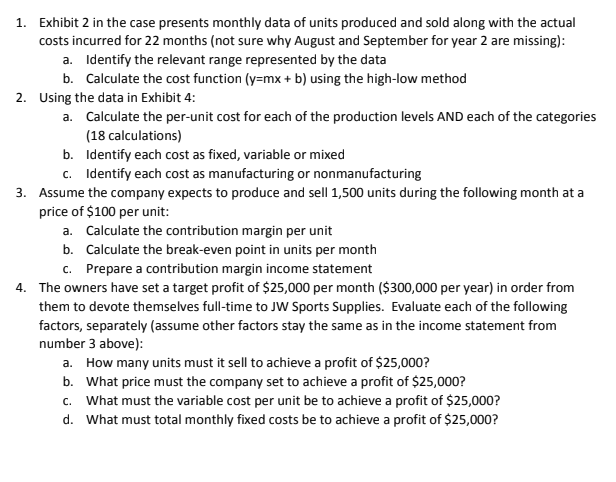
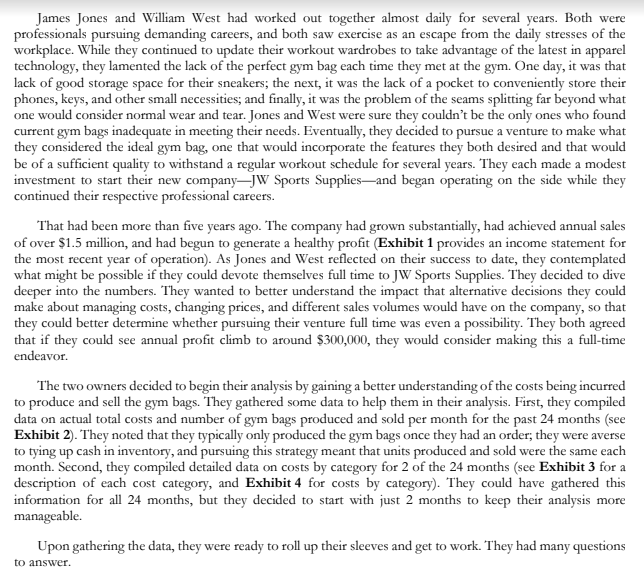
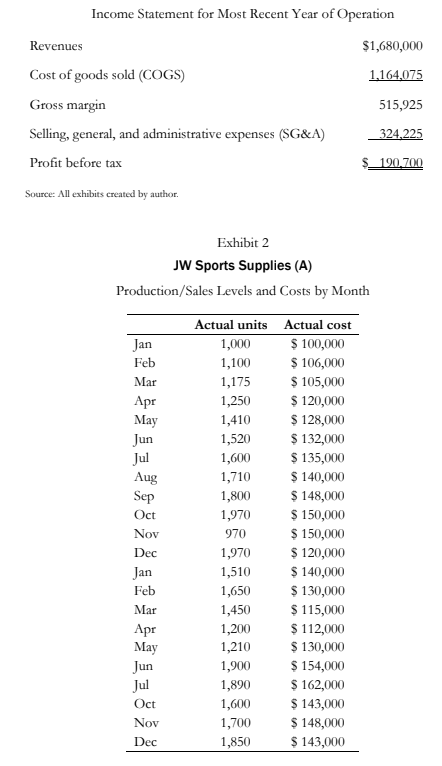
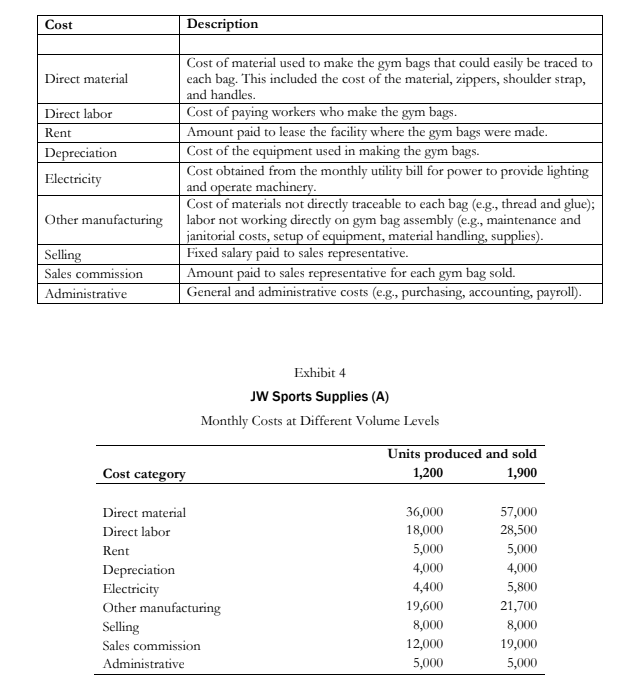
1. Exhibit 2 in the case presents monthly data of units produced and sold along with the actual costs incurred for 22 months (not sure why August and September for year 2 are missing) Identify the relevant range represented by the data Calculate the cost function (y-mx+ b) using the high-low method a. b. 2. Using the data in Exhibit 4: Calculate the per-unit cost for each of the production levels AND each of the categories (18 calculations) Identify each cost as fixed, variable or mixed Identify each cost as manufacturing or nonmanufacturing a. b. C. 3. Assume the company expects to produce and sell 1,500 units during the following month at a price of $100 per unit a. b. C. Calculate the contribution margin per unit Calculate the break-even point in units per month Prepare a contribution margin income statement The owners have set a target profit of $25,000 per month ($300,000 per year) in order from them to devote themselves full-time to JW Sports Supplies. Evaluate each of the following factors, separately (assume other factors stay the same as in the income statement from number 3 above) 4. a. b. c. d. How many units must it sell to achieve a profit of $25,000? What price must the company set to achieve a profit of $25,000? What must the variable cost per unit be to achieve a profit of $25,000? What must total monthly fixed costs be to achieve a profit of $25,000? James Jones and William West had worked out together almost daily for several years. Both were professionals pursuing demanding careers, and both saw exercise as an escape from the daily stresses of the workplace. While they continued to update their workout wardrobes to take advantage of the latest in apparel technology, they lamented the lack of the perfect gym bag each time they met at the gym. One day, it was that lack of good storage space for their sneakers; the next, it was the lack of a pocket to conveniently store their phones, keys, and other small necessities; and finally, it was the problem of the seams splitting far beyond what one would consider normal wear and tear. Jones and West were sure they couldn't be the only ones who found current gym bags inadequate in meeting their needs. Eventually, they decided to pursue a venture to make what they considered the ideal gym bag, one that would incorporate the features they both desired and that would be of a sufficient quality to withstand a regular workout schedule for several years. They each made a modest investment to start their new company-JW Sports Supplies-and began operating on the side while they continued their respective professi five years ago. The company had grown substantially, had achieved annual sales of over $1.5 million, and had begun to generate a healthy profit (Exhibit 1 provides an income statement for the most recent year of operation). As Jones and West reflected on their success to date, they contemplated what might be possible if they could devote themselves full time to JW Sports Supplies. They decided to dive deeper into the numbers. They wanted to better understand the impact that alternative decisions they could make about managing costs, changing prices, and different sales volumes would have on the company, so that That had been more than could better determine whether pursuing ty. They both time was even a that if they could see annual profit climb to around $300,000, they would consider making this a full-time endeavor. The two owners decided to begin their analysis by gaining a better understanding of the costs being incurred to produce and sell the gym bags. They gathered some data to help them in their analysis. First, they compiled data on actual total costs and number of gym bags produced and sold per month for the past 24 months (see Exhibit 2). They noted that they typically only produced the gym bags once they had an order, they were averse to tying up cash in inventory, and pursuing this strategy meant that units produced and sold were the same each month. Second, they compiled detailed data on costs by category for 2 of the 24 months (see Exhibit 3 for a description of each cost category, and Exhibit 4 for costs by category). They could have gathered this information for all 24 months, but they decided to start with just 2 months to keep their analysis more manageable. Upon gathering the data, they were ready to roll up their sleeves and get to work. They had many questions to answer Income Statement for Most Recent Year of Operation Revenues Cost of goods sold (COGS) Gross margin Selling, general, and administrative expenses (SG&A) Profit before tax Source: All exhibits created by author. $1,680,000 515,925 324.225 Exhibit 2 JW Sports Supplies (A) Production/Sales Levels and Costs by Month Actual units 1,000 1,100 1,175 1,250 1,410 Actual cost 100,000 $ 106,000 105,000 120,000 128,000 132,000 135,000 $ 140,000 148,000 150,000 150,000 120,000 $ 140,000 130,000 an Feb Mar Apr May un Jul 1,600 1,710 1,800 1,970 970 1,970 Aug Oct Dec an Feb Mar 1,650 1,450115,000 1,200 1,210 1,900 1,890 1,600 1,700 1,850 112,000 130,000 S154,000 162,000 s 143,000 148,000 $ 143,000 Apr May un Jul Oct Cost Description Cost of material used to make the gym bags that could easily be traced to each bag. This included the cost of the material, zippers, shoulder strap, and handles Direct material Direct labor Rent Cost of paying workers who make the gym bag Amount paid to lease the facility where the gym bags were made Cost of the equipment used in Cost obtained from the monthly utility bill for power to provide lighting ation Electricity and te machinery Cost of materials not directly traceable to each bag (e.g., thread and glue); Other manufacturinglabor not working directly on gym bag assembly (e.g, maintenance and anitorial l costs, setup of t, material handling, supplies Selling Sales commission Administrative Fixed s Amount paid to sales representative for each gym bag sold. General and administrative costs (e.g, purchasing, accounting, payroll) to sales representative. Exhibit 4 JW Sports Supplies (A) Monthly Costs at Different Volume Levels Units produced and sold 1,900 Cost category 1,200 Direct material Direct labor Rent Depreciation Electricity Other manufacturing Selling Sales commission Administrative 36,000 18,000 5,000 4,000 4,400 19,600 8,000 12,000 5,000 57,000 28,500 5,000 4,000 5,800 21,700 8,000 19,000 5,000 1. Exhibit 2 in the case presents monthly data of units produced and sold along with the actual costs incurred for 22 months (not sure why August and September for year 2 are missing) Identify the relevant range represented by the data Calculate the cost function (y-mx+ b) using the high-low method a. b. 2. Using the data in Exhibit 4: Calculate the per-unit cost for each of the production levels AND each of the categories (18 calculations) Identify each cost as fixed, variable or mixed Identify each cost as manufacturing or nonmanufacturing a. b. C. 3. Assume the company expects to produce and sell 1,500 units during the following month at a price of $100 per unit a. b. C. Calculate the contribution margin per unit Calculate the break-even point in units per month Prepare a contribution margin income statement The owners have set a target profit of $25,000 per month ($300,000 per year) in order from them to devote themselves full-time to JW Sports Supplies. Evaluate each of the following factors, separately (assume other factors stay the same as in the income statement from number 3 above) 4. a. b. c. d. How many units must it sell to achieve a profit of $25,000? What price must the company set to achieve a profit of $25,000? What must the variable cost per unit be to achieve a profit of $25,000? What must total monthly fixed costs be to achieve a profit of $25,000? James Jones and William West had worked out together almost daily for several years. Both were professionals pursuing demanding careers, and both saw exercise as an escape from the daily stresses of the workplace. While they continued to update their workout wardrobes to take advantage of the latest in apparel technology, they lamented the lack of the perfect gym bag each time they met at the gym. One day, it was that lack of good storage space for their sneakers; the next, it was the lack of a pocket to conveniently store their phones, keys, and other small necessities; and finally, it was the problem of the seams splitting far beyond what one would consider normal wear and tear. Jones and West were sure they couldn't be the only ones who found current gym bags inadequate in meeting their needs. Eventually, they decided to pursue a venture to make what they considered the ideal gym bag, one that would incorporate the features they both desired and that would be of a sufficient quality to withstand a regular workout schedule for several years. They each made a modest investment to start their new company-JW Sports Supplies-and began operating on the side while they continued their respective professi five years ago. The company had grown substantially, had achieved annual sales of over $1.5 million, and had begun to generate a healthy profit (Exhibit 1 provides an income statement for the most recent year of operation). As Jones and West reflected on their success to date, they contemplated what might be possible if they could devote themselves full time to JW Sports Supplies. They decided to dive deeper into the numbers. They wanted to better understand the impact that alternative decisions they could make about managing costs, changing prices, and different sales volumes would have on the company, so that That had been more than could better determine whether pursuing ty. They both time was even a that if they could see annual profit climb to around $300,000, they would consider making this a full-time endeavor. The two owners decided to begin their analysis by gaining a better understanding of the costs being incurred to produce and sell the gym bags. They gathered some data to help them in their analysis. First, they compiled data on actual total costs and number of gym bags produced and sold per month for the past 24 months (see Exhibit 2). They noted that they typically only produced the gym bags once they had an order, they were averse to tying up cash in inventory, and pursuing this strategy meant that units produced and sold were the same each month. Second, they compiled detailed data on costs by category for 2 of the 24 months (see Exhibit 3 for a description of each cost category, and Exhibit 4 for costs by category). They could have gathered this information for all 24 months, but they decided to start with just 2 months to keep their analysis more manageable. Upon gathering the data, they were ready to roll up their sleeves and get to work. They had many questions to answer Income Statement for Most Recent Year of Operation Revenues Cost of goods sold (COGS) Gross margin Selling, general, and administrative expenses (SG&A) Profit before tax Source: All exhibits created by author. $1,680,000 515,925 324.225 Exhibit 2 JW Sports Supplies (A) Production/Sales Levels and Costs by Month Actual units 1,000 1,100 1,175 1,250 1,410 Actual cost 100,000 $ 106,000 105,000 120,000 128,000 132,000 135,000 $ 140,000 148,000 150,000 150,000 120,000 $ 140,000 130,000 an Feb Mar Apr May un Jul 1,600 1,710 1,800 1,970 970 1,970 Aug Oct Dec an Feb Mar 1,650 1,450115,000 1,200 1,210 1,900 1,890 1,600 1,700 1,850 112,000 130,000 S154,000 162,000 s 143,000 148,000 $ 143,000 Apr May un Jul Oct Cost Description Cost of material used to make the gym bags that could easily be traced to each bag. This included the cost of the material, zippers, shoulder strap, and handles Direct material Direct labor Rent Cost of paying workers who make the gym bag Amount paid to lease the facility where the gym bags were made Cost of the equipment used in Cost obtained from the monthly utility bill for power to provide lighting ation Electricity and te machinery Cost of materials not directly traceable to each bag (e.g., thread and glue); Other manufacturinglabor not working directly on gym bag assembly (e.g, maintenance and anitorial l costs, setup of t, material handling, supplies Selling Sales commission Administrative Fixed s Amount paid to sales representative for each gym bag sold. General and administrative costs (e.g, purchasing, accounting, payroll) to sales representative. Exhibit 4 JW Sports Supplies (A) Monthly Costs at Different Volume Levels Units produced and sold 1,900 Cost category 1,200 Direct material Direct labor Rent Depreciation Electricity Other manufacturing Selling Sales commission Administrative 36,000 18,000 5,000 4,000 4,400 19,600 8,000 12,000 5,000 57,000 28,500 5,000 4,000 5,800 21,700 8,000 19,000 5,000
Step by Step Solution
There are 3 Steps involved in it

Get step-by-step solutions from verified subject matter experts
 Study Help