







Question: Use IS=10-15 A, BF=100, BR=5 for all problems except for those involving a commercial part (e.g. Problem 6, 2N3904) for both hand calculation and simulation.
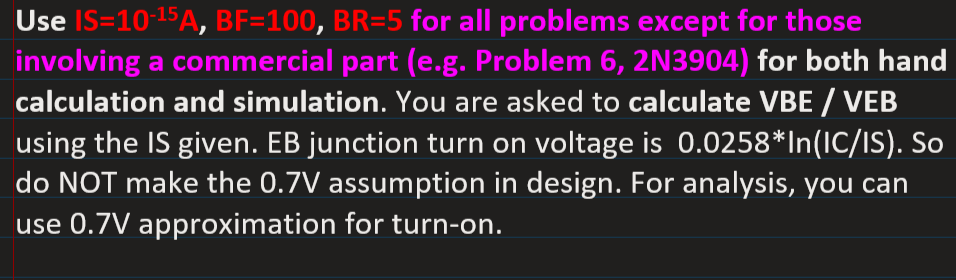
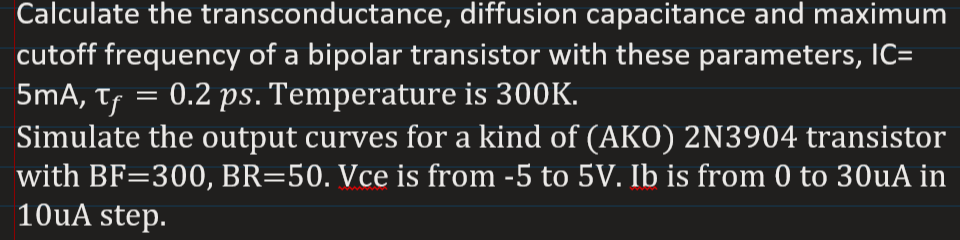
Use IS=10-15 A, BF=100, BR=5 for all problems except for those involving a commercial part (e.g. Problem 6, 2N3904) for both hand calculation and simulation. You are asked to calculate VBE / VEB using the IS given. EB junction turn on voltage is 0.0258*In(IC/IS). So do NOT make the 0.7V assumption in design. For analysis, you can use 0.7V approximation for turn-on. Calculate the transconductance, diffusion capacitance and maximum cutoff frequency of a bipolar transistor with these parameters, IC= 5mA, Tf 0.2 ps. Temperature is 300K. Simulate the output curves for a kind of (AKO) 2N3904 transistor with BF=300, BR=50. Vce is from -5 to 5V. Ib is from 0 to 30uA in 10uA step. Use IS=10-15 A, BF=100, BR=5 for all problems except for those involving a commercial part (e.g. Problem 6, 2N3904) for both hand calculation and simulation. You are asked to calculate VBE / VEB using the IS given. EB junction turn on voltage is 0.0258*In(IC/IS). So do NOT make the 0.7V assumption in design. For analysis, you can use 0.7V approximation for turn-on. Calculate the transconductance, diffusion capacitance and maximum cutoff frequency of a bipolar transistor with these parameters, IC= 5mA, Tf 0.2 ps. Temperature is 300K. Simulate the output curves for a kind of (AKO) 2N3904 transistor with BF=300, BR=50. Vce is from -5 to 5V. Ib is from 0 to 30uA in 10uA step
Step by Step Solution
There are 3 Steps involved in it

Get step-by-step solutions from verified subject matter experts
 Study Help