







Question: Use iterative method to solve these problems T(n) = cn + 3T(2n/3) where T(1) = 1 T(n) = T([n/2]) + c where T(n) = 1
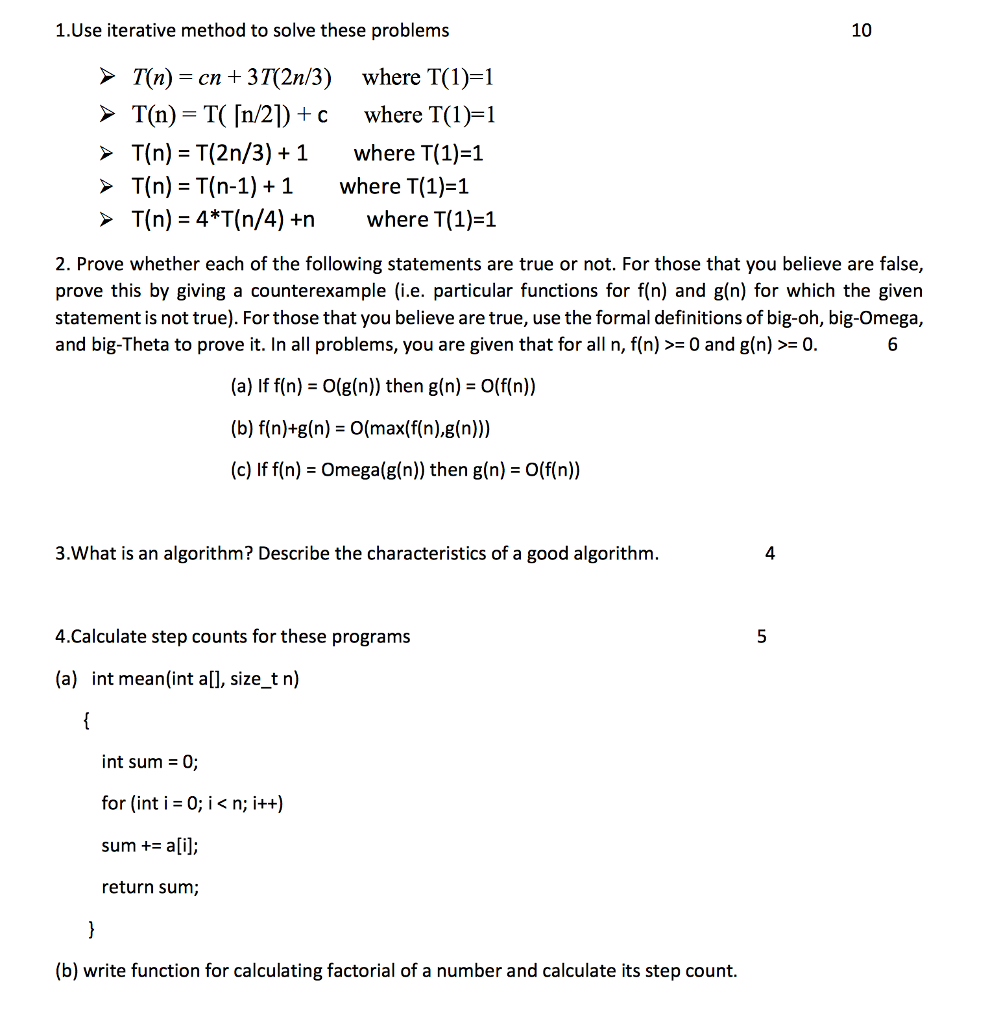
Use iterative method to solve these problems T(n) = cn + 3T(2n/3) where T(1) = 1 T(n) = T([n/2]) + c where T(n) = 1 T(n) = T(2n/3) + 1 where T(1) = 1 T(n) = T(n - 1) + 1 where T(1) = 1 T(n) 4*T(n/4) + n where T(1) = 1 Prove whether each of the following statements are true or not. For those that you believe are false, prove this by giving a counterexample (i.e. particular functions for f(n) and g(n) for which the given statement is not true). For those that you believe are true, use the formal definitions of big-oh, big-Omega, and big-Theta to prove it. In all problems, you are given that for all n, f(n) and g(n) > = 0. If f(n) = O(g(n)) then g(n) = O(f(n)) f(n) + g(n) = O(max(f(n),g(n))) If f(n) = Omega(g(n)) then g(n) = O(f(n)) What is an algorithm? Describe the characteristics of a good algorithm. Calculate step counts for these programs int mean(int a[], size_t n) { int sum = 0: for (int i = 0:
Step by Step Solution
There are 3 Steps involved in it

Get step-by-step solutions from verified subject matter experts
 Study Help