


Question: -USE JUPYTER- Given the W-shape price sequence: 100, 90, 80, 70, 60, 50, 60, 70, 80, 90, 100, 90, 80, 70, 60, 50, 60, 70,

-USE JUPYTER-

Given the W-shape price sequence: 100, 90, 80, 70, 60, 50, 60, 70, 80, 90, 100, 90, 80, 70, 60, 50, 60, 70, 80, 90, 100 and the inverse W-shape price sequence: 50, 60, 70, 80, 90, 100, 90, 80, 70, 60, 50, 60, 70, 80, 90, 100, 90, 80, 70, 60, 50 Please compare and discuss the performance discrepancy of the DCA and the lump-sum method for these two cases. Also compute the IRR, respectively; and discuss why the DCA has different behavior in these two cases even though the profit/loss of the lump-sum method is the same at the end of the investment course.
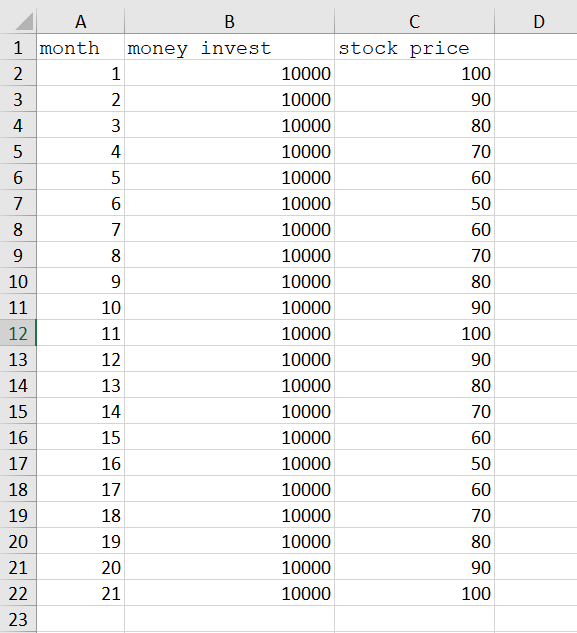
-USE JUPYTER- Given the W-shape price sequence:

\begin{tabular}{|c|r|r|r|r|} \hline \multicolumn{1}{|c|}{ A } & \multicolumn{2}{|c|}{ B } & \multicolumn{1}{c|}{ D } \\ \hline 1 & month & money & invest \\ \hline 2 & 1 & 10000 & 100 \\ \hline 3 & 2 & 10000 & 90 \\ \hline 4 & 3 & 10000 & 80 \\ \hline 5 & 4 & 10000 & 70 \\ \hline 6 & 5 & 10000 & 60 \\ \hline 7 & 6 & 10000 & 50 \\ \hline 8 & 7 & 10000 & 60 \\ \hline 9 & 8 & 10000 & 70 \\ \hline 10 & 9 & 10000 & 80 \\ \hline 11 & 10 & 10000 & 90 \\ \hline 12 & 11 & 10000 & 100 \\ \hline 13 & 12 & 10000 & 90 \\ \hline 14 & 13 & 10000 & 80 \\ \hline 15 & 14 & 10000 & 70 \\ \hline 16 & 15 & 10000 & 60 \\ \hline 17 & 16 & 10000 & 50 \\ \hline 18 & 17 & 10000 & 60 \\ \hline 19 & 18 & 10000 & 70 \\ \hline 20 & 19 & 10000 & 80 \\ \hline 21 & 20 & 10000 & 90 \\ \hline 22 & 21 & 10000 & 100 \\ \hline 23 & & & \\ \hline \end{tabular}

Step by Step Solution

There are 3 Steps involved in it

1 Expert Approved Answer
Step: 1 Unlock blur-text-image

Question Has Been Solved by an Expert!

Get step-by-step solutions from verified subject matter experts

Step: 2 Unlock
Step: 3 Unlock

Students Have Also Explored These Related General Management Questions!