







Question: Use Matlab for all questions, include graphs and comment what you did and address all questions. Upload your m-files with your submission. In this portion
Use Matlab for all questions, include graphs and comment what you did and address all questions. Upload your m-files with your submission. In this portion of the homework you will reproduce the minimalistic cell cycle model of Goldbeter, published in PNAS in 1992, a publication posted under the Resources folder Plot M dependent on C. This is called a phase plot revealing a limit cycle (see also Fig. 4 in the paper). Produce a second plot to demonstrate how a more dramatic perturbation of the initial conditions of M or C causes the system to not get back to cycle. This is a demonstration for the limit of robustness of the system. Please help!!! Thank you in advance :))
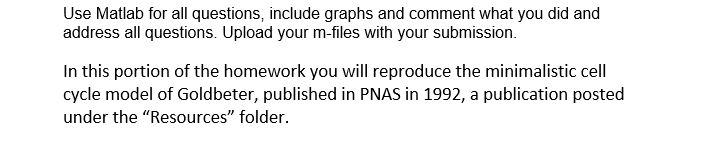
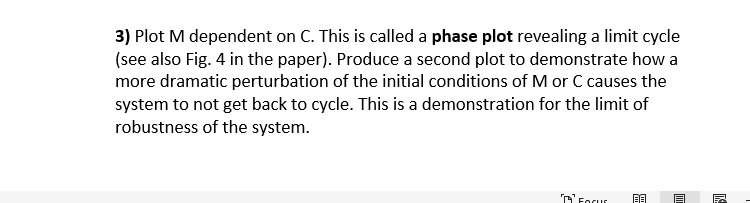
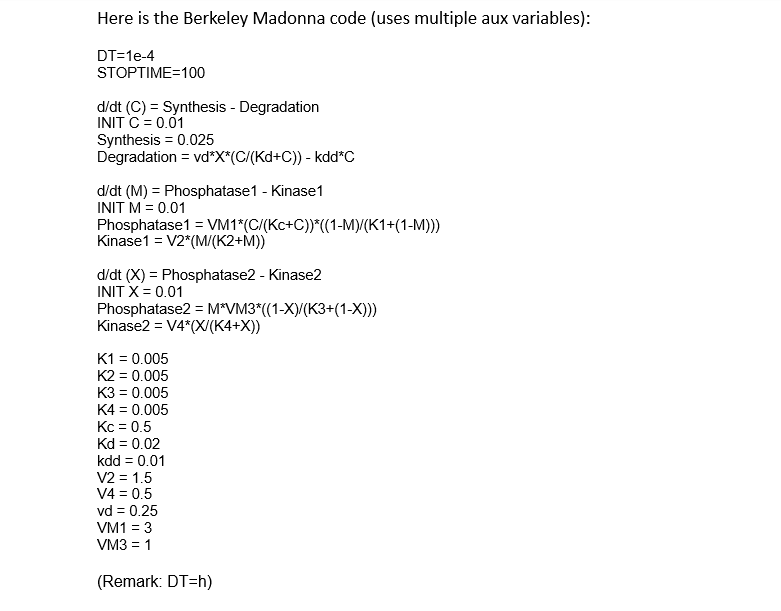
Use Matlab for all questions, include graphs and comment what you did and address all questions. Upload your m-files with your submission. In this portion of the homework you will reproduce the minimalistic cell cycle model of Goldbeter, published in PNAS in 1992, a publication posted under the "Resources" folder. 3) Plot M dependent on C. This is called a phase plot revealing a limit cycle (see also Fig. 4 in the paper). Produce a second plot to demonstrate how a more dramatic perturbation of the initial conditions of M or C causes the system to not get back to cycle. This is a demonstration for the limit of robustness of the system. Here is the Berkeley Madonna code (uses multiple aux variables): DT=1e4 STOPTIME =100 d/dt(C)= Synthesis - Degradation INIT C =0.01 Synthesis =0.025 Degradation =vdX(C/(Kd+C))kddC d/dt(M)= Phosphatase 1 Kinase 1 INIT M=0.01 Phosphatase1 =VM1(C/(KC+C))((1M)/(K1+(1M))) Kinase 1=V2(M/(K2+M)) d/dt(X)= Phosphatase 2 - Kinase 2 INIT X=0.01 Phosphatase2 =MVM3((1X)/(K3+(1X))) Kinase 2=V4(X/(K4+X)) K1=0.005 K2=0.005 K3=0.005 K4=0.005 Kc=0.5 Kd=0.02 kdd=0.01 V2=1.5 V4 =0.5 vd=0.25 VM1 =3 VM3 =1 (Remark: DT=h)
Step by Step Solution
There are 3 Steps involved in it

Get step-by-step solutions from verified subject matter experts
 Study Help