







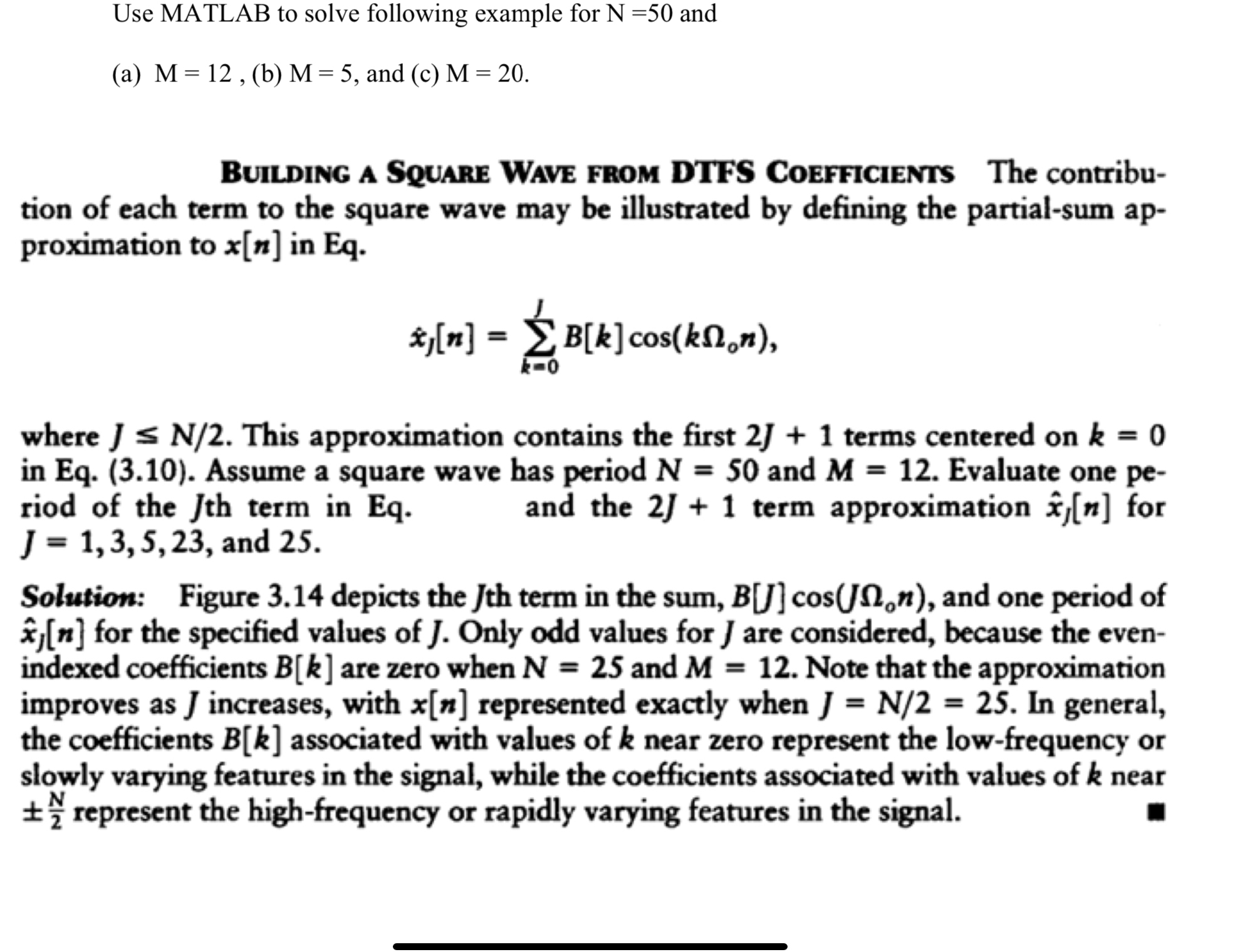
Question: Use MATLAB to solve following example for N = 5 0 and ( a ) M = 1 2 , ( b ) M =
Use MATLAB to solve following example for and
ab and c
Building a Square Wave from DTFS Coefficients The contribution of each term to the square wave may be illustrated by defining the partialsum approximation to in Eq
hat
where This approximation contains the first terms centered on in Eq Assume a square wave has period and Evaluate one period of the th term in Eq and the term approximation hat for and
Solution: Figure depicts the th term in the sum, and one period of hat for the specified values of Only odd values for are considered, because the evenindexed coefficients are zero when and Note that the approximation improves as increases, with represented exactly when In general, the coefficients associated with values of near zero represent the lowfrequency or slowly varying features in the signal, while the coefficients associated with values of near represent the highfrequency or rapidly varying features in the signal.
Step by Step Solution
There are 3 Steps involved in it
1 Expert Approved Answer
Step: 1 Unlock

Question Has Been Solved by an Expert!
Get step-by-step solutions from verified subject matter experts
Step: 2 Unlock
Step: 3 Unlock
 Study Help