







Question: Use only Flowchart Raptor Question: Shipping Charges The Fast Freight Shipping Company charges the following rates: Weight of Package Rate per 500 miles Shipped 2
Use only Flowchart Raptor
Question: Shipping Charges
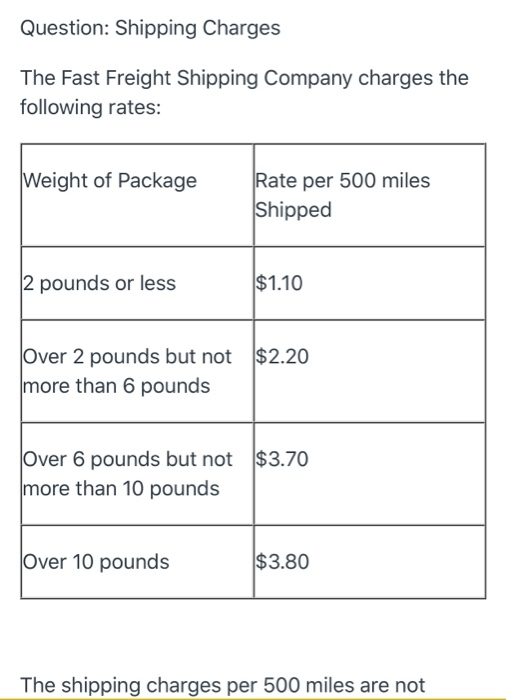
The Fast Freight Shipping Company charges the following rates:
Weight of Package | Rate per 500 miles Shipped |
2 pounds or less | $1.10 |
Over 2 pounds but not more than 6 pounds | $2.20 |
Over 6 pounds but not more than 10 pounds | $3.70 |
Over 10 pounds | $3.80 |
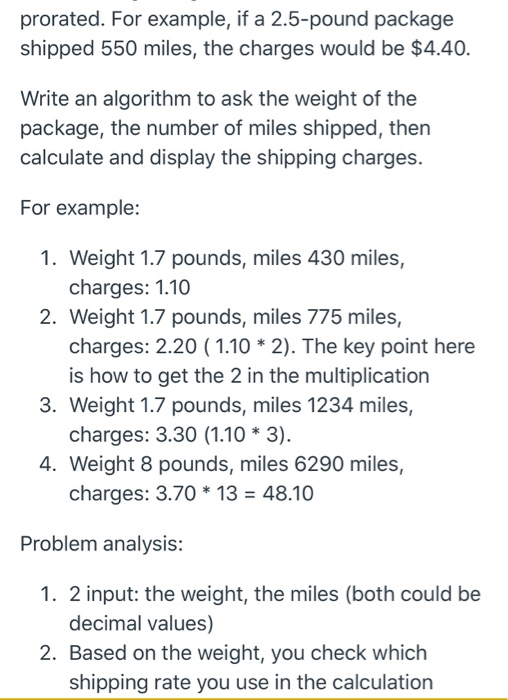
The shipping charges per 500 miles are not prorated. For example, if a 2.5-pound package shipped 550 miles, the charges would be $4.40.
Write an algorithm to ask the weight of the package, the number of miles shipped, then calculate and display the shipping charges.
For example:
- Weight 1.7 pounds, miles 430 miles, charges: 1.10
- Weight 1.7 pounds, miles 775 miles, charges: 2.20 ( 1.10 * 2). The key point here is how to get the 2 in the multiplication
- Weight 1.7 pounds, miles 1234 miles, charges: 3.30 (1.10 * 3).
- Weight 8 pounds, miles 6290 miles, charges: 3.70 * 13 = 48.10
Problem analysis:
- 2 input: the weight, the miles (both could be decimal values)
- Based on the weight, you check which shipping rate you use in the calculation
- based on the miles, you calculate how many 500 miles the package is shipped. It determines the number times the shipping rate need to multiple. Sometimes you need to round it up to the next integer, sometime not.
You can use a if-else if to check the weight
Question: Shipping Charges The Fast Freight Shipping Company charges the following rates: Weight of Package Rate per 500 miles Shipped 2 pounds or less $1.10 Over 2 pounds but not $2.20 more than 6 pounds Over 6 pounds but not $3.70 more than 10 pounds Over 10 pounds $3.80 The shipping charges per 500 miles are not prorated. For example, if a 2.5-pound package shipped 550 miles, the charges would be $4.40. Write an algorithm to ask the weight of the package, the number of miles shipped, then calculate and display the shipping charges. For example: 1. Weight 1.7 pounds, miles 430 miles, charges: 1.10 2. Weight 1.7 pounds, miles 775 miles, charges: 2.20 (1.10 * 2). The key point here is how to get the 2 in the multiplication 3. Weight 1.7 pounds, miles 1234 miles, charges: 3.30 (1.10 * 3). 4. Weight 8 pounds, miles 6290 miles, charges: 3.70 * 13 = 48.10 Problem analysis: 1. 2 input: the weight, the miles (both could be decimal values) 2. Based on the weight, you check which shipping rate you use in the calculation 3. Weight '1.7 pounds, miles 1234 miles, charges: 3.30 (1.10 * 3). 4. Weight 8 pounds, miles 6290 miles, charges: 3.70 * 13 = 48.10 Problem analysis: 1. 2 input: the weight, the miles (both could be decimal values) 2. Based on the weight, you check which shipping rate you use in the calculation 3. based on the miles, you calculate how many 500 miles the package is shipped. It determines the number times the shipping rate need to multiple. Sometimes you need to round it up to the next integer, sometime not. You can use a if-else if to check the weight
Step by Step Solution
There are 3 Steps involved in it

Get step-by-step solutions from verified subject matter experts
 Study Help