







Question: Use Python code. Decay.py is our sample simulation of spontaneous decay. An extension of this program, DecaySound.py, adds a beep each time an atom decays
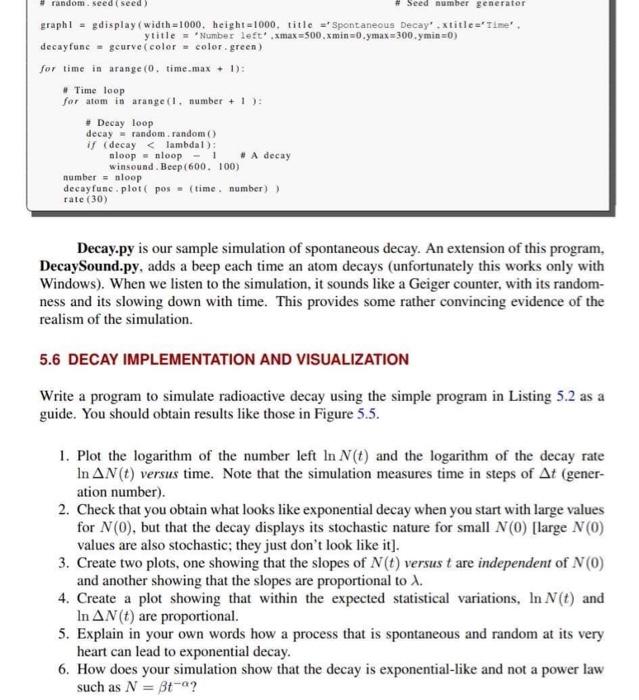
Decay.py is our sample simulation of spontaneous decay. An extension of this program, DecaySound.py, adds a beep each time an atom decays (unfortunately this works only with Windows). When we listen to the simulation, it sounds like a Geiger counter, with its randomness and its slowing down with time. This provides some rather convincing evidence of the realism of the simulation. 5.6 DECAY IMPLEMENTATION AND VISUALIZATION Write a program to simulate radioactive decay using the simple program in Listing 5.2 as a guide. You should obtain results like those in Figure 5.5. 1. Plot the logarithm of the number left lnN(t) and the logarithm of the decay rate In N(t) versus time. Note that the simulation measures time in steps of t (generation number). 2. Check that you obtain what looks like exponential decay when you start with large values for N(0), but that the decay displays its stochastic nature for small N(0) [large N(0) values are also stochastic; they just don't look like it]. 3. Create two plots, one showing that the slopes of N(t) versus t are independent of N(0) and another showing that the slopes are proportional to . 4. Create a plot showing that within the expected statistical variations, lnN(t) and lnN(t) are proportional. 5. Explain in your own words how a process that is spontaneous and random at its very heart can lead to exponential decay. 6. How does your simulation show that the decay is exponential-like and not a power law such as N=t
Step by Step Solution
There are 3 Steps involved in it

Get step-by-step solutions from verified subject matter experts
 Study Help