







Question: Use R Code to solve the following: Data set trees is in the datasets package, which is automatically available, so you do not need any
Use R Code to solve the following:
Data set trees is in the datasets package, which is automatically available, so you do not need any other package to load it
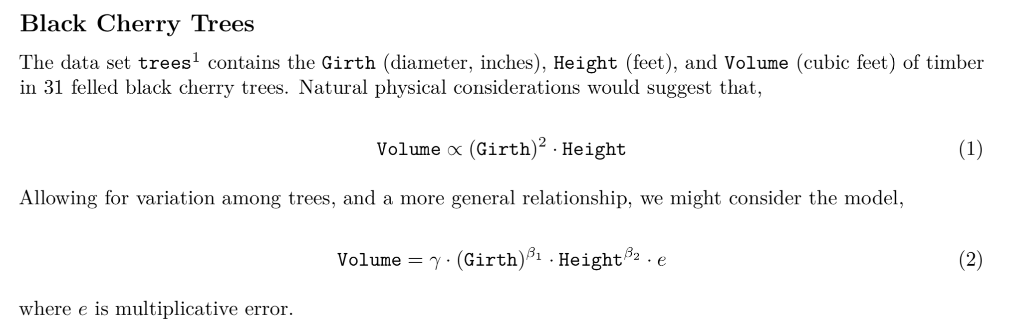
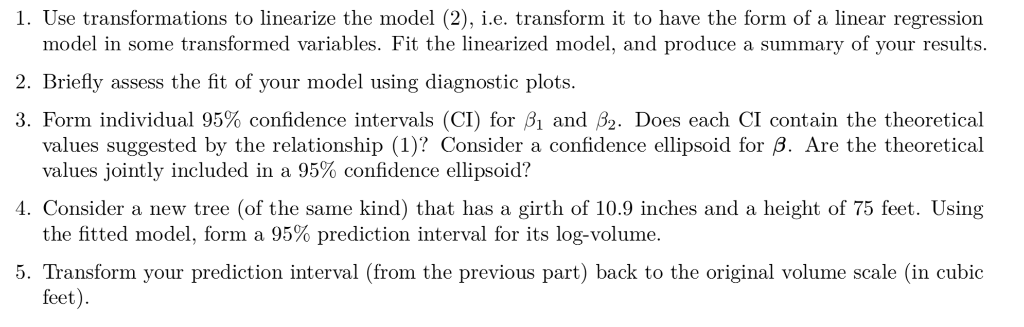
Black Cherry Trees The data set trees1 contains the Girth (diameter, inches), Height (feet), and Volume (cubic feet) of timber in 31 felled black cherry trees. Natural physical considerations would suggest that, Volume ox (Girth)2 Height Allowing for variation among trees, and a more general relationship, we might consider the model, Volume- . (Girth)A . Height',-e where e is multiplicative error 1. Use transformations to linearize the model (2), i.e. transform it to have the form of a linear regression model in some transformed variables. Fit the linearized model, and produce a summary of your results 2. Briefly assess the fit of your model using diagnostic plots. 3. Form individual 95% confidence intervals (CI) for and 2. Does each CI contain the theoretical values suggested by the relationship (1)? Consider a confidence ellipsoid for B. Are the theoretical values jointly included in a 95% confidence ellipsoid? the fitted model, form a 95% prediction interval for its log-volume. feet) 4. Consider a new tree (of the same kind) that has a girth of 10.9 inches and a height of 75 feet. Using 5. Transform your prediction interval (from the previous part) back to the original volume scale (in cubic Black Cherry Trees The data set trees1 contains the Girth (diameter, inches), Height (feet), and Volume (cubic feet) of timber in 31 felled black cherry trees. Natural physical considerations would suggest that, Volume ox (Girth)2 Height Allowing for variation among trees, and a more general relationship, we might consider the model, Volume- . (Girth)A . Height',-e where e is multiplicative error 1. Use transformations to linearize the model (2), i.e. transform it to have the form of a linear regression model in some transformed variables. Fit the linearized model, and produce a summary of your results 2. Briefly assess the fit of your model using diagnostic plots. 3. Form individual 95% confidence intervals (CI) for and 2. Does each CI contain the theoretical values suggested by the relationship (1)? Consider a confidence ellipsoid for B. Are the theoretical values jointly included in a 95% confidence ellipsoid? the fitted model, form a 95% prediction interval for its log-volume. feet) 4. Consider a new tree (of the same kind) that has a girth of 10.9 inches and a height of 75 feet. Using 5. Transform your prediction interval (from the previous part) back to the original volume scale (in cubic
Step by Step Solution
There are 3 Steps involved in it

Get step-by-step solutions from verified subject matter experts
 Study Help