







Question: use R Let's now explore how the variables may or may not relate to each other. First, calculate the correlations between variables. Correlations can help
use R
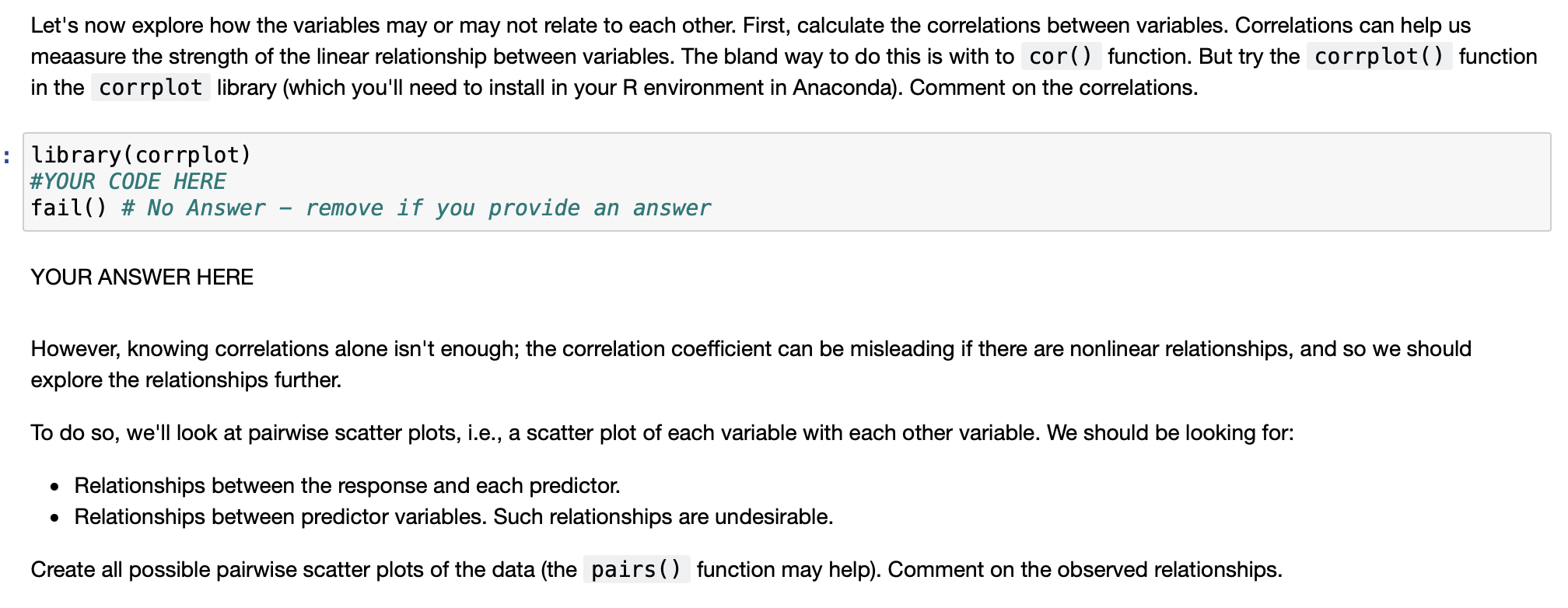
Let's now explore how the variables may or may not relate to each other. First, calculate the correlations between variables. Correlations can help us meaasure the strength of the linear relationship between variables. The bland way to do this is with to cor() function. But try the corrplot() function in the corrplot library (which you'll need to install in your R environment in Anaconda). Comment on the correlations. : library(corrplot) #YOUR CODE HERE fail() # No Answer remove if you provide an answer YOUR ANSWER HERE However, knowing correlations alone isn't enough; the correlation coefficient can be misleading if there are nonlinear relationships, and so we should explore the relationships further. To do so, we'll look at pairwise scatter plots, i.e., a scatter plot of each variable with each other variable. We should be looking for: Relationships between the response and each predictor. Relationships between predictor variables. Such relationships are undesirable. Create all possible pairwise scatter plots of the data (the pairs() function may help). Comment on the observed relationships. Let's now explore how the variables may or may not relate to each other. First, calculate the correlations between variables. Correlations can help us meaasure the strength of the linear relationship between variables. The bland way to do this is with to cor() function. But try the corrplot() function in the corrplot library (which you'll need to install in your R environment in Anaconda). Comment on the correlations. : library(corrplot) #YOUR CODE HERE fail() # No Answer remove if you provide an answer YOUR ANSWER HERE However, knowing correlations alone isn't enough; the correlation coefficient can be misleading if there are nonlinear relationships, and so we should explore the relationships further. To do so, we'll look at pairwise scatter plots, i.e., a scatter plot of each variable with each other variable. We should be looking for: Relationships between the response and each predictor. Relationships between predictor variables. Such relationships are undesirable. Create all possible pairwise scatter plots of the data (the pairs() function may help). Comment on the observed relationships
Step by Step Solution
There are 3 Steps involved in it

Get step-by-step solutions from verified subject matter experts
 Study Help