







Question: Use Round-Robin, time quantum = 4, fill the table. Please write a full answer and give a good explanation Consider processes that are described using
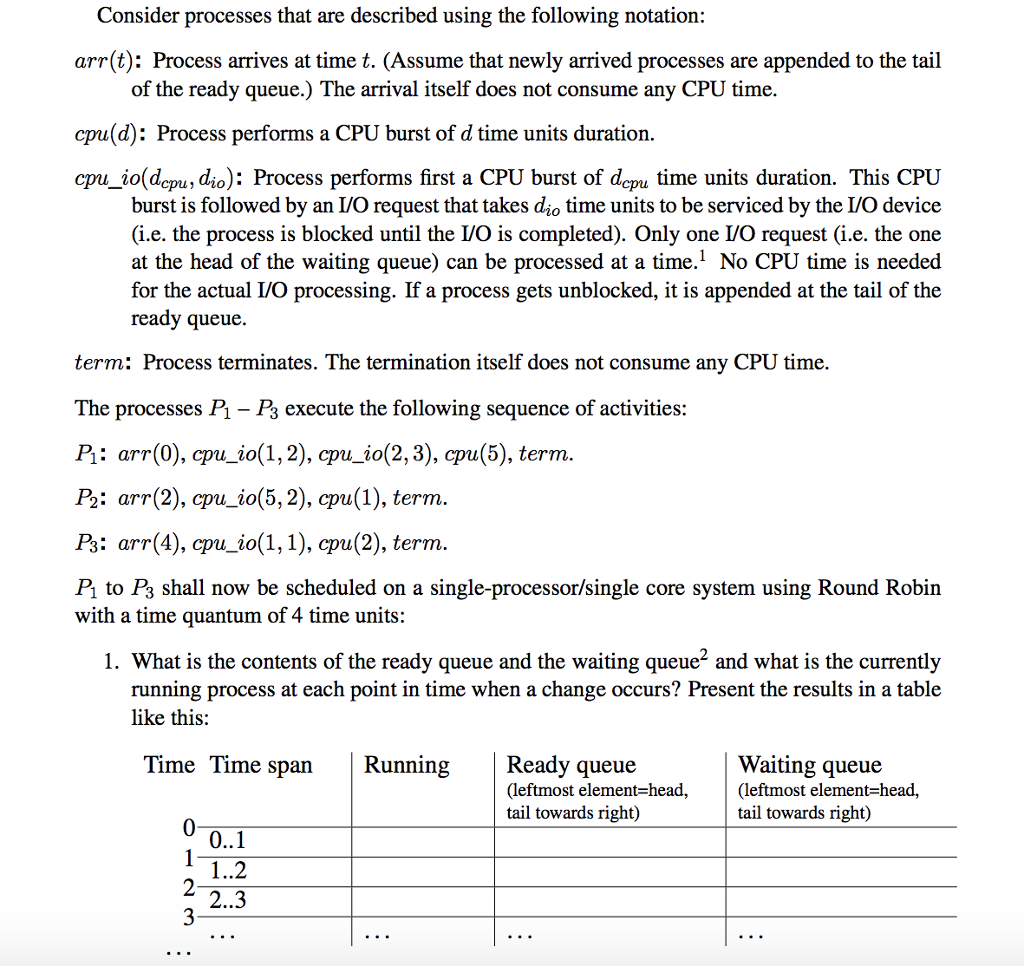
Use Round-Robin, time quantum = 4, fill the table.
Please write a full answer and give a good explanation
Consider processes that are described using the following notation: arr(t): Process arrives at time t. (Assume that newly arrived processes are appended to the tail of the ready queue.) The arrival itself does not consume any CPU time. cpu(d): Process performs a CPU burst of d time units duration cpu_io(depu, dio): Process performs first a CPU burst of dcpu time units duration. This CPU burst is followed by an I/O request that takes dio time units to be serviced by the I/O device (i.e. the process is blocked until the VO is completed). Only one I/O request (i.e. the one at the head of the waiting queue) can be processed at a time.1 No CPU time is needed for the actual I/O processing. If a process gets unblocked, it is appended at the tail of the ready queue. term: Process terminates. The termination itself does not consume any CPU time. The processes Pi - P3 execute the following sequence of activities: R: arr(0), qu-io(1,2), pu-io(2,3),cpu(5), term P2: arr(2), cpu_io(5, 2), cpu(1), term Ps: arr(4), cpu io(1,1), cpu(2), term Pi to P3 shall now be scheduled on a single-processor/single core system using Round Robin with a time quantum of 4 time units: 1. What is the contents of the ready queue and the waiting queue* and what is the currently running process at each point in time when a change occurs? Present the results in a table like this: Time Time spanRunnin,g Waiting queue Ready queue (leftmost element-head,(leftmost element-head, tail towards right) tail towards right) 0 2..3
Step by Step Solution
There are 3 Steps involved in it

Get step-by-step solutions from verified subject matter experts
 Study Help