







Question: USE stdio.h only DO NOT USE GLOBAL VARIABLES DO NOT USE ARRAYS, STRUCTS OR UNIONS USE LOOP STATEMENTS USE int and float only CREATE A
USE stdio.h only DO NOT USE GLOBAL VARIABLES DO NOT USE ARRAYS, STRUCTS OR UNIONS USE LOOP STATEMENTS USE int and float only CREATE A FUNCTION
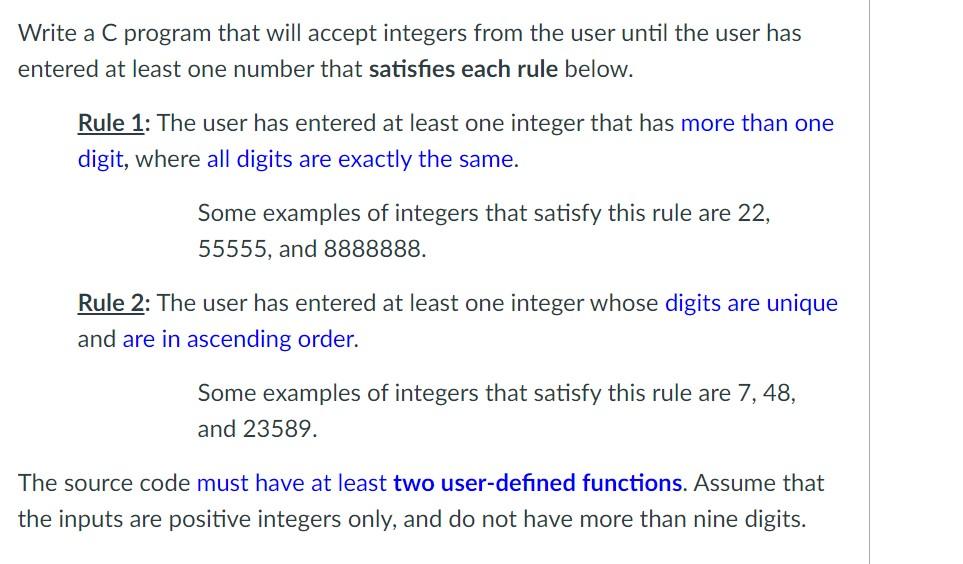
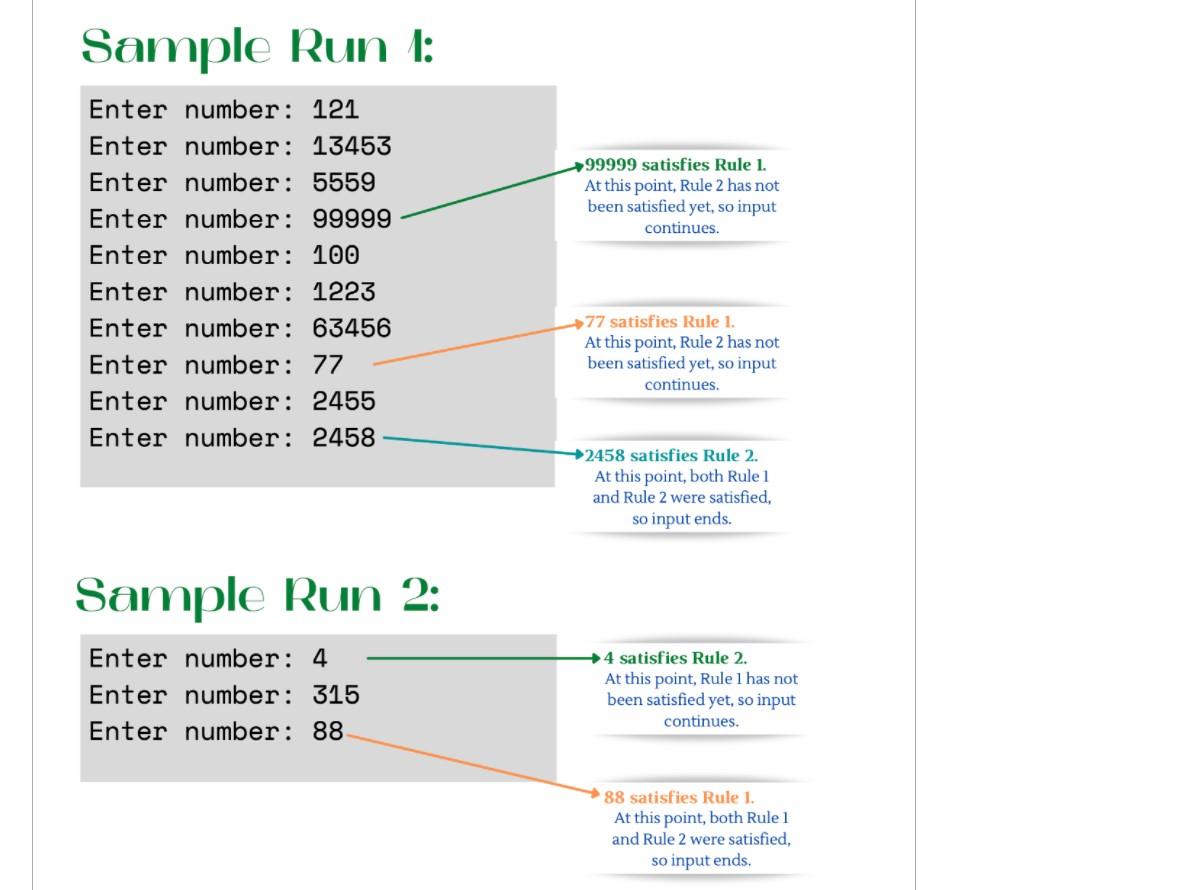
Write a C program that will accept integers from the user until the user has entered at least one number that satisfies each rule below. Rule 1: The user has entered at least one integer that has more than one digit, where all digits are exactly the same. Some examples of integers that satisfy this rule are 22, 55555, and 8888888. Rule 2: The user has entered at least one integer whose digits are unique and are in ascending order. Some examples of integers that satisfy this rule are 7, 48, and 23589. The source code must have at least two user-defined functions. Assume that the inputs are positive integers only, and do not have more than nine digits. Sample Run 1: 99999 satisfies Rule 1. At this point, Rule 2 has not been satisfied yet, so input continues. Enter number: 121 Enter number: 13453 Enter number: 5559 Enter number: 99999 Enter number: 100 Enter number: 1223 Enter number: 63456 Enter number: 77 Enter number: 2455 Enter number: 2458 77 satisfies Rule 1. At this point, Rule 2 has not been satisfied yet, so input continues 2458 satisfies Rule 2. At this point, both Rule 1 and Rule 2 were satisfied, so input ends. Sample Run 2: Enter number: 4 Enter number: 315 Enter number: 88 4 satisfies Rule 2. At this point, Rule 1 has not been satisfied yet, so input continues. 88 satisfies Rule 1. At this point, both Rule 1 and Rule 2 were satisfied, so input ends
Step by Step Solution
There are 3 Steps involved in it

Get step-by-step solutions from verified subject matter experts
 Study Help