



Question: Use the above data to solve the questions below; 1. Use the scenario approach to find the optimal order quantity and expected profit for the
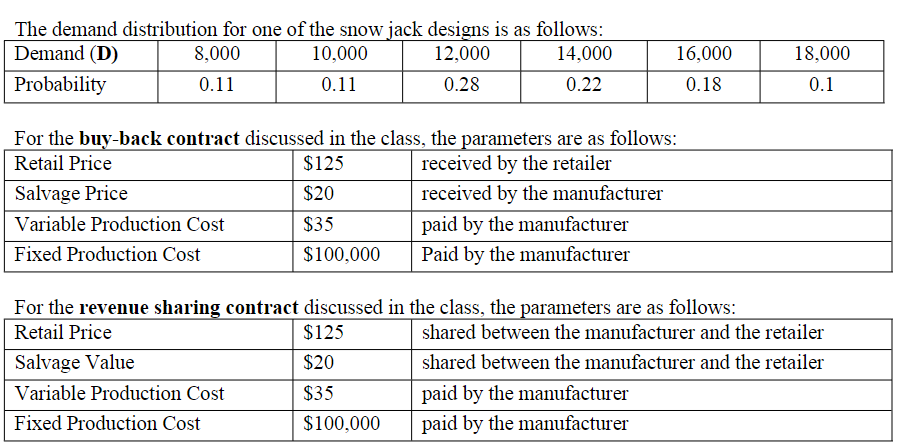
Use the above data to solve the questions below;
1. Use the scenario approach to find the optimal order quantity and expected profit for the retailer under a wholesale-price only contract. W= $80, P= $125, S=$20, fixed set-up cost F = $100,000.Please calculate the retailers and the manufacturers profits with the above parameters.
2. Find the optimal order quantity for the retailer under the following two new buy-back contracts separately: (1) w=$71 and b=$50; (2) w=$89 and b=$75. Calculate the expected profits for the retailer, the manufacturer, and the whole supply chain under each contract.

4. Find the underage cost, the overage cost, and the optimal order quantity under each scenario in the above questions.
5. The manufacturer may induce the retailer to increase the order quantity by lowering the wholesale price. Under a wholesale-price only contract, what wholesale price is needed to induce the retailer to order a quantity that is optimal for the system (i.e., manufacturer and retailer). What will be the problem with this wholesale price?
Please solve all questions and write legibly.
Thank you.
The demand distribution for one of the snow jack designs is as follows: Demand (D) 8,000 10,000 12,000 14.000 Probability 0.11 0.11 0.28 0.22 18,000 16,000 0.18 0.1 For the buy-back contract discussed in the class, the parameters are as follows: Retail Price $125 received by the retailer Salvage Price $20 received by the manufacturer Variable Production Cost $35 paid by the manufacturer Fixed Production Cost $100,000 Paid by the manufacturer For the revenue sharing contract discussed in the class, the parameters are as follows: Retail Price $125 shared between the manufacturer and the retailer Salvage Value $20 shared between the manufacturer and the retailer Variable Production Cost $35 paid by the manufacturer Fixed Production Cost $100,000 paid by the manufacturer 3. Find the optimal order quantity for the retailer under the following two new revenue sharing contracts separately: (1) w=24 and 0=0.4; (2) w=21 and $=0.6. The revenue sharing rate, o, is the proportion paid to the manufacturer. Calculate the expected profits for the retailer, the manufacturer, and the whole supply chain under each contract. The demand distribution for one of the snow jack designs is as follows: Demand (D) 8,000 10,000 12,000 14.000 Probability 0.11 0.11 0.28 0.22 18,000 16,000 0.18 0.1 For the buy-back contract discussed in the class, the parameters are as follows: Retail Price $125 received by the retailer Salvage Price $20 received by the manufacturer Variable Production Cost $35 paid by the manufacturer Fixed Production Cost $100,000 Paid by the manufacturer For the revenue sharing contract discussed in the class, the parameters are as follows: Retail Price $125 shared between the manufacturer and the retailer Salvage Value $20 shared between the manufacturer and the retailer Variable Production Cost $35 paid by the manufacturer Fixed Production Cost $100,000 paid by the manufacturer 3. Find the optimal order quantity for the retailer under the following two new revenue sharing contracts separately: (1) w=24 and 0=0.4; (2) w=21 and $=0.6. The revenue sharing rate, o, is the proportion paid to the manufacturer. Calculate the expected profits for the retailer, the manufacturer, and the whole supply chain under each contractStep by Step Solution
There are 3 Steps involved in it

Get step-by-step solutions from verified subject matter experts