



Question: Use the answers from question 3 to complete the expected cash flow for the 4 potential projects then answer question 8 discussing the results. 3.
Use the answers from question 3 to complete the expected cash flow for the 4 potential projects then answer question 8 discussing the results.
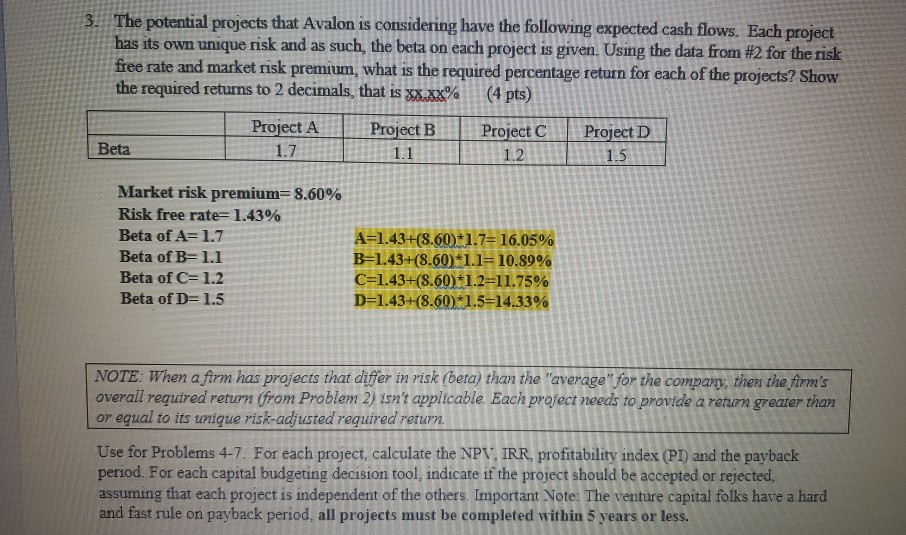
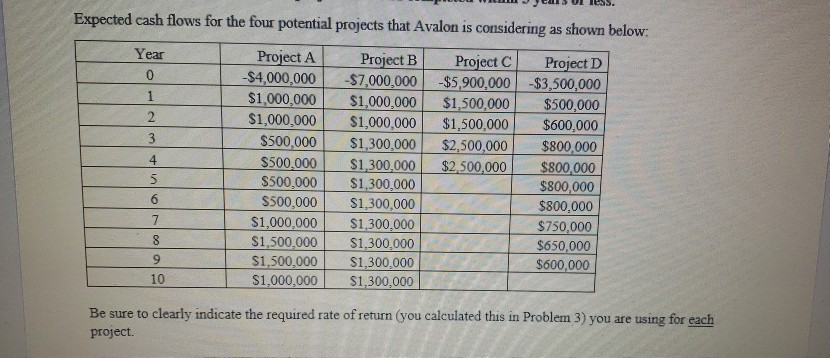
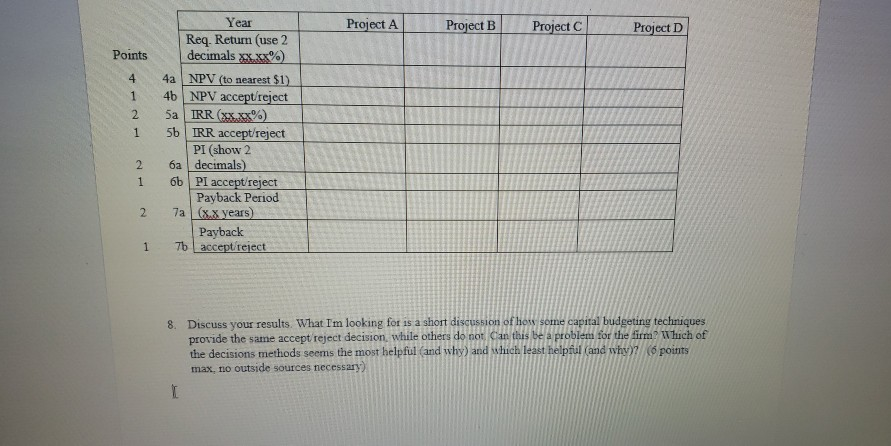
3. The potential projects that Avalon is considering have the following expected cash flows. Each project has its own unique risk and as such, the beta on each project is given. Using the data from #2 for the risk free rate and market risk premium, what is the required percentage return for each of the projects? Show the required returns to 2 decimals, that is xx.xx% (4 pts) Project A Project B Project C Project D Beta 1. 7 5 1.1 1.2 1.5 1.7 Market risk premium= 8.60% Risk free rate=1.43% Beta of A=1.7 Beta of B=1.1 Beta of C= 1.2 Beta of D= 1.5 A=1.43+(8.60)+1.7= 16.05% B=1.43+(8.60) *1.1=10.89% C=1.43+(8.60)*1.2=11.75% D=1.43+(8.60)*1.5=14.33% NOTE: When a firm has projects that differ in risk (beta) than the "average" for the company, then the firm's overall required return (from Problem 2) isn't applicable. Each project needs to provide a return greater than or equal to its unique risk-adjusted required return Use for Problems 4-7. For each project, calculate the NPV, IRR, profitability index (PI) and the payback period. For each capital budgeting decision tool, indicate if the project should be accepted or rejected assuming that each project is independent of the others. Important Note: The venture capital folks have a hard and fast rule on payback period, all projects must be completed within 5 years or less. Expected cash flows for the four potential projects that Avalon is considering as shown below: Year Project A Project B Project Project D 0 -$4,000,000 $7,000,000 $5,900,000 $3,500,000 1 $1,000,000 $1,000,000 $1,500,000 $500,000 $1,000,000 $1,000,000 $1,500,000 $600,000 3 $500,000 $1,300,000 $2,500,000 $800,000 4 $500,000 $1,300,000 $2,500,000 $800,000 5 $500,000 $1,300,000 $800,000 6 $500,000 $1,300.000 $800,000 7 $1,000,000 $1,300,000 $750,000 8 $1,500,000 $1,300,000 $650,000 9 $1,500,000 $1,300,000 $600,000 101 $1,000,000 $1,300,000 Be sure to clearly indicate the required rate of return (you calculated this in Problem 3) you are using for each project Project A Project B Project Project D Points Year Req. Return (use 2 decimals xx.xx%) 4a NPV (to nearest $1) 4b NPV accept/reject 5a IRR (xx.xx%) 56 IRR accept/reject PI (show 2 6a decimals) 66 PI accept reject Payback Period 7a (x.x years) Payback 7 | accept reject 1 2 1 8. Discuss your results. What I'm looking for is a short discussion of how semne capital budgeting techniques provide the same accept reject decision while others do not chan this be a problem for the firm? Which of the decisions methods seems the most helpful and why) and which least helpful (and why)7/(6 points max, no outside sources necessary
Step by Step Solution
There are 3 Steps involved in it

Get step-by-step solutions from verified subject matter experts