







Question: Use the Bisection method, Newtons method, and the Secant method please. Fill out the following table, to get crror 10-6. Suggestion: Use MATLAB/Octave or other

 Use the Bisection method, Newtons method, and the Secant method please.
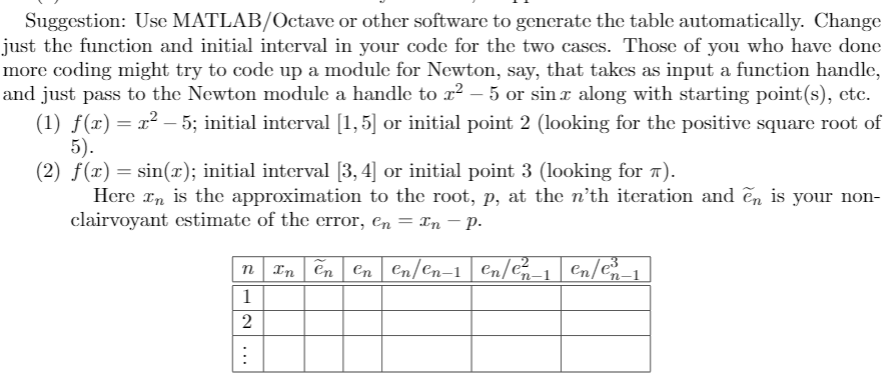
Fill out the following table, to get crror 10-6. Suggestion: Use MATLAB/Octave or other software to generate the table automatically. Change just the function and initial interval in your code for the two cases. Those of you who have done more coding might try to code up a module for Newton, say, that takes as input a function handle, and just pass to the Newton module a handle to r2 - 5 or sine along with starting point(s), etc. (1) f(x) = z 5; initial interval (1,5) or initial point 2 (looking for the positive square root of 5). (2) f(1) = sin(0); initial interval [3, 4] or initial point 3 (looking for 7). Here In is the approximation to the root, p, at the n'th iteration and n is your non- clairvoyant estimate of the error, en = In - p. en/e-1 nan en en en/en-1 en/eh- 1 2 : Discuss and speculate on any discrepancy between the theory and data a graph or graph sketch may help. Comment on cancellation error in your table, if applicable. Fill out the following table, to get crror 10-6. Suggestion: Use MATLAB/Octave or other software to generate the table automatically. Change just the function and initial interval in your code for the two cases. Those of you who have done more coding might try to code up a module for Newton, say, that takes as input a function handle, and just pass to the Newton module a handle to r2 - 5 or sine along with starting point(s), etc. (1) f(x) = z 5; initial interval (1,5) or initial point 2 (looking for the positive square root of 5). (2) f(1) = sin(0); initial interval [3, 4] or initial point 3 (looking for 7). Here In is the approximation to the root, p, at the n'th iteration and n is your non- clairvoyant estimate of the error, en = In - p. en/e-1 nan en en en/en-1 en/eh- 1 2 : Discuss and speculate on any discrepancy between the theory and data a graph or graph sketch may help. Comment on cancellation error in your table, if applicable
Step by Step Solution
There are 3 Steps involved in it

Get step-by-step solutions from verified subject matter experts
 Study Help