Question: Use the case Harley Davidson by Bhaskar Mitra to answer the question. Dont use other information than the information in the case below ,it will
Use the case Harley Davidson by Bhaskar Mitra to answer the question. Dont use other information than the information in the case below ,it will be not useful if you use otherew information.
3. Appraise Harley Davidsons resources and capabilities in terms of:
(a) Strategic importance
(b) Relative strength
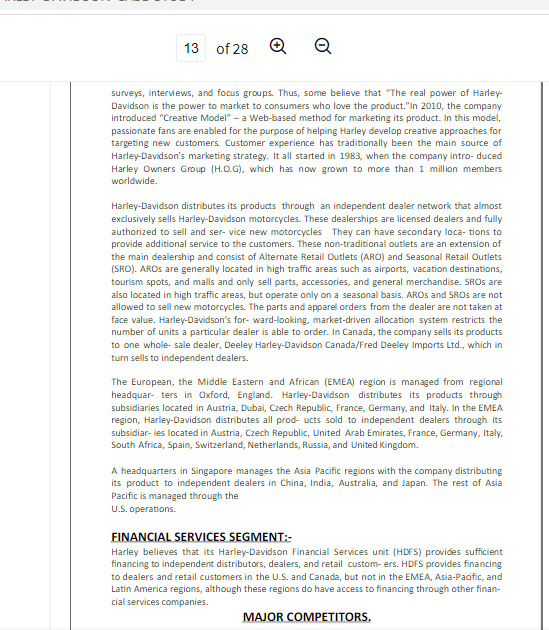
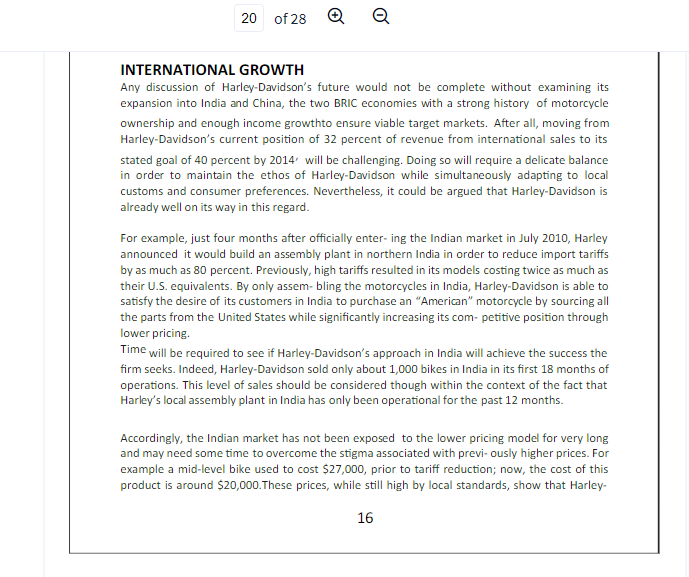
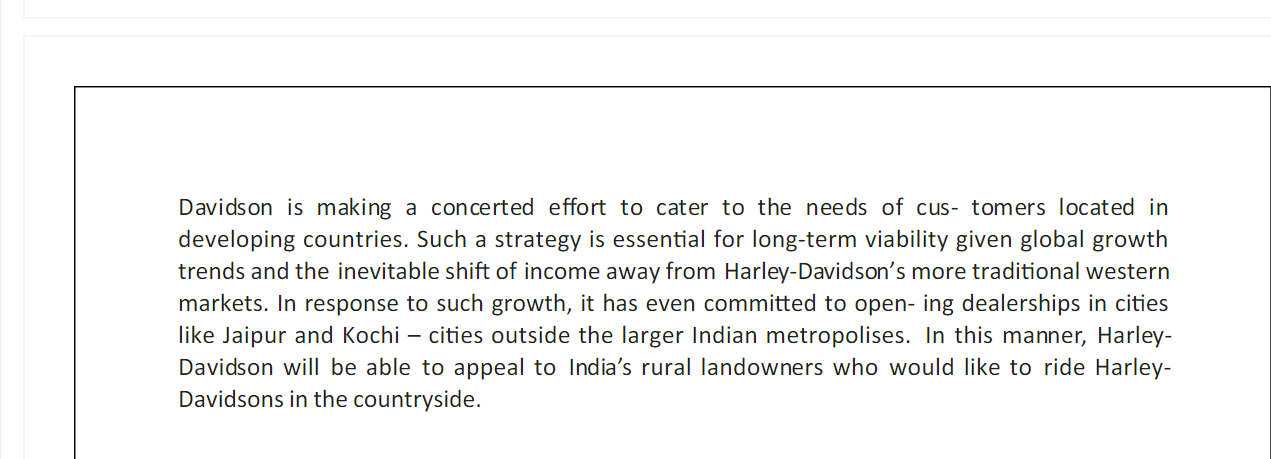
reputa 1 of 28 Q HARLEY DAVIDSON CASE STUDY. BHASKAR MITRA ABSTRACT Harley-Davidson is an American cultural and business icon on the level of Levi Strauss and Coca- Cola. Often imitated, but never duplicated, Harley-Davidson has managed to survive, and has, at times, thrived for many decades. Through depression, recessions, world wars, high technology developments, Japanese competition, and increasing government regulation, Harley-Davidson has maintained operations where over a dozen other U.S. motorcyde firms have failed. Harley-Davidson has even survived over a decade as a subsidiary of a bowling alley service firm. It has achieved this by essentially relying on designing, manufacturing, selling, and servicing a rela-tively static product: two wheels, a 45" V-Twin engine, and a set of handlebars. How has Harley-Davidson managed to survive through these and other hardships in a motorcycle market that is dominated by leisure riders? How has it kept the doors open while its historic U.S. rival, Indian Motorcycles, is currently in its fourth incarnation? How has it maintained its attractiveness with outlaw bikers, investment bankers, and those who appear to be experiencing a mid-life crisis" and who sometimes turn to the firm's products as a result? More importantly, what is this firm selling that keeps it as the industry leader in full-size motorcycles? The answer to these questions is not a 526-pound batch of steel with 250 feet of wiring, but rather the fact that Harley-Davidson is selling the American dream of freedom. How it is able to do this is a fascinating story. KEYWORDS:- Harley Davidson, Motorcycles, Competition, Challenges faced, etc. LITERATURE REVIEW With over 6,000 employees, 1,400 franchises, and nine production facilities, Harley-Davidson has managed to survive the economic downturn that was in full force in late 2007 and for the next few years, but the firm is not out of the woods yet. In fact, Harley-Davidson is struggling with three pivotal issues, the first of which is that the firm's products are viewed as leisure items. The other two issues are similar in nature in that they deal with the fact that managing the firm's target market is challenging, particularly as demand for its products is chang-ing. Individually and collectively these issues pose a real challenge to the company's long-term success. Without addressing these issues, Harley-Davidson may lose its ability to create value for customers and to serve stake-holders' needs as a result. Second, Harley-Davidson is challenged to effectively specify its target market as a first step to appropriately serving that market's needs. Historically, the firm's target market has been males between the ages of 29 and 55. However, in the last decade, Harley-Davidson has pursued younger riders and women as a means of expanding its target customer segments. But expanding the segments the firm serves with its products is not a risk-free decision or choice for the firm to make in that serving others might cause the firm to lose its ability to effectively serve the specific needs of the 29- to 55-year-old male (again, the historical target customer). This matter is considered more fully later in the case. Third, demands and cost drivers for the motor- cycle market are ever changing. Overseas competitors have shifted their focus from being the least expensive to being affordable and to providing a wider variety of motorcycles to customers as options to purchase. This competitive shift has put pressure on Harley-Davidson's key markets and has forced the firm to respond. With over 12 percent and 55 percent of the European and U.S. heavyweight motorcycle market respectively, Harley-Davidson has a substantial territory to defend. 7 of 28 a BODY. COMPANY HISTORY:- In 1903, William S. Harley and Arthur Davidson founded Harley-Davidson Motor Company, known by enthusiasts as "the Motor Company," in order to fund their racing pursuits. Accordingly, their first motorcycles were merely contemporary bicycles with small engines retrofitted to the frame. It was Harley-Davidson's early success in motorcycle racing that fueled the demand for its early models, which were sold in dealerships as early as 1904. Because these turn of the century races were as much about endurance as speed, Harley- Davidson acquired invaluable knowledge perti- nent to practicality and robust design. After significant success in road and endurance races, Harley-Davidson broke fresh ground with the introduction of the V-Twin engine design. Superior to large single-cylinder engines, the lighter V-Twin design allowed similar displacement in a lighter package with a shape that fit naturally into the bicycle-inspired frames of the early 1900s. Few suspected that this design would become so integral to modern motorcycles. Having dedicated over a third of its production to the U.S. Ammy, Harley-Davidson sales exploded during World War I. With the advent of motorized warfare, the motorcycle proved itself to be far more than just a novel invention. In addition to proving itself to the Army, Harley-Davidson also proved itself to soldiers. After the war, soldiers returned home and became a loyal customer base for the young firm. Through the 1920s, Harley-Davidson continued to focus on design improve-ment and racing. It spent much of this decade fighting for market share with multiple medium and small com- petitors. During this time, firms producing automobiles, airplanes, bicycles, and industrial machinery also tried their hand at building motorcycles The 1930s were a unique time for the motorcycle industry. In the wake of the Great Depression, the public was looking for inexpensive, simple transportation. At the same time, unemployment and inflation shrank potential customers' purchasing power. It was during this time that many of the smaller motorcycle manufacturers dropped out of the industry. Most of these firms were subsidiaries of companies in related industries. These failed motorcycle firms had many of the capabilities needed to produce motorcycles, but lacked the corporate focus and support to continue production during such a difficult economic time. It was during this time that the U.S. domestic market shrank, with only Indian and Harley-Davidson remaining. With the market divided between only two domestic producers, Harley-Davidson's production held steady. With the onset of World War II, Harley-Davidson found itself to be a major supplier for the Allied war effort. Again, war vaulted Harley-Davidson into a posi- tion of higher volume, improved reputation, and deeper loyalty with owners and soldiers. As the war came to an end, the United States was flooded with a surplus of Army WL45 motorcycles. Suddenly, this country was full of prospective riders who understood Harley-Davidson's product and appreciated how 8 of 28 Q motorcycles could provide inexpensive, dependable transportation. At this point, only Indian Motorcycles was a competitor for Harley-Davidson. But in 1956, at the height of an economic recession, Indian Motorcydes declared bankruptcy and stopped producing motorcycles altogether, leaving only Harley as a major producer and seller of motorcycles As the sole U.S.-based motorcyde power, Harley-Davidson enjoyed great success. Nevertheless, the lack of competition nearly became its undoing. This market condition allowed Harley-Davidson to take more risk in the form of acquisitions, causing the firm to lose its tight focus on a single market. It began branching out to other leisure and motorized products such as off-road motorcycles, ski boats, and golf carts. At the same time, the bulk of Harley- Davidson's revenue stream was still coming from the sale of its heavy motorcycles. Many of the acquisitions the firm completed in the latter part of the 1950s and the early 1960s, such as the Tomahawk Boat Manufacturing Company in 1962, were in similar industries, but a poor fit with Harley nonetheless. The acquired companies were often in deep trouble when Harley-Davidson purchased them. In the end, Harley-Davidson was hobbled with losing ventures that diluted its focus and did not fit well with its core competencies. In 1969, the American Machine and Foundry Company (AMF - a longtime producer of leisure products such as tile bowling pins and ball returns) purchased the financially distressed Harley-Davidson Most enthusiasts consider the AMF years as the "dark ages" of Harley-Davidson's history. AMF operated Harley-Davidson as a profit center, reducing allocations to the unit's marketing and research and development (R&D) functions as a result. For the next 13 years, Harley's aging product line remained essentially unchanged. In fact, its line was so static over the years that many of the parts from a 1937 model fit on the 1969 design. Harley-Davidson had just two motorcycles with different trim packages: the low-budget sportster, the sport bike of its day, and a full-size motorcycle available in two different models. In light of Honda and Kawasaki's entrance into the US market, Harley-Davidson's stale product line was even more disappointing. Many did not see these imports as a threat given the prestige and heritage of the Harley-Davidson name. However, the Harley-Davidson image was deteriorating. Even with its products in desperate need of a facelift, AMF relied on Harley-Davidson's reputation to defend its competitive position; AMF plastered Harley-Davidson's name on products like snowmobiles and golf carts. While trying to capitalize on the value of Harley-Davidson's brand name quality became a serious problem; customers would have to return new motorcycles to a dealership multiple times to fix manufacturing problems. It was during this time that owners coined the saying "a Harley always marks its spot," a phrase referring to the machine's nearly universal oil leaks. This turned off many prospective customers, as they believed a Harley-Davidson would require constant owner maintenance. All the while, Japanese motorcycle companies enticed more and more riders looking for inexpensive, dependable transportation By 1981, Japanese motorcycles were established in the U.S. market not only as dependable transportation, but also as performance machines. Harley-Davidson's sales were in free-fall as its tired designs appealed to a nar-rowing market segment. It was selling to customers who 8 of 28 0 liked classic style and dated functionality, and all for a high price. Finally, the employees and management of Harley-Davidson led a managed buyout of the company from AMF. The new owners immediately took stock of the firm's strengths and vulnerabilities and increased its R&D and marketing budgets significantly. Because negative effects of AMF's past business decisions still hampered the new management team, sales remained low. In 1985, Harley-Davidson's top management team struggled to restructure the firm and divested itself of most of its unrelated assets. In 1987, Harley-Davidson became a publicly traded company, and none too soon as Harley-Davidson had revamped its product line into four motorcycle styles that were united by the introduction of a new engine. This was the turning point for Harley-Davidson From this point forward, the fim's quality control was exponentially more effective. In addition, Harley- Davidson focused more on efforts to operate efficiently and effectively. Following the pre-cepts of just-in-time techniques and enhancement to the logistics function were critical to the firm's attempts to enhance efficiency and effectiveness. At the same time, Harley shifted to three major initiatives Improved manufacturing process, leveraging tech-nology, robotics, and employee involvement Restructuring business management to a modern system Aggressive management of its brand name through dealership management, patenting activities, and careful licensing of related products The modern day Harley Davidson has fought back from the brink several times, each time seeming to evolve & adapt. What appears to be universal to each evolution of the company is that quality, promotion, and market focus have always been a priority Harley-Davidson, Inc. has been a publicly traded firm since 1987. It has two primary divi- sions: Motorcycles and Related Products and Financial Services. The Financial Services Division provides credit to motorcycle buyers and dealerships as well as risk man- agement and insurance services for all parts of the firm. The Motorcycles and Related Products Division cur- rently operates through eight primary segments: Parts & Accessories (17.5 percent of net revenue) General Merchandise (5.9 percent of net revenue) Licensing ($43.2 million of net revenue) Harley-Davidson Museum nternational Sales (32 percent of net motorcycle revenue) Patents and Trademarks Other Services Marketing 10 of 28 Q Today Harley-Davidson Inc., an employer of 4,694 workers, consists of Harley-Davidson Motor Company based in Milwaukee and Eagelmark Financial Services Inc. based in Chicago, Illinois. In addition, there are nearly 600 dealerships throughout the United States. HOW DOES HARLEY DO IT?? Harley-Davidson focuses on a subset of the motorcycle market featuring customers who value heritage, style, reputation, durability, and adaptability. Until 2000, Harley-Davidson's motorcycles sold at nearly a 25 per cent premium. In the last decade, that premium has dropped to 5 to 10 percent, depending on the class of motorcycle. This is due to Japanese motorcycle manufacturers shifting to marketing and selling somewhat unique motorcycles for a better than average price. In comparison, Harley-Davidson uses the Sportster line as an introductory product, but most of its motorcycles sell for over $15,000, with the average sale price of just over $16,893. Harley-Davidson motorcycles provide a unique product at a price that its target customers deem acceptable or reasonable. While its competitors may have attempted to cut costs, Harley-Davidson has continued to invest in its products in ways that protect the quality of its brand image. Harley-Davidson's market focus is primarily males between the ages of 29 and 55. However, this has been changing. Recently, it has targeted female customers. WHAT DOES IT DO BEST?? In its modern incarnation (1987 to present), Harley-Davidson achieved success by doing what it does best. Granted, multiple firms make great motorcycles, and many of these firms have a dedicated following. However, through the actions the firm has taken over the years, Harley- Davidson has developed and maintained what is a unique position in the U.S. motorcycle mar- ket. Effectively managing its brand name, production or manufacturing simplicity, and a dedicated product following are the key sources of the fim's competitive strength. Harley-Davidson's brand name is its most important asset. Cultivated through good times and bad, its brand name is a powerful motivator for current and prospective customers. For many Americans, Harley-Davidson is the American motorcycle. This belief is no accident. After being separated from AMF, Harley-Davidson's top management team decided to significantly increase the amount of resources being allocated to marketing and R&D. This appears to have been a wise decision in that Harley-Davidson now holds 55 percent of the entire U.S. motorcycle market, and an even higher share in the U.S. heavy motorcycle market. Strict protection of its brand name permeates every decision the firm makes. Its motorcydes, while occasionally deviating in style, generally follow traditional themes. Harley-Davidson only makes a design change after witnessing a strong market trend. For example, the custom portion of the motorcy









 Study Help