Question: Use the conditional proof to prove that this argument is valid: 1. 1. (D v C) ? (A ? C) 2. A ? B 3.
Use the conditional proof to prove that this argument is valid:
1. 1. (D v C) ? (A ? C) 2. A ? B 3. ~B v ~C /~C
For instance, you may have the conditional 'P (Q R)' as a line in your proof, but need the conditional 'P Q'. Since 'P Q' does follow from 'P (Q R)' (as a truth table would show) you could construct a direct proof for 'P Q'. Such a proof, however, is rather tricky as it involves Distribution:
1. P ? (Q R)Premise
2. ~P V (Q R) 1 Imp
3. (~P V Q) (~P V R)2 Dist
4. ~P V Q 3 Simp
5. P ? Q 4 Imp
Question:
1. 1. (D v C) ? (A ? C) 2. A ? B 3. ~B v ~C /~C
Below is the reference
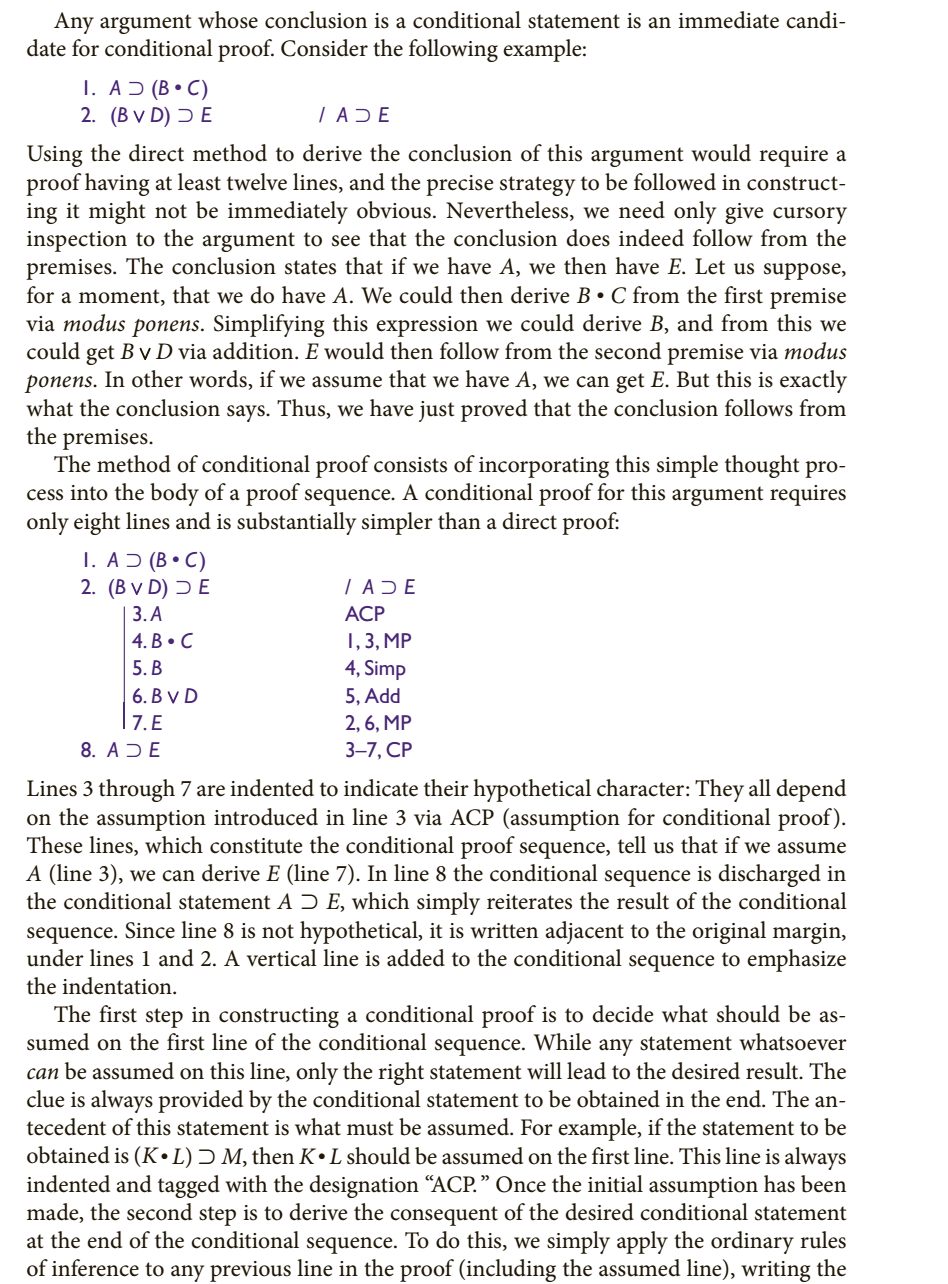
Any argument whose conclusion is a conditional statement is an immediate candi date for conditional proof. Consider the following example: I. A3(soC) 2. (BVD)3E IADE Using the direct method to derive the conclusion of this argument would require a proof having at least twelve lines, and the precise strategy to be followed in construct ing it might not be immediately obvious. Nevertheless, we need only give cursory inspection to the argument to see that the conclusion does indeed follow from the premises. The conclusion states that if we have A, we then have B. Let us suppose, for a moment, that we do have A. We could then derive B - C from the first premise via modus ponens. Simplifying this expression we could derive B, and from this we could get B v D via addition. B would then follow from the second premise via modus ponens. In other words, if we assume that we have A, we can get E. But this is exactly what the conclusion says. Thus, we have just proved that the conclusion follows from the premises. The method of conditional proof consists of incorporating this simple thought pro cess into the body of a proof sequence. A conditional proof for this argument requires only eight lines and is substantially simpler than a direct proof: I. AD(BC) 2. (BVD)3E EASE 3.A ACP 4.B-C l,3.MP 5.8 4,Simp 6.BVD 5,Add 7.E 2,6.MP 3. ADE 37.CP Lines 3 through 7 are indented to indicate their hypothetical character: They all depend on the assumption introduced in line 3 via ACP (assumption for conditional proof). These lines, which constitute the conditional proof sequence, tell us that if we assume A (line 3), we can derive B (line 7). In line 8 the conditional sequence is discharged in the conditional statement A 3 B, which simply reiterates the result of the conditional sequence. Since line 8 is not hypothetical, it is written adjacent to the original margin, under lines 1 and 2. A vertical line is added to the conditional sequence to emphasize the indentation. The first step in constructing a conditional proof is to decide what should be as sumed on the rst line of the conditional sequence. While any statement whatsoever can be assumed on this line, only the right statement will lead to the desired result. The clue is always provided by the conditional statement to be obtained in the end. The an tecedent of this statement is what must be assumed. For example, if the statement to be obtained is (K - L) I) M, then K - L should be assumed on the rst line. This line is always indented and tagged with the designation \"ACP. \" Once the initial assumption has been made, the second step is to derive the consequent of the desired conditional statement at the end of the conditional sequence. To do this, we simply apply the ordinary rules of inference to any previous line in the proof (including the assumed line), writing the
Step by Step Solution
There are 3 Steps involved in it
1 Expert Approved Answer
Step: 1 Unlock
Question Has Been Solved by an Expert!
Get step-by-step solutions from verified subject matter experts
Step: 2 Unlock
Step: 3 Unlock
Students Have Also Explored These Related Mathematics Questions!









 Study Help