







Question: Use the Euler method and fourth-order Runge Kutta algorithm to solve the following differential equations, and please compare the calculation accuracy of the two methods

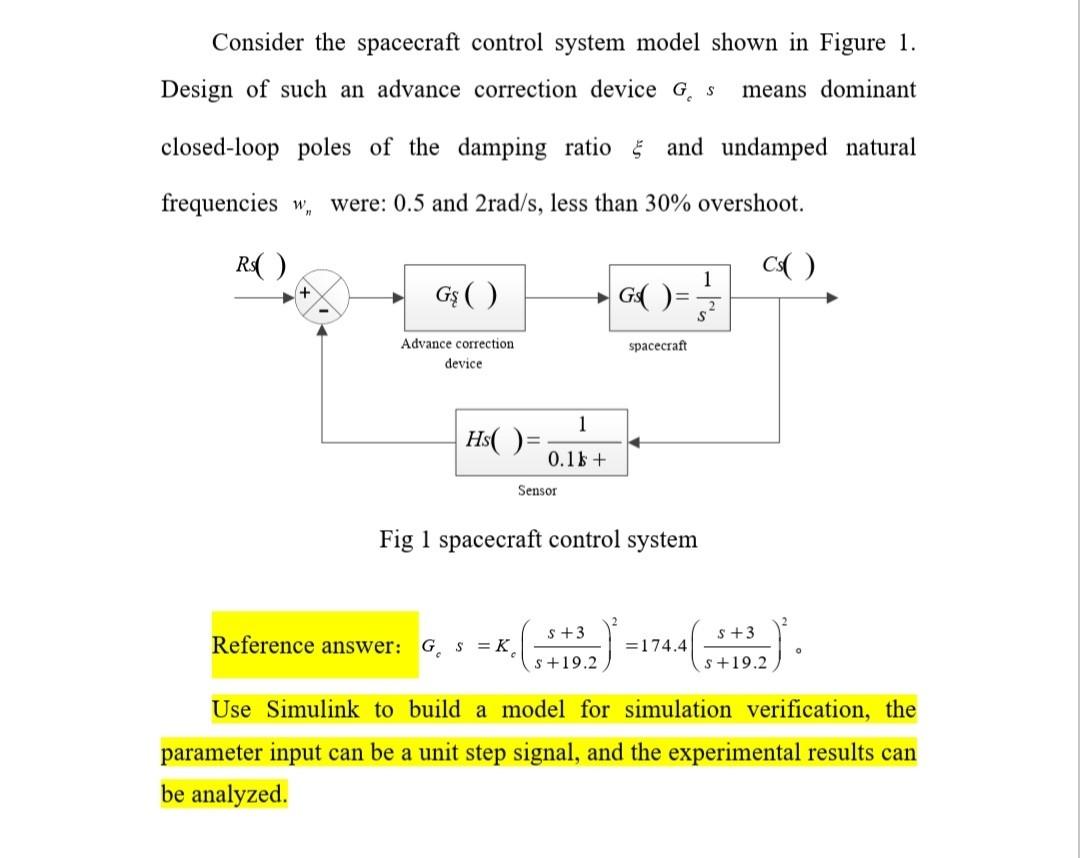
Use the Euler method and fourth-order Runge Kutta algorithm to solve the following differential equations, and please compare the calculation accuracy of the two methods 9 yo' = y; yi'=-y. -- (y2' =-y2 y,(0) = -1.0 y (0) =0.0 y (0) = 1.0 9 = 9 h=0.01 Consider the spacecraft control system model shown in Figure 1. Design of such an advance correction device GS means dominant closed-loop poles of the damping ratio & and undamped natural frequencies w, were: 0.5 and 2rad/s, less than 30% overshoot. RO) CO) 1 G () -605 GO Advance correction device spacecraft 1 Hs()= 0.11 + Sensor Fig 1 spacecraft control system S +3 S +3 Reference answer: GS = K = 174.4 S +19.2 S +19.2 Use Simulink to build a model for simulation verification, the parameter input can be a unit step signal, and the experimental results can be analyzed. Use the Euler method and fourth-order Runge Kutta algorithm to solve the following differential equations, and please compare the calculation accuracy of the two methods 9 yo' = y; yi'=-y. -- (y2' =-y2 y,(0) = -1.0 y (0) =0.0 y (0) = 1.0 9 = 9 h=0.01 Consider the spacecraft control system model shown in Figure 1. Design of such an advance correction device GS means dominant closed-loop poles of the damping ratio & and undamped natural frequencies w, were: 0.5 and 2rad/s, less than 30% overshoot. RO) CO) 1 G () -605 GO Advance correction device spacecraft 1 Hs()= 0.11 + Sensor Fig 1 spacecraft control system S +3 S +3 Reference answer: GS = K = 174.4 S +19.2 S +19.2 Use Simulink to build a model for simulation verification, the parameter input can be a unit step signal, and the experimental results can be analyzed
Step by Step Solution
There are 3 Steps involved in it

Get step-by-step solutions from verified subject matter experts
 Study Help