Question: Use the file below as a guide to creating the significance of the study of research entitled 'Factors leading to poor performance in Mathematics subject
Use the file below as a guide to creating the significance of the study of research entitled 'Factors leading to poor performance in Mathematics subject in Manaoag, Pangasinan.'
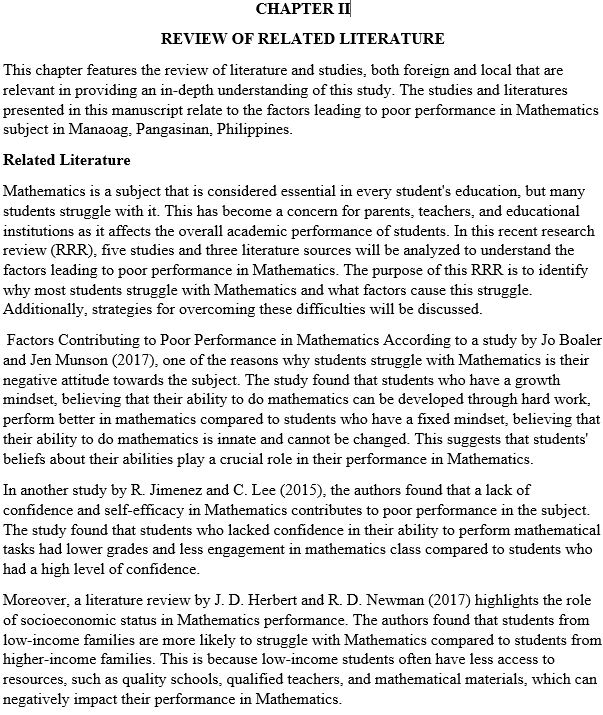
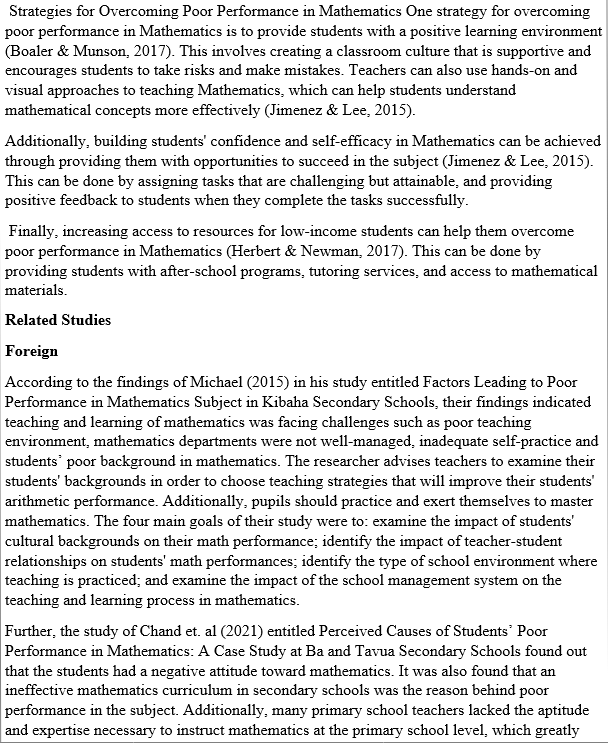
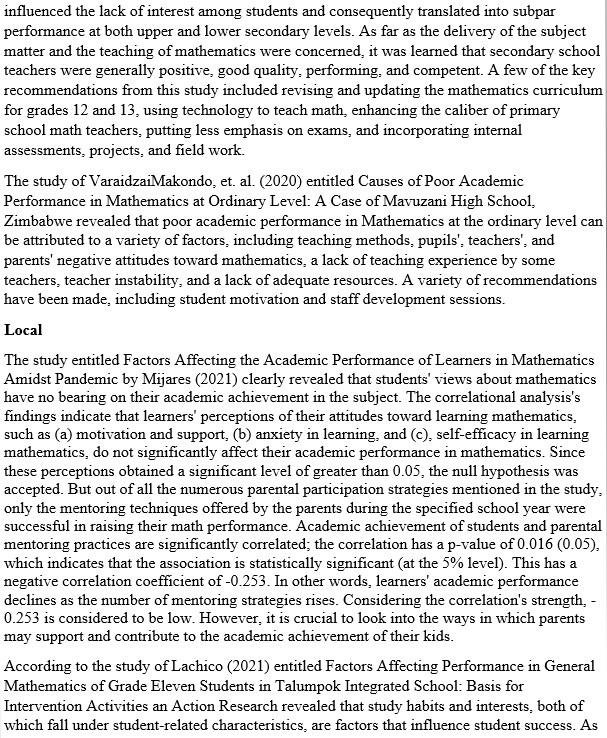
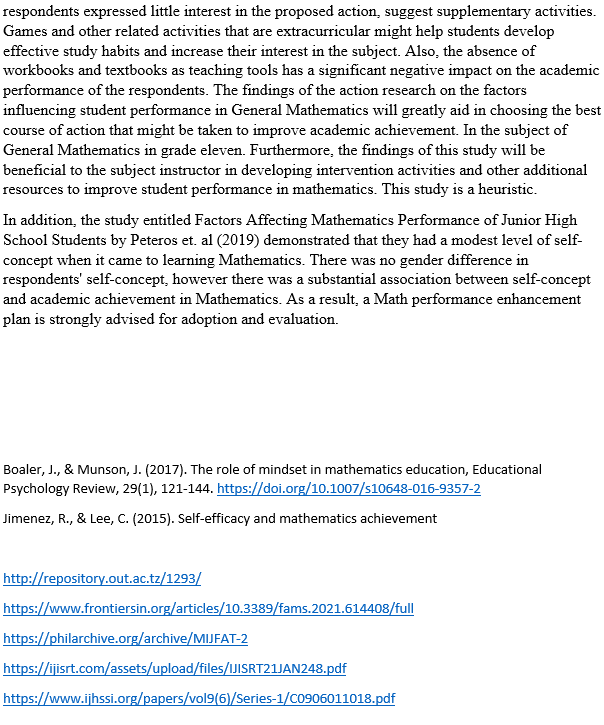
(SI-MPTER 111 REviEw or RELATED LITERATURE This chapter features the revieyl.r of literature and studies, both foreign and local that are relevant in providing an indepth understanding of this study. The studies and literatures presented in this manuscript relate to the factors leading to poor performance in Mathematics subject in Manaoag, Pangasinan, Philippines. Related Literature Mathematics is a subject that is considered essential in every student's education= but many students struggle with it. This has become a concern for parents, teachers, and educational institutions as it a'ects the overall academic performance of students. In this recent research review (ERR) five studies and three literature sources will be analyzed to understand the factors leading to poor performance in Mathematics. The purpose of this ERR is to identir why most students struggle with Mathematics and what factors cause this struggle. Additionally, strategies for overcoming these difficulties will be discussed. Factors Contributing to Poor Performance in Mathematics According to a study by Jo Boaler and Jen Munson (201?), one of the reasons why students struggle with Mathematics is their negative attitude towards the subject. The study found that students who have a growth mindset, believing that their ability to do mathematics can be developed through hard worlr, perform better in mathematics compared to students who have a fixed mindset, believing that their ability to do mathematics is innate and carmot be changed. This suggests that studentsr beliefs about their abilities play a crucial role in their performance in Mathematics. In another study by R. Jimenez and C. Lee {2015), the authors found that a lack of condence and self-efficacy in Mathematics contributes to poor performance in the subject. The study found that students who lacked confidence in their ability to perform mathematical tasks had lower grades and less engagement in mathematics class compared to students who had a high level of confidence. Moreover, a literature review by I. D. Herbert and R. D. Newman {21]1?) highlights the role of socioeconomic status in Mathematics performance. The authors found that students from lowincome families are more likely to struggle with Mathematics compared to students from higherincome families. This is because lowincome students often have less access to resources, such as qualityr schools, qualied teachers, and mathematical materials, which can negatively impact their performance in Mathematics. Strategies for Overcoming Poor Performance in Mathematics One strategy for overcoming poor performance in l'v'lathematics is to provide students with a positive learning environment (Boaler dc Munson, 2131?). This involves creating a classroom culture that is supportive and encourages students to take risks and make mistakes. Teachers can also use handson and visual approaches to teaching Mathematics, which can help students understand mathematical concepts more effectively {Jimenez 35 Lee, 21315). Additionally, building students' condence and selfercacy in Mathematics can be achieved through providing them with opportunities to succeed in the subject {Jimenez 3: Lee, 2'315}. This can be done by assigning tasks that are challenging but attainable, and providing positive feedback to students when they complete the tasks successrlly. Finally, increasing access to resources for lowincome students can help them overcome poor performance in l'v'lathematics {Herbert S: Newman, 2131?). This can be done by providing students with after-school programs, tutoring services, and access to mathematical materials. Related Studies Foreign According to the ndings of Michael (2015) in his study entitled Factors Leading to Poor Performance in Mathematics Subject in Kibaha Secondary Schools, their ndings indicated teaching and learning of mathematics was facing challenges such as poor teaching environment, mathematics departments were not wellmanaged= inadequate selfpractice and students= poor backgron in mathematics. The researcher advises teachers to examine their studentsr backgrounds in order to choose teaching strategies that will improve their students' arithmetic performance. Additionally, pupils should practice and exert themselves to master mathematics. The four main goals of their study were to: examine the impact of studentsr cultural backgrounds on their math performance; identify the impact of teacher student relationships on students' math performances; identify the type of school environment where teaching is practiced; and examine the impact of the school management system on the teaching and learning process in mathematics. Further, the study of lChand et. al (2132]) entitled Perceived Causes of Students' Poor Performance in Mathematics: A Case Study at Ba and Tavua Secondary Schools found out that the students had a negative attitude toward mathematics. It was also found that an ine'ective mathematics curriculum in secondary schools was the reason behind poor performance in the subject. Additionally, many primary school teachers lacked the aptitude . and expertise necessary to instruct mathematics at the primary school level, which greatly influenced the lack of interest among students and consequently translated into subpar performance at both upper and lower secondary levels. As far as the delivery of the subject matter and the teaching of mathematics were concerned, it was learned that secondary school teachers were generally positive, good quality, performing, and competent. A few of the key recommendations from this study included revising and updating the mathematics curriculum for grades 12 and 13, using technology to teach math, enhancing the caliber of primary school math teachers, putting less emphasis on exams, and incorporating internal assessments, projects, and field work. The study of VaraidzaiMakondo, et. al. (2020) entitled Causes of Poor Academic Performance in Mathematics at Ordinary Level: A Case of Mavuzani High School, Zimbabwe revealed that poor academic performance in Mathematics at the ordinary level can be attributed to a variety of factors, including teaching methods, pupils', teachers', and parents' negative attitudes toward mathematics, a lack of teaching experience by some teachers, teacher instability, and a lack of adequate resources. A variety of recommendations have been made, including student motivation and staff development sessions. Local The study entitled Factors Affecting the Academic Performance of Learners in Mathematics Amidst Pandemic by Mijares (2021) clearly revealed that students' views about mathematics have no bearing on their academic achievement in the subject. The correlational analysis's findings indicate that learners perceptions of their attitudes toward learning mathematics, such as (a) motivation and support, (b) anxiety in learning, and (c), self-efficacy in learning mathematics, do not significantly affect their academic performance in mathematics. Since these perceptions obtained a significant level of greater than 0.05, the null hypothesis was accepted. But out of all the numerous parental participation strategies mentioned in the study, only the mentoring techniques offered by the parents during the specified school year were successful in raising their math performance. Academic achievement of students and parental mentoring practices are significantly correlated; the correlation has a p-value of 0.016 (0.05), which indicates that the association is statistically significant (at the 5% level). This has a negative correlation coefficient of -0.253. In other words, learners' academic performance declines as the number of mentoring strategies rises. Considering the correlation's strength, - 0.253 is considered to be low. However, it is crucial to look into the ways in which parents may support and contribute to the academic achievement of their kids. According to the study of Lachico (2021) entitled Factors Affecting Performance in General Mathematics of Grade Eleven Students in Talumpok Integrated School: Basis for Intervention Activities an Action Research revealed that study habits and interests, both of which fall under student-related characteristics, are factors that influence student success. Asrespondents expressed little interest in the proposed action, suggest supplemental}r activities. Games and other related activities that are extracurricular might help students develop effective stud}; habits and increase their interest in the subject. Also= the absence of workbooks and textbooks as teaching tools has a signicant negative impact on the academic performance of the respondents. The findings of the action re search on the factors inuencing student performance in General Mathematics will greatly aid in choosing the best course of action that might be talren to improve academic achievement. In the subject of General Dvlalematics in grade eleven. Furthermore= the ndings of this study will be beneficial to the subject instructor in developing intervention activities and other additional resources to improve student performance in mathematics. This study is aheuristic. In addition, the study entitled Factors Affecting I'vlathematics Performance of Junior High School Students by Peteros et. al (2019) demonstrated that the}: had a modest level of self concept when it came to learning Mathematics. There was no gender difference in respondents' self-concept, however there was a substantial association between selfcone ept and academic achievement in Mathematics. As a result, a Math performance enhancement plan is strongly advised for adoption and evaluation. Boaler, 1., Es Manson, J. {201?}. The role of mindset in mathematics education, Educational Psychology Review, 29(1), 121144. htt s: doi.or 10.100?r 51054801663512 Jimenez, Ft, 0 Lee, C. {2015}. selfefficacy.f and mathematics achievement htt : re ositor .out.ac.tz 1293 https://www.iejme.com/download/factors-affecting-mathematics-performance-of-junior-high- school-students-5938.pdf
Step by Step Solution
There are 3 Steps involved in it
1 Expert Approved Answer
Step: 1 Unlock
Question Has Been Solved by an Expert!
Get step-by-step solutions from verified subject matter experts
Step: 2 Unlock
Step: 3 Unlock
Students Have Also Explored These Related Accounting Questions!










 Study Help