







Question: Use the following case study to answer the questions below What were Musks and Eberhards goals in founding Tesla? How would you characterize competition in
Use the following case study to answer the questions below


- What were Musks and Eberhards goals in founding Tesla?
- How would you characterize competition in the auto industry?
- What do you think are Teslas core competencies? Does it have any sources of sustainable competitive advantage?
- What is your assessment of Teslas moves into a) mass-market cars, b) batteries (car batteries and Powerwall), c) solar panels? Please consider both the motivation for the moves, and the opportunities and challenges for Tesla to compete in these businesses.
- Do you think Tesla will be profitable in all of these businesses? Why or why not?
- What do you think Teslas (or Elon Musks) strategic intent is?
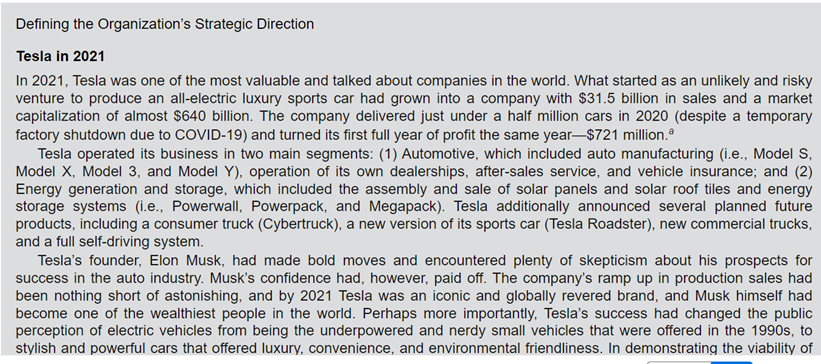
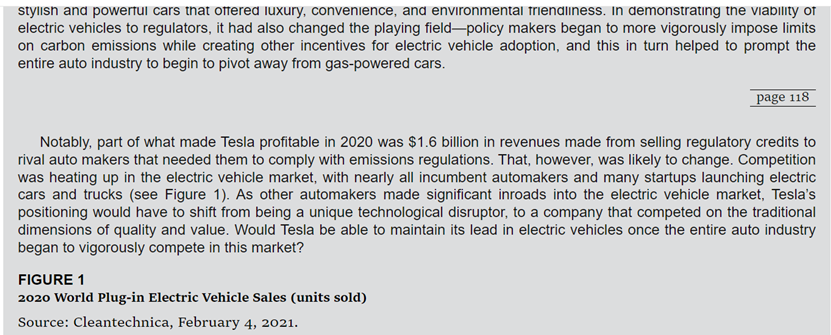
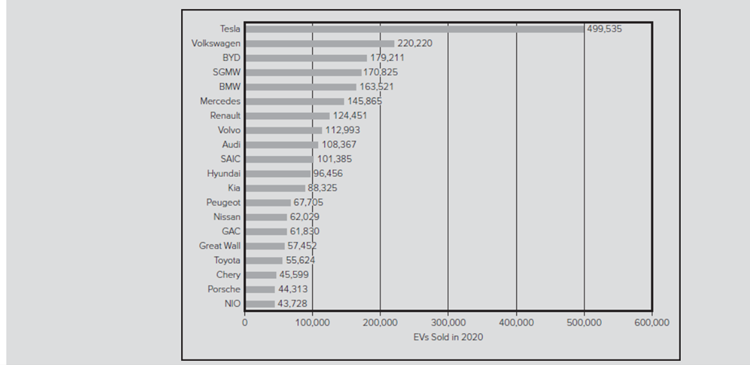
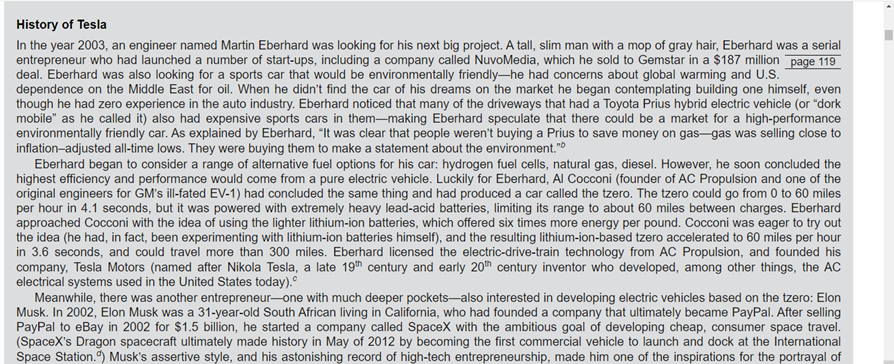
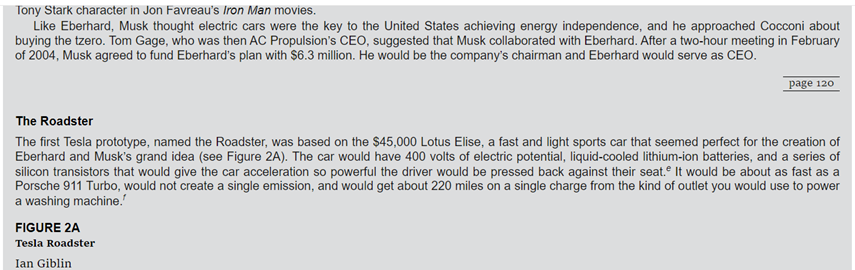
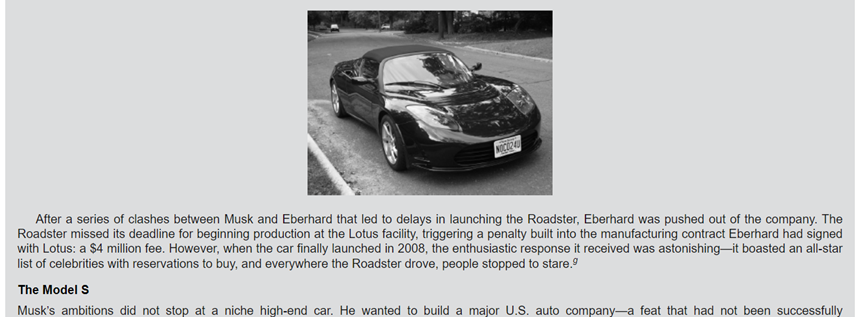
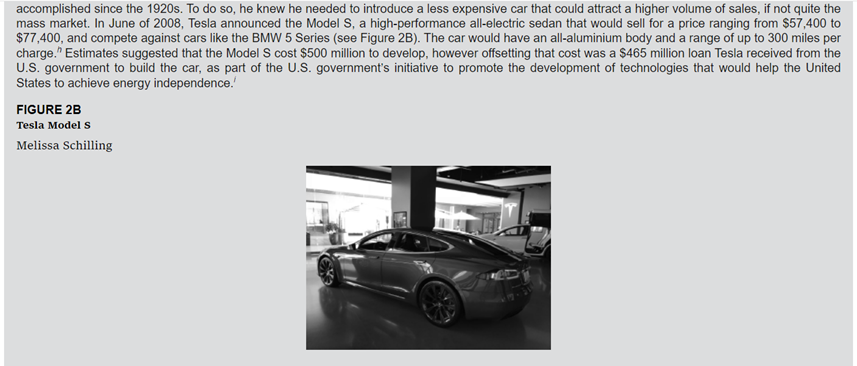
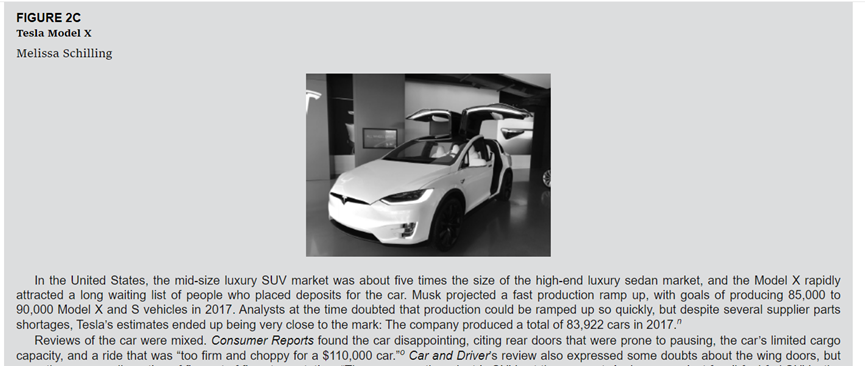
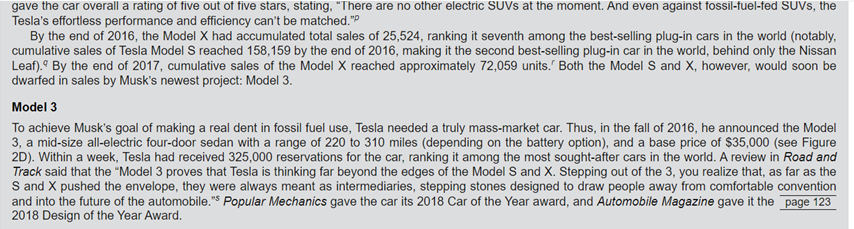
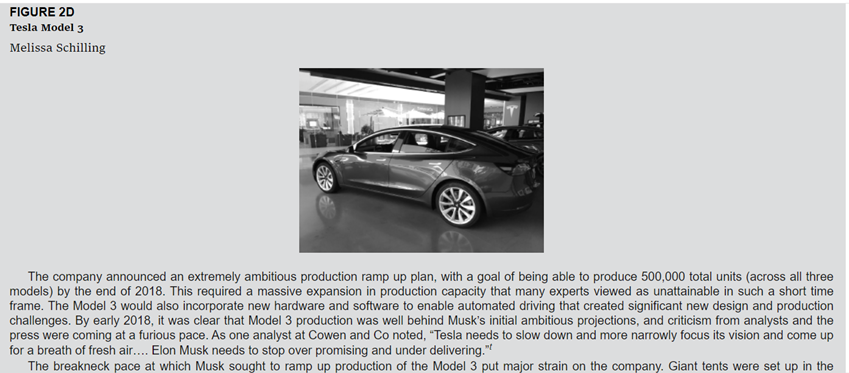
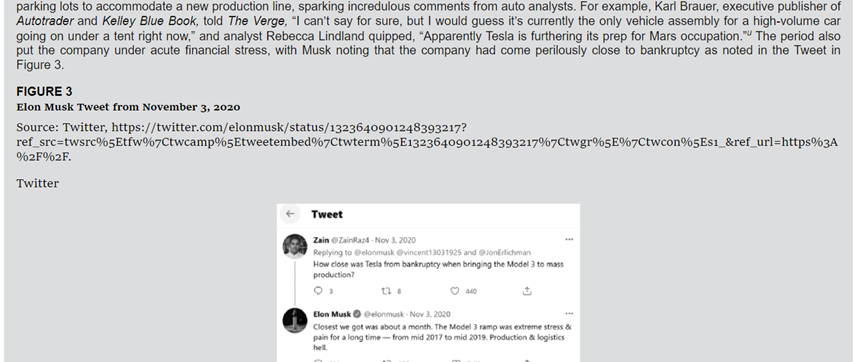
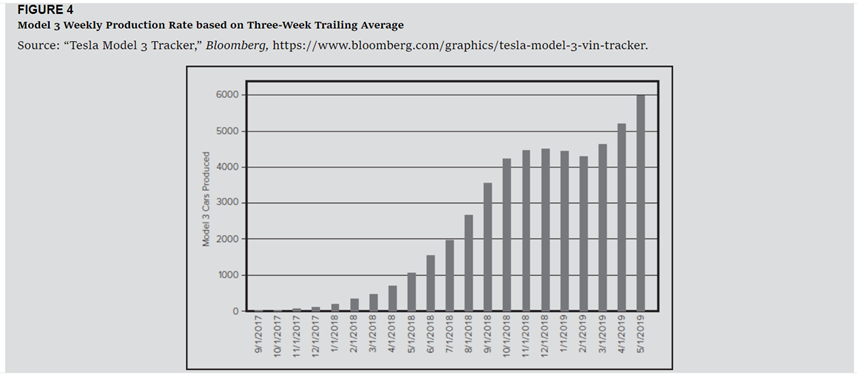
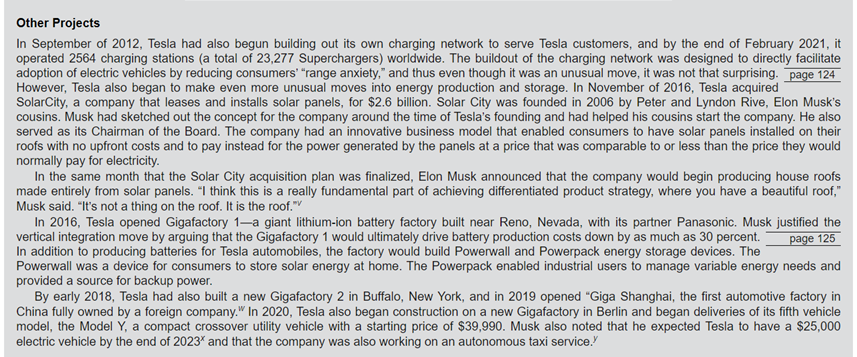
Defining the Organization's Strategic Direction Tesla in 2021 In 2021, Tesla was one of the most valuable and talked about companies in the world. What started as an unlikely and risky venture to produce an all-electric luxury sports car had grown into a company with $31.5 billion in sales and a market capitalization of almost $640 billion. The company delivered just under a half million cars in 2020 (despite a temporary factory shutdown due to COVID-19) and turned its first full year of profit the same year- $721 million. Tesla operated its business in two main segments: (1) Automotive, which included auto manufacturing (i.e., Model S, Model X, Model 3, and Model Y), operation of its own dealerships, after-sales service, and vehicle insurance; and (2) Energy generation and storage, which included the assembly and sale of solar panels and solar roof tiles and energy storage systems (i.e., Powerwall, Powerpack, and Megapack). Tesla additionally announced several planned future products, including a consumer truck (Cybertruck), a new version of its sports car (Tesla Roadster), new commercial trucks, and a full self-driving system. Tesla's founder, Elon Musk, had made bold moves and encountered plenty of skepticism about his prospects for success in the auto industry. Musk's confidence had, however, paid off. The company's ramp up in production sales had been nothing short of astonishing, and by 2021 Tesla was an iconic and globally revered brand, and Musk himself had become one of the wealthiest people in the world. Perhaps more importantly, Tesla's success had changed the public perception of electric vehicles from being the underpowered and nerdy small vehicles that were offered in the 1990 s, to stylish and powerful cars that offered luxury, convenience, and environmental friendliness. In demonstrating the viability of stys and powertul cars that ortered Iuxury, convenence, and environmental triendness. In demonstratng the viability or electric vehicles to regulators, it had also changed the playing field-policy makers began to more vigorously impose limits on carbon emissions while creating other incentives for electric vehicle adoption, and this in turn helped to prompt the entire auto industry to begin to pivot away from gas-powered cars. page 118 Notably, part of what made Tesla profitable in 2020 was $1.6 billion in revenues made from selling regulatory credits to rival auto makers that needed them to comply with emissions regulations. That, however, was likely to change. Competition was heating up in the electric vehicle market, with nearly all incumbent automakers and many startups launching electric cars and trucks (see Figure 1). As other automakers made significant inroads into the electric vehicle market, Tesla's positioning would have to shift from being a unique technological disruptor, to a company that competed on the traditional dimensions of quality and value. Would Tesla be able to maintain its lead in electric vehicles once the entire auto industry began to vigorously compete in this market? FIGURE 1 2020 World Plug-in Electric Vehicle Sales (units sold) Source: Cleantechnica, February 4, 2021. History of Tesla In the year 2003, an engineer named Martin Eberhard was looking for his next big project. A tall, slim man with a mop of gray hair, Eberhard was a serial entrepreneur who had launched a number of start-ups, including a company called NuvoMedia, which he sold to Gemstar in a $187 million page 119 deal. Eberhard was also looking for a sports car that would be environmentally friendly - he had concerns about global warming and U.S. dependence on the Middle East for oil. When he didn't find the car of his dreams on the market he began contemplating building one himself, even though he had zero experience in the auto industry. Eberhard noticed that many of the driveways that had a Toyota Prius hybrid electric vehicle (or "dork mobile" as he called it) also had expensive sports cars in them-making Eberhard speculate that there could be a market for a high-performance environmentally friendly car. As explained by Eberhard, "It was clear that people weren't buying a Prius to save money on gas - gas was selling close to inflation-adjusted all-time lows. They were buying them to make a statement about the environment." b Eberhard began to consider a range of alternative fuel options for his car: hydrogen fuel cells, natural gas, diesel. However, he soon concluded the highest efficiency and performance would come from a pure electric vehicle. Luckily for Eberhard, Al Cocconi (founder of AC Propulsion and one of the original engineers for GM's ill-fated EV-1) had concluded the same thing and had produced a car called the tzero. The tzero could go from 0 to 60 miles per hour in 4.1 seconds, but it was powered with extremely heavy lead-acid batteries, limiting its range to about 60 miles between charges. Eberhard approached Cocconi with the idea of using the lighter lithium-ion batteries, which offered six times more energy per pound. Cocconi was eager to try out the idea (he had, in fact, been experimenting with lithium-ion batteries himself), and the resulting lithium-ion-based tzero accelerated to 60 miles per hour in 3.6 seconds, and could travel more than 300 miles. Eberhard licensed the electric-drive-train technology from AC Propulsion, and founded his company, Tesla Motors (named after Nikola Tesla, a late 19th century and early 20th century inventor who developed, among other things, the AC electrical systems used in the United States today). c Meanwhile, there was another entrepreneur-one with much deeper pockets-also interested in developing electric vehicles based on the tzero: Elon Musk. In 2002, Elon Musk was a 31-year-old South African living in California, who had founded a company that ultimately became PayPal. After selling PayPal to eBay in 2002 for $1.5 billion, he started a company called SpaceX with the ambitious goal of developing cheap, consumer space travel. (SpaceX's Dragon spacecraft ultimately made history in May of 2012 by becoming the first commercial vehicle to launch and dock at the International Space Station. ) Musk's assertive style, and his astonishing record of high-tech entrepreneurship, made him one of the inspirations for the portrayal of Tony Stark character in Jon Favreau's Iron Man movies. Like Eberhard, Musk thought electric cars were the key to the United States achieving energy independence, and he approached Cocconi about buying the tzero. Tom Gage, who was then AC Propulsion's CEO, suggested that Musk collaborated with Eberhard. After a two-hour meeting in February of 2004, Musk agreed to fund Eberhard's plan with \$6.3 million. He would be the company's chairman and Eberhard would serve as CEO. page 120 The Roadster The first Tesla prototype, named the Roadster, was based on the $45,000 Lotus Elise, a fast and light sports car that seemed perfect for the creation of Eberhard and Musk's grand idea (see Figure 2A). The car would have 400 volts of electric potential, liquid-cooled lithium-ion batteries, and a series of silicon transistors that would give the car acceleration so powerful the driver would be pressed back against their seat. e It would be about as fast as a Porsche 911 Turbo, would not create a single emission, and would get about 220 miles on a single charge from the kind of outlet you would use to power a washing machine.' FIGURE 2A Tesla Roadster After a series of clashes between Musk and Eberhard that led to delays in launching the Roadster, Eberhard was pushed out of the company. The Roadster missed its deadline for beginning production at the Lotus facility, triggering a penalty built into the manufacturing contract Eberhard had signed with Lotus: a \$4 million fee. However, when the car finally launched in 2008, the enthusiastic response it received was astonishing - it boasted an all-star list of celebrities with reservations to buy, and everywhere the Roadster drove, people stopped to stare. 9 The Model S Musk's ambitions did not stop at a niche high-end car. He wanted to build a maior U.S. auto company-a feat that had not been successfully accomplished since the 1920 s. To do so, he knew he needed to introduce a less expensive car that could attract a higher volume of sales, if not quite the mass market. In June of 2008, Tesla announced the Model S, a high-performance all-electric sedan that would sell for a price ranging from \$57,400 to $77,400, and compete against cars like the BMW 5 Series (see Figure 2B). The car would have an all-aluminium body and a range of up to 300 miles per charge. " Estimates suggested that the Model $ cost $500 million to develop, however offsetting that cost was a $465 million loan Tesla received from the U.S. government to build the car, as part of the U.S. government's initiative to promote the development of technologies that would help the United States to achieve energy independence. FIGURE 2B Tesla Model s Melissa Schilling To build the car, Tesla bought a recently closed automobile factory in Fremont California that had been used for the New United Motor Manufacturing Inc. (NUMMI) venture between Toyota and General Motors. The factory, which was capable of producing 1000 cars a week, was far bigger than Tesla's immediate needs and would give the company room to grow. Furthermore, though the plant and the land it was on had been appraised at around $1 billion before NUMMI was shut down, Tesla was able to snap up the idled factory for $42 million. Tesla also used the factory to produce battery packs for Toyota's RAV4, and a charger for a subcompact Daimler AG electric vehicle. These projects supplemented Tesla's income while also helping it to build scale and learning-curve efficiencies in its technologies. In the first quarter of 2013, Tesla announced its first quarterly profit. The company had taken in $562 million in revenues, and reported an $11.2 million profit. Then more good news came: the Model S had earned Consumer Reports' highest rating, and had outsold similarly priced BMW and Mercedes models in the first quarter. k In May of 2013, the company raised $1 billion by issuing new shares, and then surprised investors by announcing that it had paid back its government loan. After repaying the loan, Tesla had about $679 million in cash. Musk had announced confidently that he felt it was his obligation to pay back taxpayer money as soon as possible, and that the company had sufficient funds now to develop its next generation of automobiles without the loan, and without issuing further shares.' page 122 Model X The Model X, unveiled in 2015, was designed as a high-end sport utility vehicle (SUV) that seats seven. It had several distinctive features that set it apart from the crowded luxury SUV market (Figure 2C). In addition to being all-electric and able to go from 0 to 60 miles per hour in just 3.2 seconds, it featured a panoramic windshield and distinctive gull-wing doors (that open upward rather than swinging out) that open automatically in response to the driver's approach. "It will triangulate my position," Musk said, "It will open the front door without touching. When you sit down, it will close the door." The Model X had a range of about 250 miles (like the Model $ ) but could tow 5000 pounds. Its selling price would start at $70,000 but could exceed $100,000 depending on the options selected. FIGURE 2C Tesla Model X Melissa Schilling In the United States, the mid-size luxury SUV market was about five times the size of the high-end luxury sedan market, and the Model X rapidly attracted a long waiting list of people who placed deposits for the car. Musk projected a fast production ramp up, with goals of producing 85,000 to 90,000 Model X and S vehicles in 2017. Analysts at the time doubted that production could be ramped up so quickly, but despite several supplier parts shortages, Tesla's estimates ended up being very close to the mark: The company produced a total of 83,922 cars in 2017." Reviews of the car were mixed. Consumer Reports found the car disappointing, citing rear doors that were prone to pausing, the car's limited cargo capacity, and a ride that was "too firm and choppy for a $110,000 car. m0 Car and Driver's review also expressed some doubts about the wing doors, but Tesla's effortless performance and efficiency can't be matched."p By the end of 2016, the Model X had accumulated total sales of 25,524, ranking it seventh among the best-selling plug-in cars in the world (notably, cumulative sales of Tesla Model S reached 158,159 by the end of 2016, making it the second best-selling plug-in car in the world, behind only the Nissan Leaf). 9 By the end of 2017, cumulative sales of the Model X reached approximately 72,059 units.' Both the Model S and X, however, would soon be dwarfed in sales by Musk's newest project: Model 3. Model 3 To achieve Musk's goal of making a real dent in fossil fuel use, Tesla needed a truly mass-market car. Thus, in the fall of 2016, he announced the Model 3 , a mid-size all-electric four-door sedan with a range of 220 to 310 miles (depending on the battery option), and a base price of $35,000 (see Figure 2D). Within a week, Tesla had received 325,000 reservations for the car, ranking it among the most sought-after cars in the world. A review in Road and Track said that the "Model 3 proves that Tesla is thinking far beyond the edges of the Model S and X. Stepping out of the 3 , you realize that, as far as the S and X pushed the envelope, they were always meant as intermediaries, stepping stones designed to draw people away from comfortable convention and into the future of the automobile.".5 Popular Mechanics gave the car its 2018 Car of the Year award, and Automobile Magazine gave it the page 123 2018 Design of the Year Award. FIGURE 2D Tesla Model 3 Melissa Schilling The company announced an extremely ambitious production ramp up plan, with a goal of being able to produce 500,000 total units (across all three models) by the end of 2018. This required a massive expansion in production capacity that many experts viewed as unattainable in such a short time frame. The Model 3 would also incorporate new hardware and software to enable automated driving that created significant new design and production challenges. By early 2018, it was clear that Model 3 production was well behind Musk's initial ambitious projections, and criticism from analysts and the press were coming at a furious pace. As one analyst at Cowen and Co noted, "Tesla needs to slow down and more narrowly focus its vision and come up for a breath of fresh air.... Elon Musk needs to stop over promising and under delivering."t The breakneck pace at which Musk sought to ramp up production of the Model 3 put major strain on the company. Giant tents were set up in the parking lots to accommodate a new production line, sparking incredulous comments from auto analysts. For example, Karl Brauer, executive publisher of Autotrader and Kelley Blue Book, told The Verge, "I can't say for sure, but I would guess it's currently the only vehicle assembly for a high-volume car going on under a tent right now," and analyst Rebecca Lindland quipped, "Apparently Tesla is furthering its prep for Mars occupation." The period also put the company under acute financial stress, with Musk noting that the company had come perilously close to bankruptcy as noted in the Tweet in Figure 3. FIGURE 3 Elon Musk Tweet from November 3,2020 Source: Twitter, https://twitter.com/elonmusk/status/1323640901248393217? ref_src = twsrc %5 Etfw %7 Ctwcamp %5 Etweetembed %7 Ctwterm %5 E1323640901248393217 %7 Ctwgr %5 E %7 Ctwcon %5 Es1_\&ref_url = https %3 A %2F%2F. Twitter Tweet Zain CZainRan4 - Nov 3, 2020 Replying to Qelonmusk Qvincent13031925 and QJonErlichman How close was Tesla from barknuptcy when bringing the Model 3 to mass production? 3 440 Elon Musk Q Qellonmusk - Nov 3, 2020 Closest we got was about a month. The Model 3 ramp was extreme stress & pain for a long time - from mid 2017 to mid 2019. Production 8 logistics hel. Though it took longer to achieve Musk's goal of more than 5000 cars per week than initially hoped, Tesla did hit the production target by April 1,2019 (see Figure 4), an undeniably impressive exponential ramp up. Model 3 Weekly Production Rate based on Three-Week Trailing Average Source: "Tesla Model 3 Tracker," Bloomberg, https://www.bloomberg.com/graphics/tesla-model-3-vin-tracker. In September of 2012, Tesla had also begun building out its own charging network to serve Tesla customers, and by the end of February 2021, it operated 2564 charging stations (a total of 23,277 Superchargers) worldwide. The buildout of the charging network was designed to directly facilitate adoption of electric vehicles by reducing consumers' "range anxiety," and thus even though it was an unusual move, it was not that surprising. "page 124 However, Tesla also began to make even more unusual moves into energy production and storage. In November of 2016, Tesla acquired SolarCity, a company that leases and installs solar panels, for \$2.6 billion. Solar City was founded in 2006 by Peter and Lyndon Rive, Elon Musk's cousins. Musk had sketched out the concept for the company around the time of Tesla's founding and had helped his cousins start the company. He also served as its Chairman of the Board. The company had an innovative business model that enabled consumers to have solar panels installed on their roofs with no upfront costs and to pay instead for the power generated by the panels at a price that was comparable to or less than the price they would normally pay for electricity. In the same month that the Solar City acquisition plan was finalized, Elon Musk announced that the company would begin producing house roofs made entirely from solar panels. "I think this is a really fundamental part of achieving differentiated product strategy, where you have a beautiful roof," Musk said. "It's not a thing on the roof. It is the roof." In 2016, Tesla opened Gigafactory 1-a giant lithium-ion battery factory built near Reno, Nevada, with its partner Panasonic. Musk justified the vertical integration move by arguing that the Gigafactory 1 would ultimately drive battery production costs down by as much as 30 percent. In addition to producing batteries for Tesla automobiles, the factory would build Powerwall and Powerpack energy storage devices. The Powerwall was a device for consumers to store solar energy at home. The Powerpack enabled industrial users to manage variable energy needs and provided a source for backup power. By early 2018, Tesla had also built a new Gigafactory 2 in Buffalo, New York, and in 2019 opened "Giga Shanghai, the first automotive factory in China fully owned by a foreign company. w In 2020 , Tesla also began construction on a new Gigafactory in Berlin and began deliveries of its fifth vehicle model, the Model Y, a compact crossover utility vehicle with a starting price of $39,990. Musk also noted that he expected Tesla to have a $25,000 electric vehicle by the end of 2023x and that the company was also working on an autonomous taxi service. y Tesla's cars had rapidly attracted a large and loyal fan base, and sales were growing at an impressive rate. However, designing and launching multiple major car platforms while building a large-scale battery company, a network of charging stations, and operating Solar City was a lot for a company to take on in its first fifteen years. This left some analysts scratching their heads. Was Tesla trying to do too much too quickly
Step by Step Solution
There are 3 Steps involved in it

Get step-by-step solutions from verified subject matter experts
 Study Help