







Question: Use the following image (only if needed), to answer the T/F question below. QUESTION: The sum of cost of goods sold and ending inventory may
Use the following image (only if needed), to answer the T/F question below.
QUESTION:
The sum of cost of goods sold and ending inventory may equal or exceed goods available for sale.
o True
o False
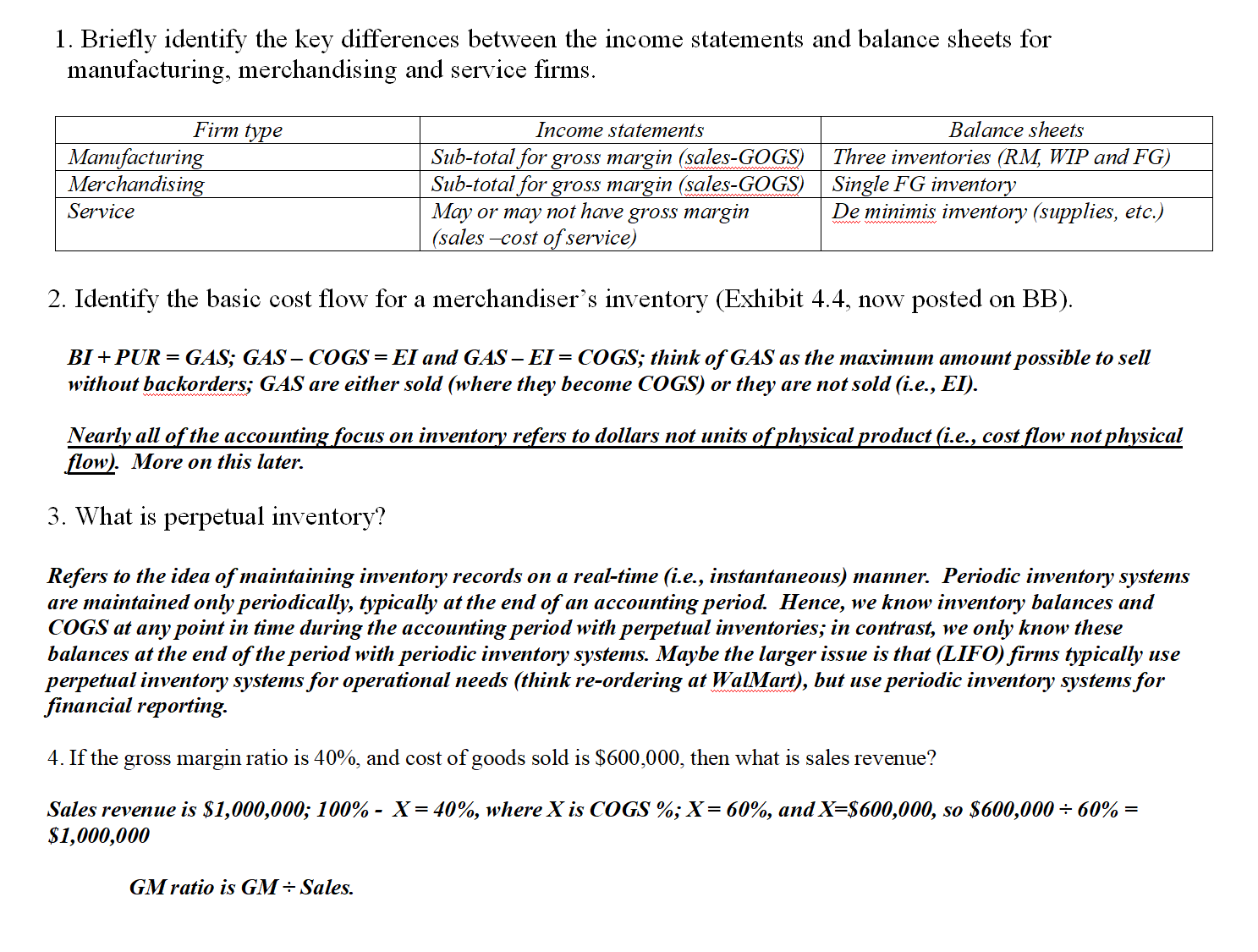
1. Briefly identify the key differences between the income statements and balance sheets for manufacturing, merchandising and service firms. Firm type Manufacturing Merchandising Service Income statements Balance sheets Sub-total for gross margin (sales-GOGS) Three inventories (RM, WIP and FG) Sub-total for gross margin (sales-GOGS) Single FG inventory May or may not have gross margin De minimis inventory (supplies, etc.) (sales -cost of service) 2. Identify the basic cost flow for a merchandiser's inventory (Exhibit 4.4, now posted on BB). BI + PUR = GAS; GAS COGS = EI and GAS EI = COGS; think of GAS as the maximum amount possible to sell without backorders; GAS are either sold (where they become COGS) or they are not sold (i.e., EI). Nearly all of the accounting focus on inventory refers to dollars not units of physical product (i.e., cost flow not physical flow). More on this later. 3. What is perpetual inventory? Refers to the idea of maintaining inventory records on a real-time (i.e., instantaneous) manner. Periodic inventory systems are maintained only periodically, typically at the end of an accounting period. Hence, we know inventory balances and COGS at any point in time during the accounting period with perpetual inventories; in contrast, we only know these balances at the end of the period with periodic inventory systems. Maybe the larger issue is that (LIFO) firms typically use perpetual inventory systems for operational needs (think re-ordering at WalMart), but use periodic inventory systems for financial reporting. 4. If the gross margin ratio is 40%, and cost of goods sold is $600,000, then what is sales revenue? Sales revenue is $1,000,000; 100% - X = 40%, where X is COGS %; X = 60%, and X=$600,000, so $600,000 = 60% = $1,000,000 GM ratio is GM - Sales
Step by Step Solution
There are 3 Steps involved in it

Get step-by-step solutions from verified subject matter experts
 Study Help