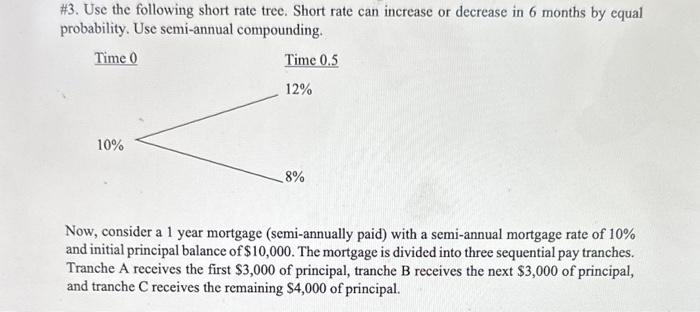
Question: Use the following short rate tree. Short rate can increase or decrease in 6 months by equal probability. Use semi-annual compounding. Time 0 Time 0.5

Use the following short rate tree. Short rate can increase or decrease in 6 months by equal probability. Use semi-annual compounding.

Time 0 Time 0.5

10%-12%-8%

Now, consider a 1 year mortgage (semi-annually paid) with a semi-annual mortgage rate of 10% and initial principal balance of $10,000. The mortgage is divided into three sequential pay tranches. Tranche A receives the first $3,000 of principal, tranche B receives the next $3,000 of principal, and tranche C receives the remaining $4,000 of principal. ( it is urgent! pls help me!)
Use the following short rate tree. Short rate can
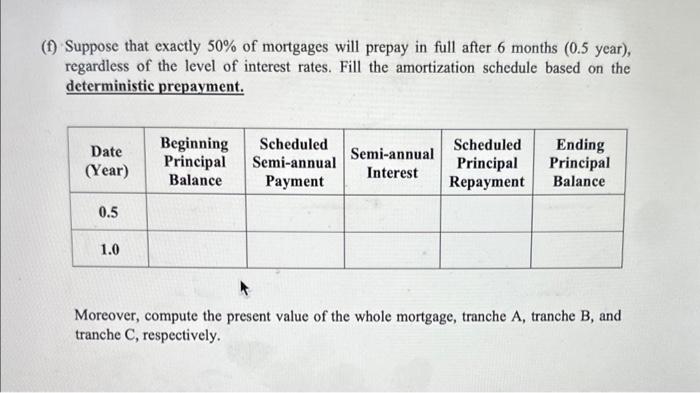
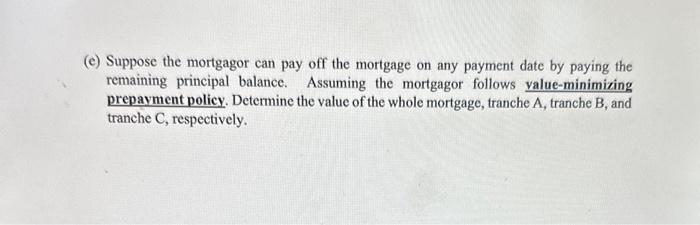
\#3. Use the following short rate tree. Short rate can increase or decrease in 6 months by equal probability. Use semi-annual compounding. Now, consider a 1 year mortgage (semi-annually paid) with a semi-annual mortgage rate of 10% and initial principal balance of $10,000. The mortgage is divided into three sequential pay tranches. Tranche A receives the first $3,000 of principal, tranche B receives the next $3,000 of principal, and tranche C receives the remaining $4,000 of principal. e) Suppose the mortgagor can pay off the mortgage on any payment date by paying the remaining principal balance. Assuming the mortgagor follows yalue-minimixing prepayment policy. Determine the value of the whole mortgage, tranche A, tranche B, and tranche C, respectively. (f) Suppose that exactly 50% of mortgages will prepay in full after 6 months ( 0.5 year), regardless of the level of interest rates. Fill the amortization schedule based on the deterministic prepayment. Moreover, compute the present value of the whole mortgage, tranche A, tranche B, and tranche C, respectively

Step by Step Solution

There are 3 Steps involved in it

1 Expert Approved Answer
Step: 1 Unlock blur-text-image

Question Has Been Solved by an Expert!

Get step-by-step solutions from verified subject matter experts

Step: 2 Unlock
Step: 3 Unlock

Students Have Also Explored These Related General Management Questions!