







Question: Use the information in #2 to answer #5 2. Mass balance on primary treatment: A 3000 m/d wastewater is treated by primary sedimentation before being
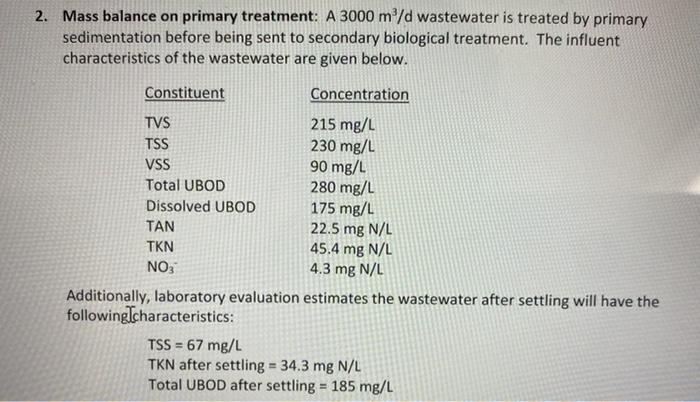

2. Mass balance on primary treatment: A 3000 m/d wastewater is treated by primary sedimentation before being sent to secondary biological treatment. The influent characteristics of the wastewater are given below. Constituent Concentration TVS 215 mg/L TSS 230 mg/L VSS 90 mg/L Total UBOD 280 mg/L Dissolved UBOD 175 mg/L TAN 22.5 mg N/L TKN 45.4 mg N/A NO3 4.3 mg N/A Additionally, laboratory evaluation estimates the wastewater after settling will have the followingIcharacteristics: TSS = 67 mg/L TKN after settling = 34.3 mg N/L Total UBOD after settling = 185 mg/L 5. If the primary sludge has a solids content of 4.5% and a specific gravity ofl.05, estimate the volumetric rate of sludge production, Qs, and the BOD and TKN concentration in the sludge in Problem 2 above. 2. Mass balance on primary treatment: A 3000 m/d wastewater is treated by primary sedimentation before being sent to secondary biological treatment. The influent characteristics of the wastewater are given below. Constituent Concentration TVS 215 mg/L TSS 230 mg/L VSS 90 mg/L Total UBOD 280 mg/L Dissolved UBOD 175 mg/L TAN 22.5 mg N/L TKN 45.4 mg N/A NO3 4.3 mg N/A Additionally, laboratory evaluation estimates the wastewater after settling will have the followingIcharacteristics: TSS = 67 mg/L TKN after settling = 34.3 mg N/L Total UBOD after settling = 185 mg/L 5. If the primary sludge has a solids content of 4.5% and a specific gravity ofl.05, estimate the volumetric rate of sludge production, Qs, and the BOD and TKN concentration in the sludge in Problem 2 above
Step by Step Solution
There are 3 Steps involved in it

Get step-by-step solutions from verified subject matter experts
 Study Help