Question: Use the information regarding the Foreign Corrupt Practices Act found in Section 5-5b on pages 102-103 of your textbook to write a report that fully
Use the information regarding the Foreign Corrupt Practices Act found in Section 5-5b on pages 102-103 of your textbook to write a report that fully answers the following:
You are an executive for a multinational tobacco company that wishes to bring the joy of American tobacco products to the previously closed, but potentially highly profitable, Taiquat market.
The minor Taiquat government official who must issue the order allowing your ships to unload refuses to carry out his ministerial duty unless you pay him a specific amount of money.
You initially refuse to do so; now you have learned that the Taiquat government does not pay such minor officials a salary, so the officials resort to negotiating a price with the incoming companies such as yours in order to make a living.
Discuss your options and justify your final decision.
Please note, you should take the time to analyze each aspect of the law outlined on pages 102-103 of your textbook in completing this assignment. You will present the results of your analysis in the form of an APA style paper.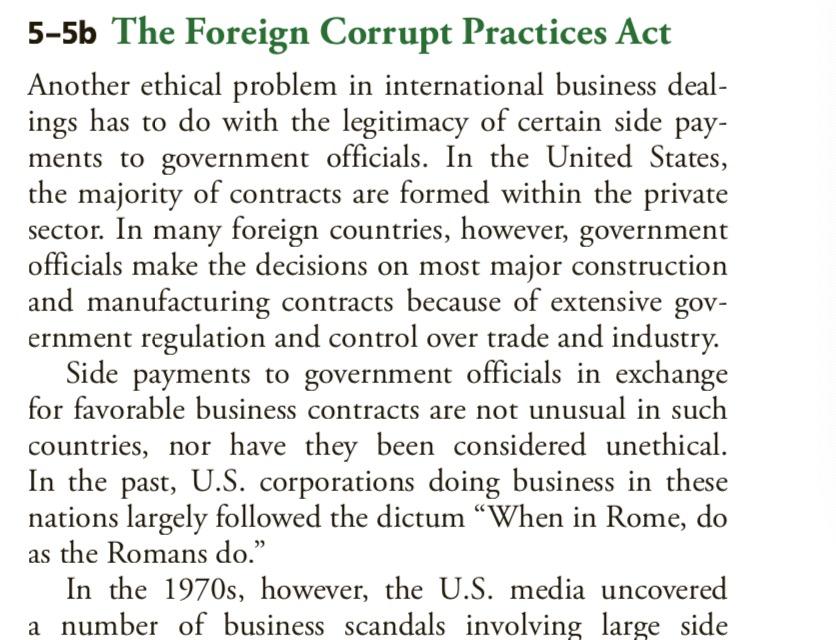
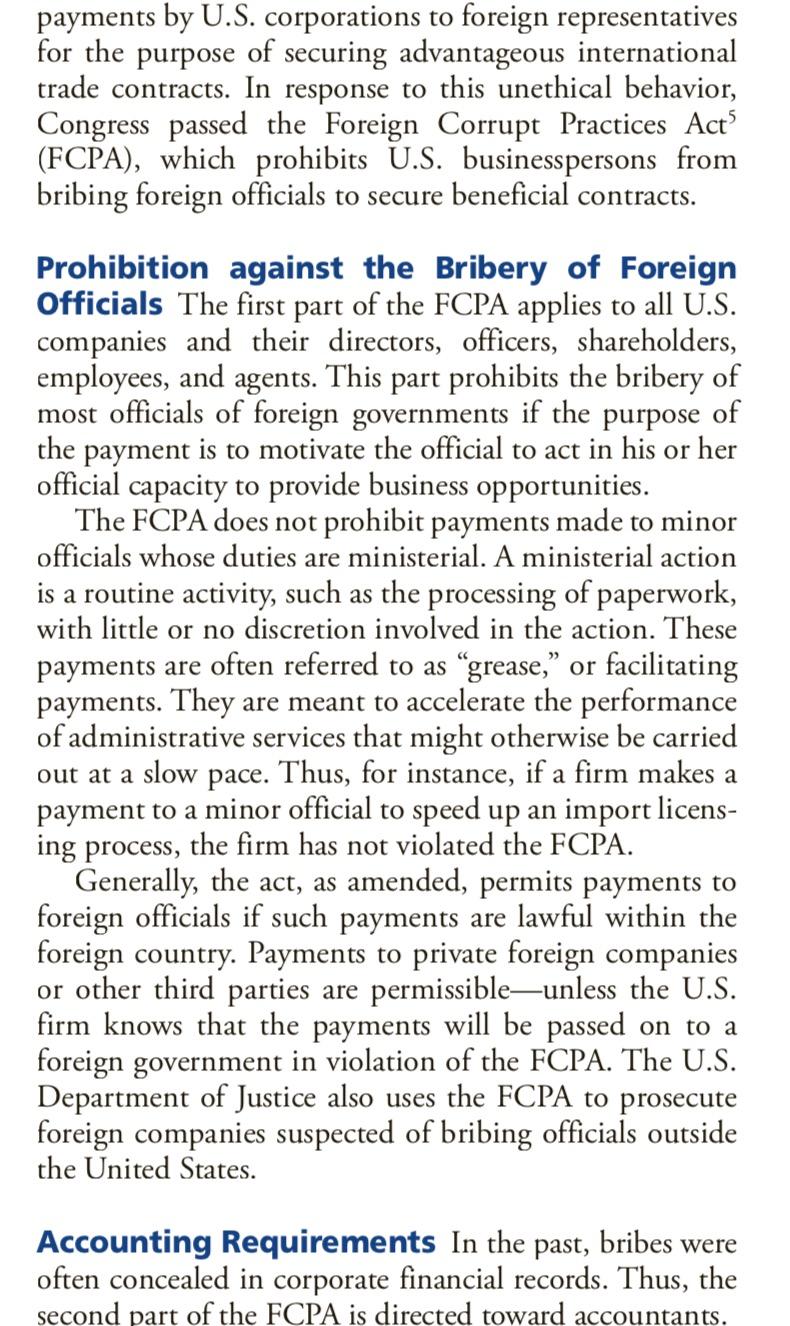
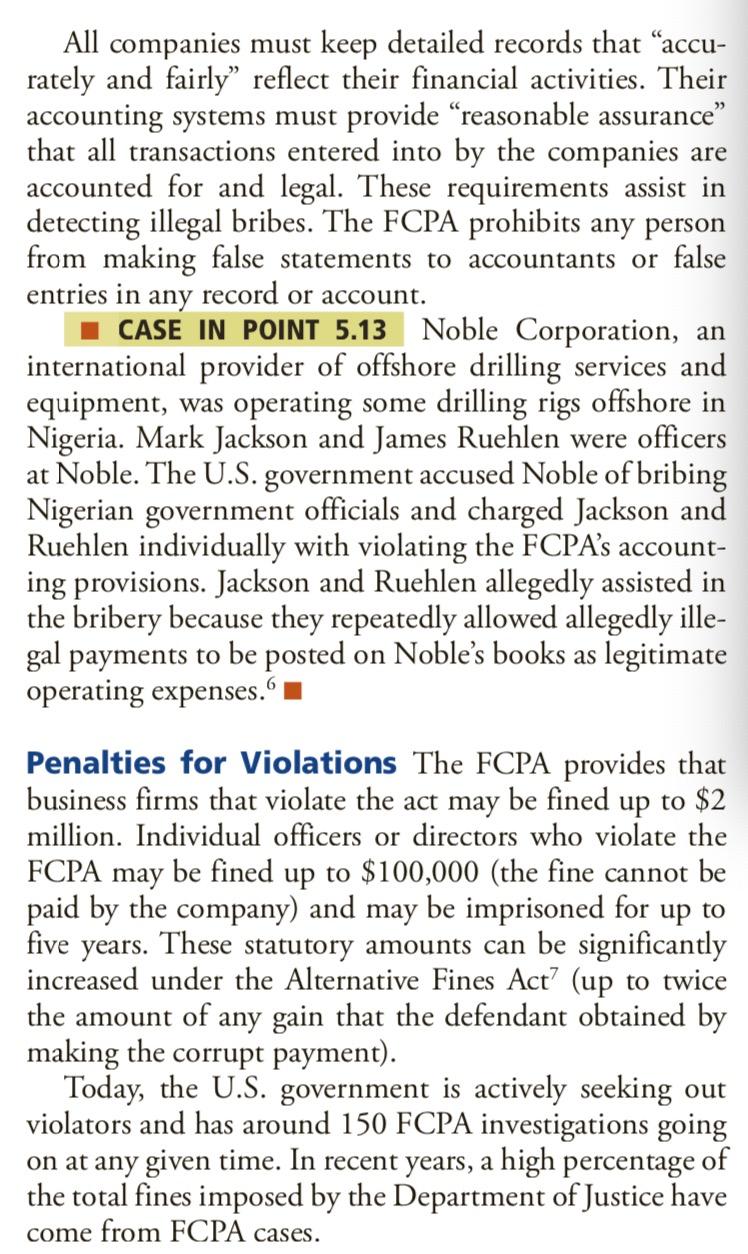
5-5b The Foreign Corrupt Practices Act Another ethical problem in international business deal- ings has to do with the legitimacy of certain side pay- ments to government officials. In the United States, the majority of contracts are formed within the private sector. In many foreign countries, however, government officials make the decisions on most major construction and manufacturing contracts because of extensive gov- ernment regulation and control over trade and industry. Side payments to government officials in exchange for favorable business contracts are not unusual in such countries, nor have they been considered unethical. In the past, U.S. corporations doing business in these nations largely followed the dictum When in Rome, do as the Romans do." In the 1970s, however, the U.S. media uncovered a number of business scandals involving large side payments by U.S. corporations to foreign representatives for the purpose of securing advantageous international trade contracts. In response to this unethical behavior, Congress passed the Foreign Corrupt Practices Act (FCPA), which prohibits U.S. businesspersons from bribing foreign officials to secure beneficial contracts. Prohibition against the Bribery of Foreign Officials The first part of the FCPA applies to all U.S. companies and their directors, officers, shareholders, employees, and agents. This part prohibits the bribery of most officials of foreign governments if the purpose of the payment is to motivate the official to act in his or her official capacity to provide business opportunities. The FCPA does not prohibit payments made to minor officials whose duties are ministerial. A ministerial action is a routine activity, such as the processing of paperwork, with little or no discretion involved in the action. These payments are often referred to as grease, or facilitating payments. They are meant to accelerate the performance of administrative services that might otherwise be carried out at a slow pace. Thus, for instance, if a firm makes a payment to a minor official to speed up an import licens- ing process, the firm has not violated the FCPA. Generally, the act, as amended, permits payments to foreign officials if such payments are lawful within the foreign country. Payments to private foreign companies or other third parties are permissibleunless the U.S. firm knows that the payments will be passed on to a foreign government in violation of the FCPA. The U.S. Department of Justice also uses the FCPA to prosecute foreign companies suspected of bribing officials outside the United States. Accounting Requirements In the past, bribes were often concealed in corporate financial records. Thus, the second part of the FCPA is directed toward accountants. All companies must keep detailed records that "accu- rately and fairly reflect their financial activities. Their accounting systems must provide reasonable assurance" that all transactions entered into by the companies are accounted for and legal. These requirements assist in detecting illegal bribes. The FCPA prohibits any person from making false statements to accountants or false entries in any record or account. CASE IN POINT 5.13 Noble Corporation, an international provider of offshore drilling services and equipment, was operating some drilling rigs offshore in Nigeria. Mark Jackson and James Ruehlen were officers at Noble. The U.S. government accused Noble of bribing Nigerian government officials and charged Jackson and Ruehlen individually with violating the FCPA's account- ing provisions. Jackson and Ruehlen allegedly assisted in the bribery because they repeatedly allowed allegedly ille- gal payments to be posted on Noble's books as legitimate operating expenses. Penalties for Violations The FCPA provides that business firms that violate the act may be fined up to $2 million. Individual officers or directors who violate the FCPA may be fined up to $100,000 (the fine cannot be paid by the company) and may be imprisoned for up to five years. These statutory amounts can be significantly increased under the Alternative Fines Act? (up to twice the amount of any gain that the defendant obtained by making the corrupt payment). Today, the U.S. government is actively seeking out violators and has around 150 FCPA investigations going on at any given time. In recent years, a high percentage of the total fines imposed by the Department of Justice have come from FCPA cases









 Study Help