







Question: Use the Intermediate Value Theorem to show that the given function has a zero in the interval 0, 3]. f(x) =x-+2x - 6 f (x)
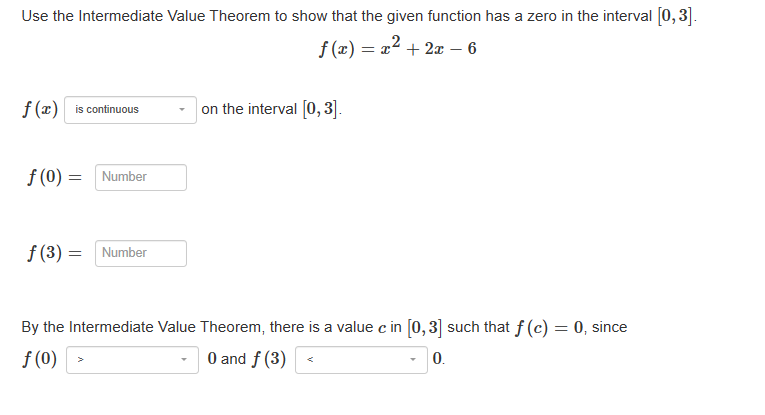
![has a zero in the interval 0, 3]. f(x) =x-+2x - 6](https://s3.amazonaws.com/si.experts.images/answers/2024/06/66668ccceafff_74866668cccdd9ed.jpg)
![f (x) is continuous on the interval [0, 3] f (0) =](https://s3.amazonaws.com/si.experts.images/answers/2024/06/66668ccd3bfa8_74966668ccd2b23f.jpg)
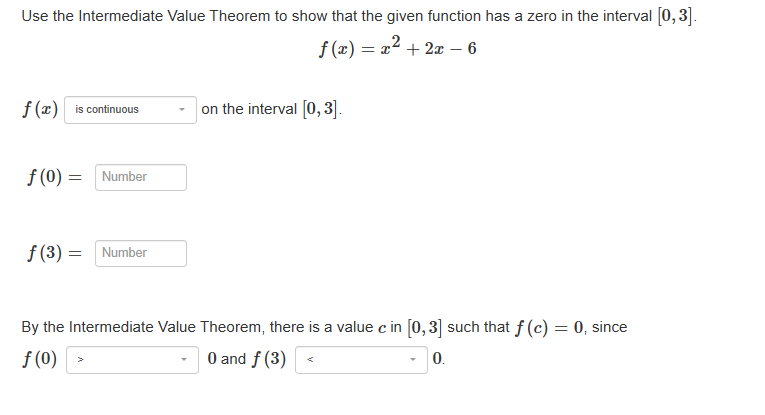
![a value c in [0, 3] such that f (c) = 0,](https://s3.amazonaws.com/si.experts.images/answers/2024/06/66668ccdcb5f9_74966668ccdb3808.jpg)
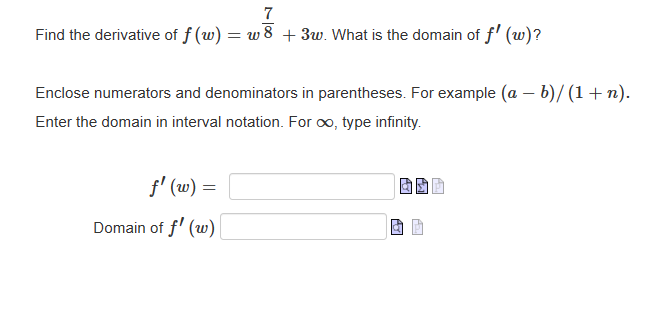
Use the Intermediate Value Theorem to show that the given function has a zero in the interval 0, 3]. f(x) =x-+2x - 6 f (x) is continuous on the interval [0, 3] f (0) = Number f (3) = Number By the Intermediate Value Theorem, there is a value c in [0, 3] such that f (c) = 0, since f (0) 0 and f (3) 0.The derivative of a function of f at * is given by f' () = lim f(eth)-f(I) h-0 h provided the limit exists. Use the definition of the derivative to find the derivative of f (x) = 7x- + 2x + 9 Enter the fully simplified expression for f (x + h) - f (x). Do not factor. f (x t h) - f (I) = f (x) =Find the derivative of f (w) = w8 + 3w. What is the domain of f (w)? Enclose numerators and denominators in parentheses. For example (a - b) / (1 + n). Enter the domain in interval notation. For oo, type infinity. f' (w) = Domain of f (w)
Step by Step Solution
There are 3 Steps involved in it

Get step-by-step solutions from verified subject matter experts
 Study Help