







Question: Use the Java code below to complete the excercise. /* driver class for the Java Calculator. * You give it an expression in double quotes
Use the Java code below to complete the excercise.
/* driver class for the Java Calculator. * You give it an expression in double quotes and it will print out the value: * $ java Calc "1+1" * value = 2.0 * $ */
public class Calc { public static void main(String [] args) { CalcParser parser = new CalcParser(args[0]); // TODO: This should be changed from value to stack machine code System.out.println("value = " + parser.getValue());
} }
/** * A CalcLexer provides a simple scanner for a * CalcParser. We hold the string being parsed, and the * CalcParser uses us to read the string as a sequence * of tokens. */ public class CalcLexer { /** * The string being parsed, held in a * StringTokenizer. */ private java.util.StringTokenizer tokens;
/** * The error message. This will be null if there * has been no error. */ private String errorMessage = null;
/** * The current token. */ private int tokenChar;
/** * If the current token is NUMBER_TOKEN, this is * the number in question. */ private double tokenNum;
/** * Non-character values for tokenChar. By choosing * negative values we are certain not to collide * with any char values stored in the int tokenChar. */ public static final int NUMBER_TOKEN = -1; public static final int EOLN_TOKEN = -2;
/** * Constructor for a CalcLexer. Our parameter is the * string to be tokenized. * @param s the String to be tokenized */ public CalcLexer(String s) {
// We use a StringTokenizer to tokenize the string. // Our delimiters are the operators, parens, and // white space. By making the third parameter true // we instruct the StringTokenizer to return those // delimiters as tokens.
tokens = new java.util.StringTokenizer( s," \t +-*/()",true);
// Start by advancing to the first token. Note that // this may get an error, which would set our // errorMessage instead of setting tokenChar.
advance(); }
/** * Advance to the next token. We don't return * anything; the caller must use nextToken() to see * what that token is. */ public void advance() {
// White space is returned as a token by our // StringTokenizer, but we will loop until something // other than white space has been found.
while (true) {
// If we're at the end, make it an EOLN_TOKEN.
if (!tokens.hasMoreTokens()) { tokenChar = EOLN_TOKEN; return; }
// Get a token--if it looks like a number, // make it a NUMBER_TOKEN.
String s = tokens.nextToken(); char c1 = s.charAt(0); if (s.length()>1 || Character.isDigit(c1)) { try { tokenNum = Double.valueOf(s).doubleValue(); tokenChar = NUMBER_TOKEN; } catch (NumberFormatException x) { errorMessage = "Illegal format for a number."; } return; }
// Any other single character that is not // white space is a token.
else if (!Character.isWhitespace(c1)) { tokenChar = c1; return; } } }
/** * Return our error message. This will be null if no * error has occurred. * * @return error String or null if no error */ public String getErrorMessage() { return errorMessage; }
/** * Return the value of a numeric token. This should * only be called when nextToken() reports a * NUMBER_TOKEN. * * @return the double value of the number */ public double getNum() { return tokenNum; }
/** * Return the next token. Repeated calls will * return the same token again; the caller should * use advance() to advance to another token. * @return the next token as an int */ public int nextToken() { return tokenChar; } }
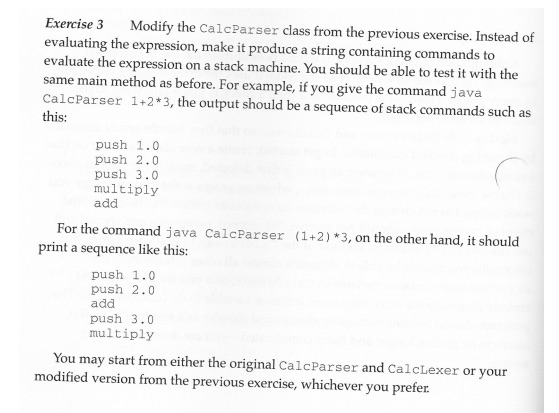
Exercise 3 Modify the CalcParser class from the previous exercise. Instead of evaluating the expression, make it produce a string containing commands to evaluate the expression on a stack machine. You should be able to test it with the same main method as before. For example, if you give the command java calcParser 1+2*3, the output should be a sequence of stack commands such as 1S: push 1.0 push 2.0 push 3.0 multiply add For the command java CalcParser (1+2) 3, on the other hand, it should print a sequence like this: push 1.0 push 2.0 add push 3.0 multiply You may start from either the original calcParser and CalcLexer or your modified version from the previous exercise, whichever you prefer. Exercise 3 Modify the CalcParser class from the previous exercise. Instead of evaluating the expression, make it produce a string containing commands to evaluate the expression on a stack machine. You should be able to test it with the same main method as before. For example, if you give the command java calcParser 1+2*3, the output should be a sequence of stack commands such as 1S: push 1.0 push 2.0 push 3.0 multiply add For the command java CalcParser (1+2) 3, on the other hand, it should print a sequence like this: push 1.0 push 2.0 add push 3.0 multiply You may start from either the original calcParser and CalcLexer or your modified version from the previous exercise, whichever you prefer
Step by Step Solution
There are 3 Steps involved in it

Get step-by-step solutions from verified subject matter experts
 Study Help