



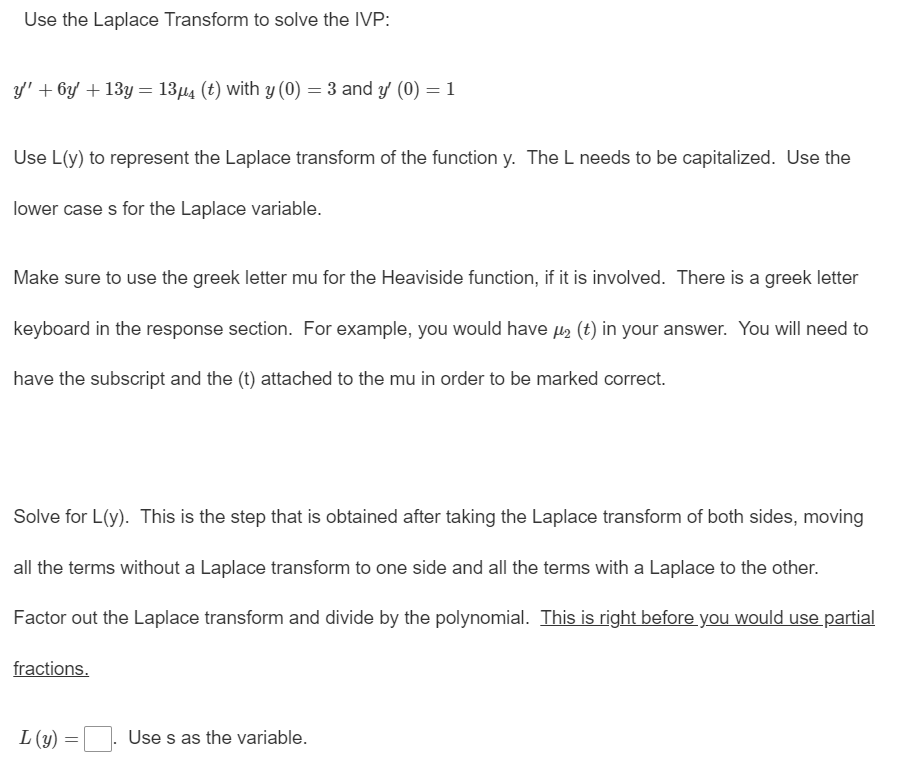
Question: Use the Laplace Transform to solve the IVP: y + 69' + 13;; = 13y.1 [t] with y(0) = 3 and y' (D) = 1
![+ 13;; = 13y.1 [t] with y(0) = 3 and y' (D)](https://dsd5zvtm8ll6.cloudfront.net/si.experts.images/questions/2024/11/6732e153c3b6f_7316732e153affaf.jpg)
Use the Laplace Transform to solve the IVP: y\" + 69' + 13;; = 13y.1 [t] with y(0) = 3 and y' (D) = 1 Use L{y) to represent the Laplace transform of the function y. The L needs to be capitalized. Use the lower case s for the Laplace variable. Make sure to use the greek letter mu for the Heaviside function, if it is involved. There is a greek letter keyboard in the response section. For example, you would have m (t) in your answer. You will need to have the subscript and the (t} attached to the mu in order to be marked correct. Solve for L(y}. This is the step that is obtained after taking the Laplace transform of both sides. moving all the terms without a Laplace transform to one side and all the terms with a Laplace to the other. Factor out the Laplace transform and divide by the polynomial. This is right before you would use partial fractions. L (y) = D. Use s as the variable. Use partial fractions to break up the fractions. Now, combine like fractions and pull the constants out front of the fraction. Split the fractions up further to the point were they are in the correct form to take the inverse Laplace transform. Please leave the s and the to values in the numerator since they are needed there for the inverse Laplace transform to work. For example, a part of your answer could look like (sf+4) or g ( $214). If the exponential ,e'\
Step by Step Solution
There are 3 Steps involved in it

Get step-by-step solutions from verified subject matter experts