







Question: Use the Method of Midpoint Rectangles (do NOT use the integral or antiderivative) to approximate the area under the curve f(@) = a - *

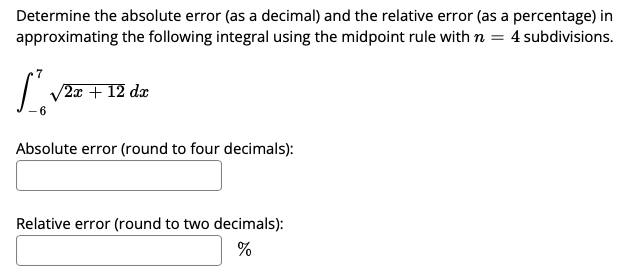
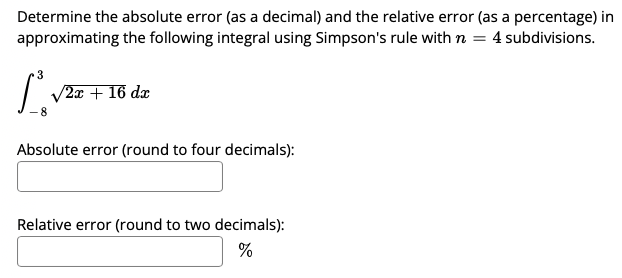
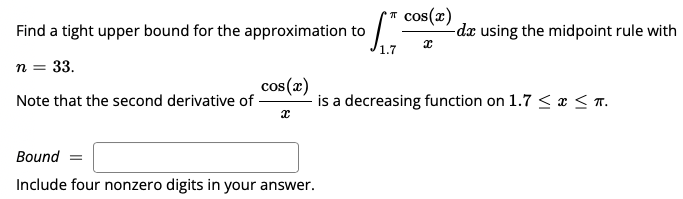
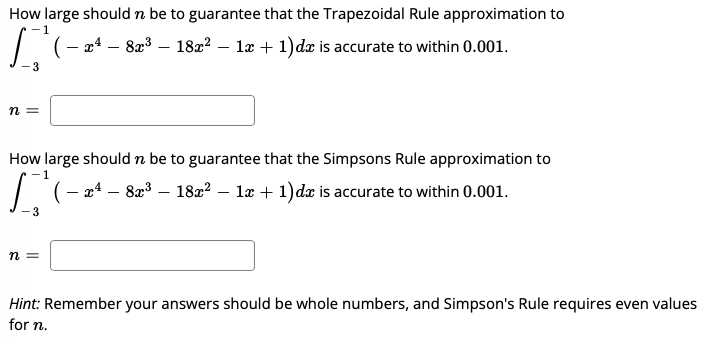
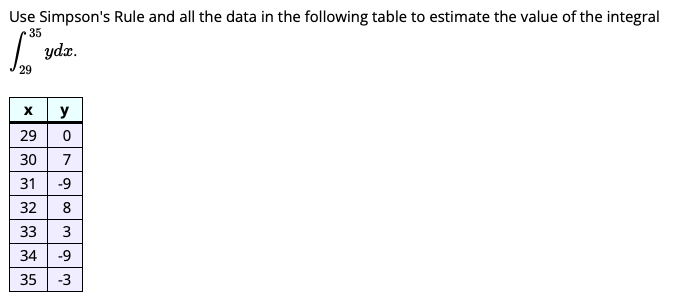
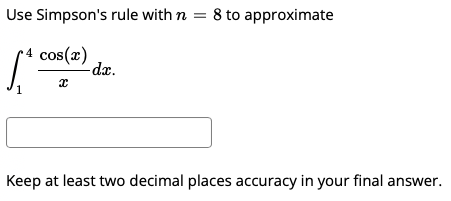

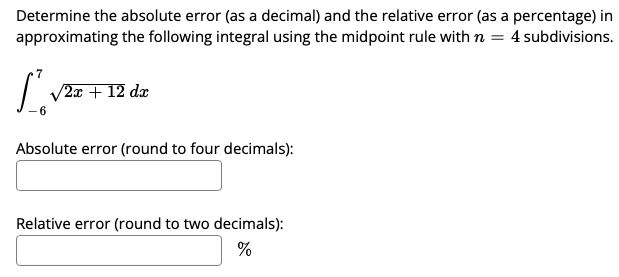
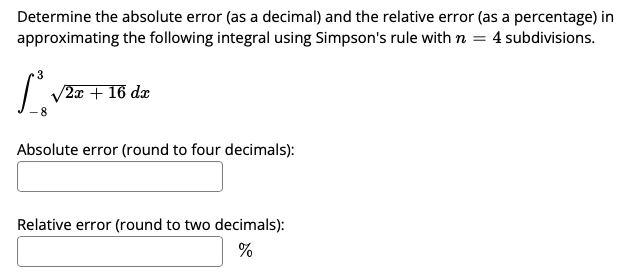
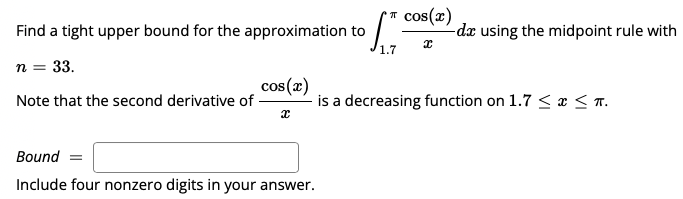
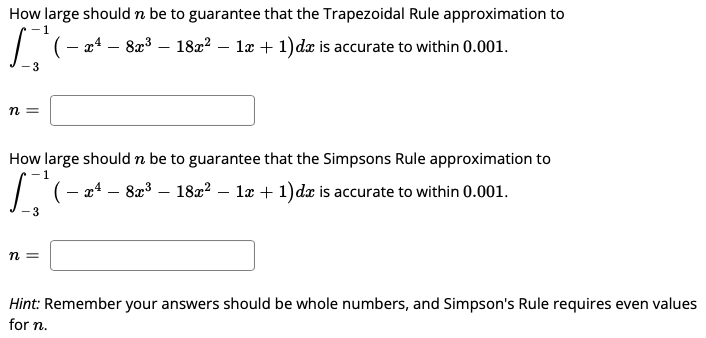
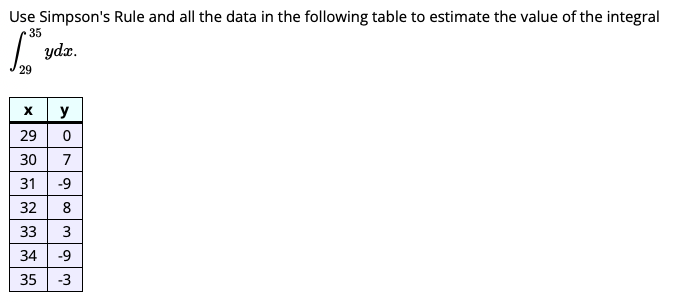
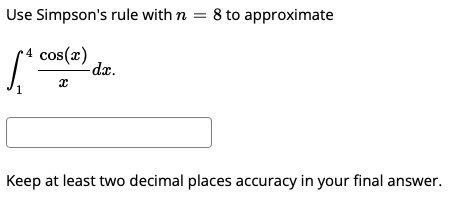
Use the Method of Midpoint Rectangles (do NOT use the integral or antiderivative) to approximate the area under the curve f(@) = a - * + 4 froma = 2 tor = 12. Use n = 5 rectangles to find your approximation. AnswerDetermine the absolute error (as a decimal) and the relative error (as a percentage) in approximationg the following integral using the midpoint rule with n = 4 subdivisions. V2x + 12 da Absolute error (round to four decimals): Relative error (round to two decimals): %Determine the absolute error (as a decimal) and the relative error (as a percentage) in approximationg the following integral using Simpson's rule with n = 4 subdivisions. V2x + 16 de 8 Absolute error (round to four decimals): Relative error (round to two decimals): %1T ooo{:1:) Find a tight upper bound for the approximation to f in: using the midpoint rule with 1.7 I n = 33. oosfm) Note that the second derivative of is a decreasing function on 1.? E m 5 11'. :1: Bound : - | Include four nonzero digits in your answer. How large should n be to guarantee that the Trapezoidal Rule approximation to 1 (- 24 - 8x3 - 18x2 - 1x + 1) do is accurate to within 0.001. 3 n How large should n be to guarantee that the Simpsons Rule approximation to 1 (- 24 - 8x3- 18x2 - 1x + 1) de is accurate to within 0.001. 3 Hint: Remember your answers should be whole numbers, and Simpson's Rule requires even values for n.Use Simpson's Rule and all the data in the following table to estimate the value of the integral 35 ydx. 29 X y 29 0 30 7 31 -9 32 8 33 3 34 -9 35 -3Use Simpson's rule with n = 8 to approximate 4 cost(Er dax. Keep at least two decimal places accuracy in your final
Step by Step Solution
There are 3 Steps involved in it

Get step-by-step solutions from verified subject matter experts
 Study Help