Question: use the poisson proccess or the bernoulli process to solve number 4 please t 0 and t 2 Describe the distribution of M in one
use the poisson proccess or the bernoulli process to solve number 4 please
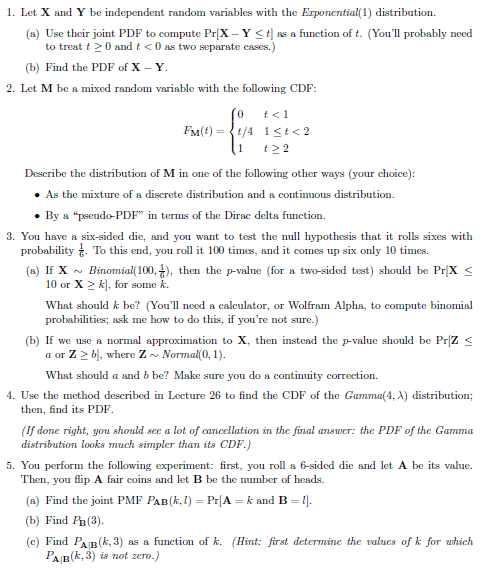
t 0 and t 2 Describe the distribution of M in one of the following other ways your choice): As the mixture of a discrete distribution and a continuous distribution. By a "pseudo-PDF" in terms of the Dirac delta function. 3. You have a six-sided die, and you want to test the null hypothesis that it rolls sixes with probability. To this end, you roll it 100 times, and it comes up six only 10 times. (a) If X-Binomial 100,), then the p-value (for a two-sided test) should be Pr| XS 10 or X > k], for some k. What should k be? (You'll need a calculator, or Wolfram Alpha, to compute binomial probabilities, ask me how to do this, if you're not sure.) (b) If we use a normal approximation to X, then instead the p-value should be Pr[Z a or Zb], where Z - Normal(0,1). What should a and b be? Make sure you do a continuity correction. 4. Use the method described in Lecture 26 to find the CDF of the Gamma(4. X) distribution; then, find its PDF (If done right, you should see a lot of cancellation in the final answer the PDF of the Gamma distribution looks much simpler than its CDF.) 5. You perform the following experiment: first, you roll a 6-sided die and let A be its value. Then, you flip A fnir coins and let B be the number of hends. (a) Find the joint PMF PAB(k.1) = Pr[A = k and B =1). (b) Find PB(3). (c) Find PAB(5,3) as a function of k. (Hint: first determine the values of k for which PAB, 3) is not zero.) t 0 and t 2 Describe the distribution of M in one of the following other ways your choice): As the mixture of a discrete distribution and a continuous distribution. By a "pseudo-PDF" in terms of the Dirac delta function. 3. You have a six-sided die, and you want to test the null hypothesis that it rolls sixes with probability. To this end, you roll it 100 times, and it comes up six only 10 times. (a) If X-Binomial 100,), then the p-value (for a two-sided test) should be Pr| XS 10 or X > k], for some k. What should k be? (You'll need a calculator, or Wolfram Alpha, to compute binomial probabilities, ask me how to do this, if you're not sure.) (b) If we use a normal approximation to X, then instead the p-value should be Pr[Z a or Zb], where Z - Normal(0,1). What should a and b be? Make sure you do a continuity correction. 4. Use the method described in Lecture 26 to find the CDF of the Gamma(4. X) distribution; then, find its PDF (If done right, you should see a lot of cancellation in the final answer the PDF of the Gamma distribution looks much simpler than its CDF.) 5. You perform the following experiment: first, you roll a 6-sided die and let A be its value. Then, you flip A fnir coins and let B be the number of hends. (a) Find the joint PMF PAB(k.1) = Pr[A = k and B =1). (b) Find PB(3). (c) Find PAB(5,3) as a function of k. (Hint: first determine the values of k for which PAB, 3) is not zero.)









 Study Help