







Question: Use the Policy Analysis Framework for Proposed Legislation template to create a comprehensive knowledge of the cycle of policy change by combining all 3 components
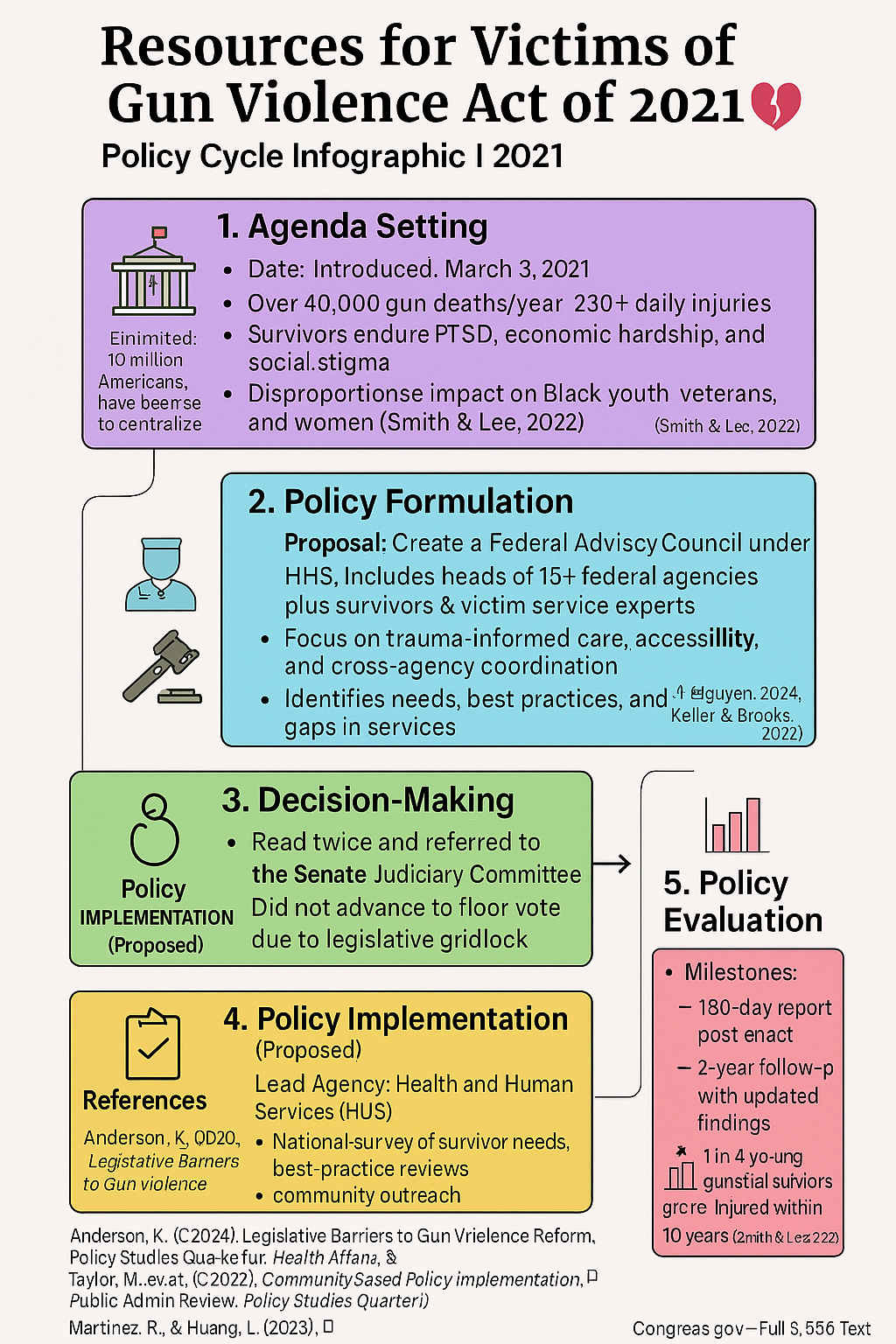
Use the Policy Analysis Framework for Proposed Legislation template to create a comprehensive knowledge of the cycle of policy change by combining all 3 components of policy analysis. The Legislative Analysis Assignment will be a detailed comprehensive look into bill S. 556 Resources for Victims of Gun Violence Act of 2021. You will include the Legislative Analysis: Cycle of Policy Change, Infographic as an appendix with at least one reference within the content of this final analysis to the infographic appendix. be sure to include a minimum of 9 total scholarly sources: minimum of 3 new scholarly sources along with new citation content from the minimum 5 in the Cycle of Policy Change Infographic as well as citations from the congress.gov from the Bill Identification.
A Policy Analysis Framework for Proposed Legislation Description and History of the Legislation Identify the bill selected, stating the official title of the bill and its reference. Who introduced the bill and what is their political affilia-tion? Who are the co-sponsors of the legislation? Is there bipartisan support? What is the history of the bill? Note carefully any historical changes that have been made to the bill. Where is the bill in the legislative process? Description of the Problem, Population, and Context Provide a brief analysis of the problems and changing contexts that the policy is designed to address. Contexts may include scientific and technological advances, societal and economic trends, and issues related to specific locales (rural, urban, poor, etc.). This section must include a description of the problem and an analysis of the population affected by the policy. End this section with how and to what extent (will) your bill helps the identified population and service providers. Values Discussion How does the bill reflect or not reflect social work values? Be spe-cific. Discuss how this policy sets forth a model of prevention and advocates for human rights. Political Analysis and Feasibility Who in the private sector will gain or lose if the bill is enacted or not enacted? Think in terms of money, power, or other factors. Who are the people or groups advocating for the bill? Against it? You may even want to look at such things as campaign contributions to key legislators. Be sure to include an analysis of likelihood that the bill will be passed. Advocacy In this section you are to create an advocacy strategy to promote passage of the bill. Strategies may include coalition building, letter writing, and other methods for influencing legislators and the public. Your strategy should include, but is not limited to, affected clients, colleagues, and other social workers. Implementation If the requirements of the bill involve funding, where will the fund-ing come from? Is there a related bill that addresses funding? Will changes in existing agencies or other institutions be required? What will be involved in enacting the bill?
Name of Bill with Identification Number and Official Name
Bill Number: S. 556
Official Name:Resources for Victims of Gun Violence Act of 2021
The bill selected for this analysis is the Resources for Victims of Gun Violence Act of 2021 (S. 556). This proposed legislation aims to address the support needs of individuals, families, and communities affected by gun violence across the United States. It suggests establishing a national advisory council to study and recommend effective strategies for providing long-term support and resources to victims and survivors of firearm-related trauma.
Chamber of Origin
Introduced in: United States Senate
Date Introduced: March 3, 2021
Sponsor: Senator Robert P. Casey Jr.
Cosponsors: 16 Senators, including Senators Edward J. Markey, Cory A. Booker, and Elizabeth Warren
This legislation originated in the United States Senate. Senator Robert P. Casey Jr., a Pennsylvania Democrat, introduced it. The bill's submission to the Senate reflects a national effort to prioritize the needs of gun violence victims through a legislative framework and support infrastructure.
Latest Action
Date: March 3, 2021
Action: Read twice and referred to the Senate Committee on the Judiciary
As for its most recent update, S. 556 was read twice and referred to the Senate Committee on the Judiciary. This step is an early stage in the legislative process, where the bill awaits further consideration, possible hearings, or debate before it can move forward in the Senate.
Status of Legislation
Current Status: Introduced; pending further action in the Senate Committee on the Judiciary
Progress: No further legislative action has been recorded since referral
The bill's current status is "introduced," meaning it has been officially submitted and referred to a committee but has not yet advanced to a vote or received additional legislative action. It remains under review under committee review, and no amendments or movement toward passage have occurred as of the latest records.
Summary of Bill Intent
Assessing Needs: Surveying victims and professionals to understand the comprehensive needs of gun violence victims
Information Dissemination: Identifying and promoting resources to assist victims in areas such as medical care, mental health, legal support, and financial assistance
Reporting: Preparing and submitting reports to Congress detailing findings, best practices, and recommendations for addressing gaps in services
The primary intent of the Resources for Victims of Gun Violence Act of 2021 is to establish a federal advisory council responsible for researching, developing, and recommending comprehensive support systems for victims of gun violence. This includes survivors of shootings, families of deceased victims, and communities experiencing long-term trauma. The bill seeks to enhance access to mental health services, financial assistance, and trauma-informed care while collecting data to assess and improve victim support services across states. By taking a public health and community wellness approach, this legislation aims to address both the immediate and long-term needs of those affected by gun violence.
Summary of How the Bill is Related to a Grand Challenge
Providing Support: Offering resources and support systems for young victims of gun violence to aid in their recovery and development
Preventing Recurrence: Implementing best practices to avoid re-victimization and to promote safety in communities
Enhancing Well-being: Focusing on mental health and emotional well-being, crucial for the healthy development of youth affected by gun violence
This legislation aligns with the Grand Challenge of "Ensure Healthy Development for All Youth" from the American Academy of Social Work and Social Welfare's 13 Grand Challenges. Gun violence disproportionately affects young people, particularly in underserved urban areas. The trauma resulting from such exposure has significant consequences for mental, emotional, and physical development. The bill supports holistic and developmental health strategies by focusing on victims' long-term recovery, including youth and families. Furthermore, it aims to prevent intergenerational trauma, reduce barriers to recovery, and ensure equitable access to trauma-informed care, which is central to the healthy development of all youth.
Summary of One Related Bill
A closely related bill is H.R. 1560, the House companion version of the Resources for Victims of Gun Violence Act. Congressman Dwight Evans of Pennsylvania introduced it in the House of Representatives. While nearly identical in content, this bill targets the same goals through the legislative process in the House, highlighting bipartisan and bicameral recognition of the urgency in supporting gun violence victims. Like S. 556, H.R. 1560 also seeks to establish a national advisory council and calls for research and resource distribution to meet the long-term needs of affected individuals.
Summary of Biographical Sponsor Background
The sponsor of S. 556, Senator Robert P. Casey Jr., is a senior U.S. Senator from Pennsylvania who has served in Congress since 2007. A member of the Democratic Party, Senator Casey has consistently focused on issues such as health care access, education, child welfare, disability rights, and gun safety. He is known for advocating on behalf of vulnerable populations, including children and individuals with disabilities, aligning his legislative priorities with the values of social equity and public health. His sponsorship of this bill is consistent with his broader legislative focus on safeguarding the well-being of at-risk communities.
Summary of Another Bill by the Sponsor
Another relevant legislation sponsored by Senator Casey is the Children with Disabilities Access to Care Act. Although it addresses a different policy area, this bill reflects a shared concern with ensuring access to critical support services for vulnerable populations. It seeks to improve healthcare access for children with disabilities by removing administrative and systemic barriers within Medicaid. The legislation complemented S. 556 in emphasizing equity, trauma-informed care, and long-term support systems for individuals facing adversity. Both bills illustrate Senator Casey's commitment to building a supportive infrastructure for marginalized and underserved groups through targeted federal policy.
References
Resources for Victims of Gun Violence Act of 2021, S. 556, 117th Cong. (2021).https://www.congress.gov/bill/117th-congress/senate-bill/556
Step by Step Solution
There are 3 Steps involved in it

Get step-by-step solutions from verified subject matter experts
 Study Help