







Question: Use the skeleton code provided to solve the following. package graph; public class Graph2 { public int n; /umber of vertice public int[][] A;//the adjacency
Use the skeleton code provided to solve the following. 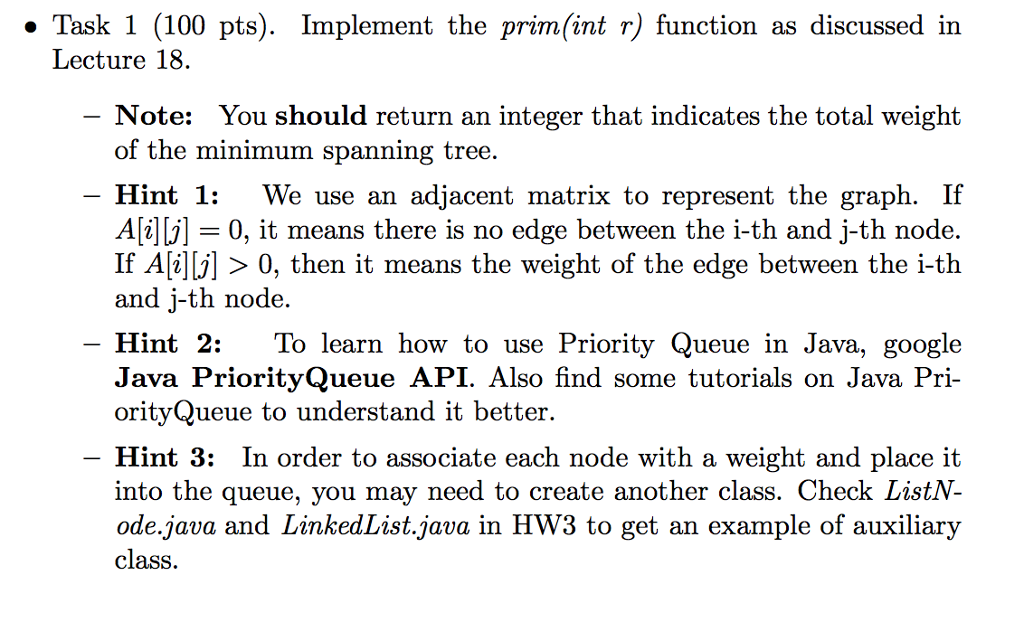
package graph;
public class Graph2 {
public int n; /umber of vertice
public int[][] A;//the adjacency matrix
public Graph2 () {
n = 0;
A = null;
}
public Graph2 (int _n, int[][] _A) {
this.n = _n;
this.A = _A;
}
public int prim (int r) {
}
/**
* @param args
*/
public static void main(String[] args) {
// TODO Auto-generated method stub
int n = 9;
int A[][] = {
{0, 4, 0, 0, 0, 0, 0, 8, 0},
{4, 0, 8, 0, 0, 0, 0, 11, 0},
{0, 8, 0, 7, 0, 4, 0, 0, 2},
{0, 0, 7, 0, 9, 14, 0, 0, 0},
{0, 0, 0, 9, 0, 10, 0, 0, 0},
{0, 0, 4, 14, 10, 0, 2, 0, 0},
{0, 0, 0, 0, 0, 2, 0, 1, 6},
{8, 11, 0, 0, 0, 0, 1, 0, 7},
{0, 0, 2, 0, 0, 0, 6, 7, 0}
};
Graph2 g = new Graph2(n, A);
System.out.println(g.prim(0));
}
}
Task 1 (100 pts). Implement the prim(int r) function as discussed in Lecture 18. -Note: You should return an integer that indicates the total weight of the minimum spanning tree. Hint 1: W h. If Ai[j]-0, it means there is no edge between the i-th and j-th node If A [i][j] 0, then it means the weight of the edge between the i-th and j-th node. Hint 2: To learn how to use Priority Queue in Java, google Java PriorityQueue API. Also find some tutorials on Java Pri orityQueue to understand it better Hint 3: In order to associate each node with a weight and place it e use an adjacent matrix to represent the grap reate another class. Check ListN- ode.java and LnkedList.java in HW3 t class. o get an exanple of auxiliary
Step by Step Solution
There are 3 Steps involved in it

Get step-by-step solutions from verified subject matter experts
 Study Help