



Question: Use the two-path test to prove What value does f(x,y) = - X + 2y that the following limit does not X - 2y approach
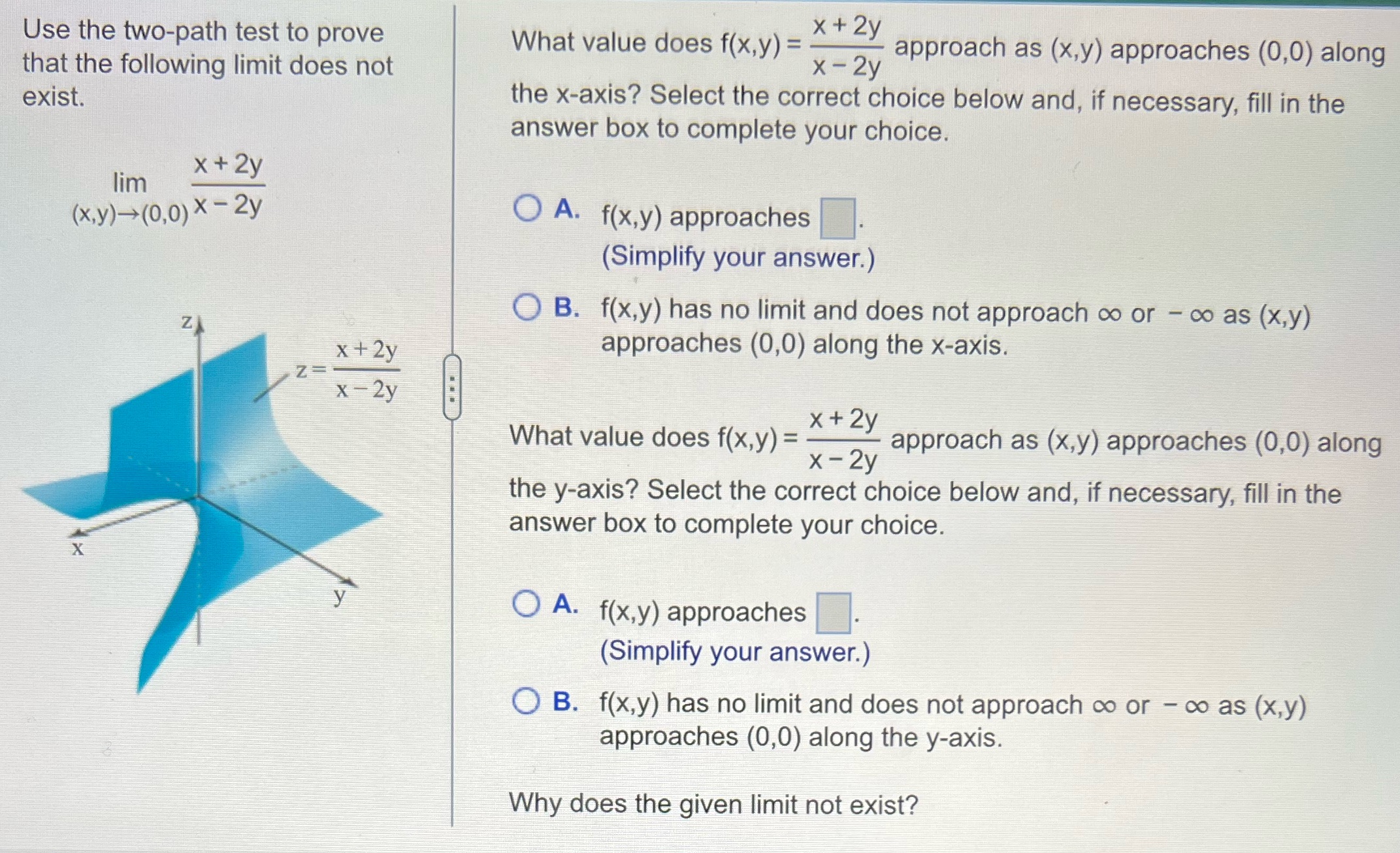
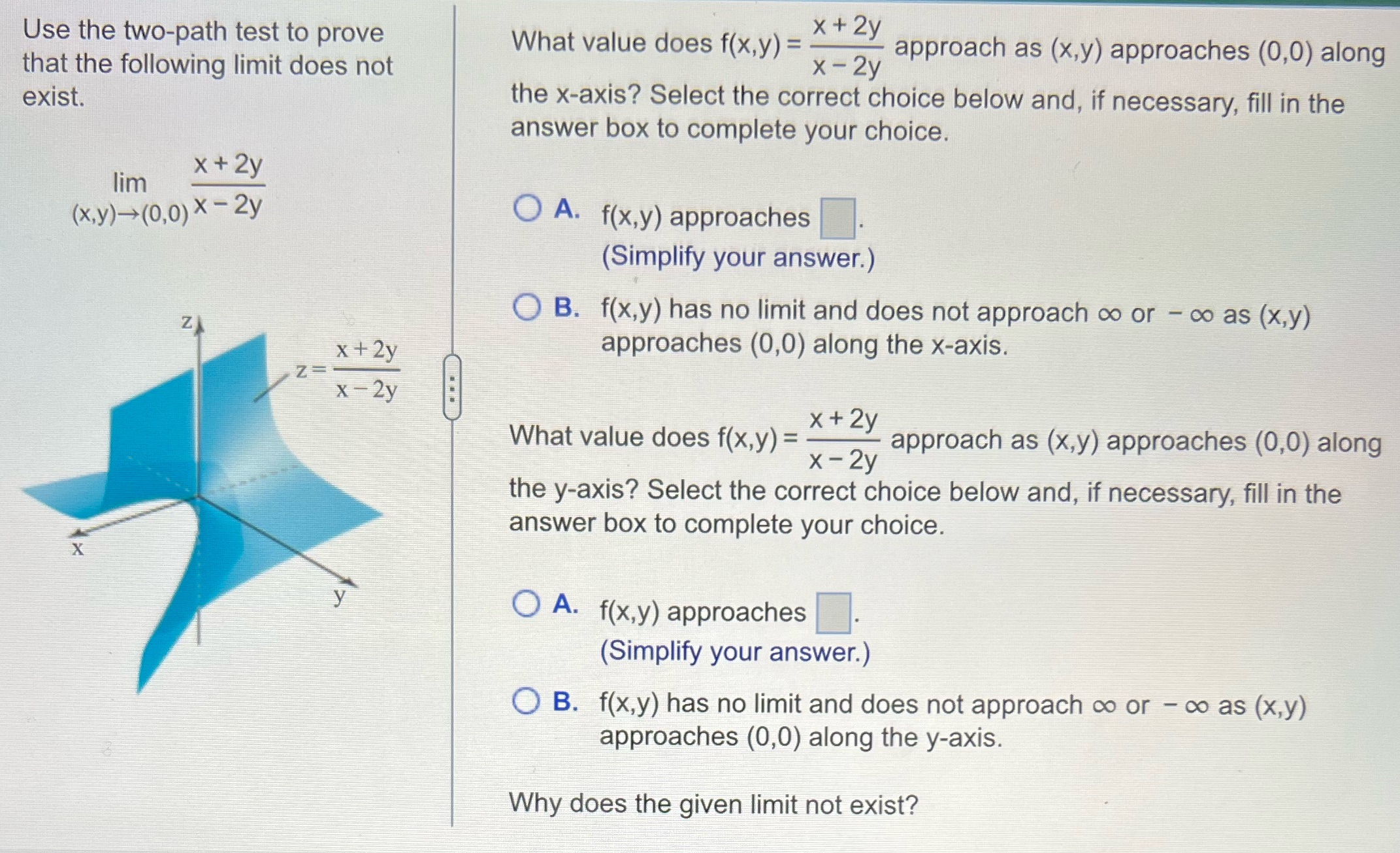
Use the two-path test to prove What value does f(x,y) = - X + 2y that the following limit does not X - 2y approach as (x,y) approaches (0,0) along exist. the x-axis? Select the correct choice below and, if necessary, fill in the answer box to complete your choice. X + 2y lim (x,y)-(0,0) x - 2y O A. f(x,y) approaches (Simplify your answer.) Z O B. f(x,y) has no limit and does not approach co or - co as (x,y) x + 2y approaches (0,0) along the x-axis. Z= X - 2y What value does f(x,y) = * + 2y x - 2y approach as (x,y) approaches (0,0) along the y-axis? Select the correct choice below and, if necessary, fill in the answer box to complete your choice. X O A. f(x,y) approaches (Simplify your answer.) O B. f(x,y) has no limit and does not approach co or - co as (x,y) approaches (0,0) along the y-axis. Why does the given limit not exist
Step by Step Solution
There are 3 Steps involved in it

Get step-by-step solutions from verified subject matter experts