







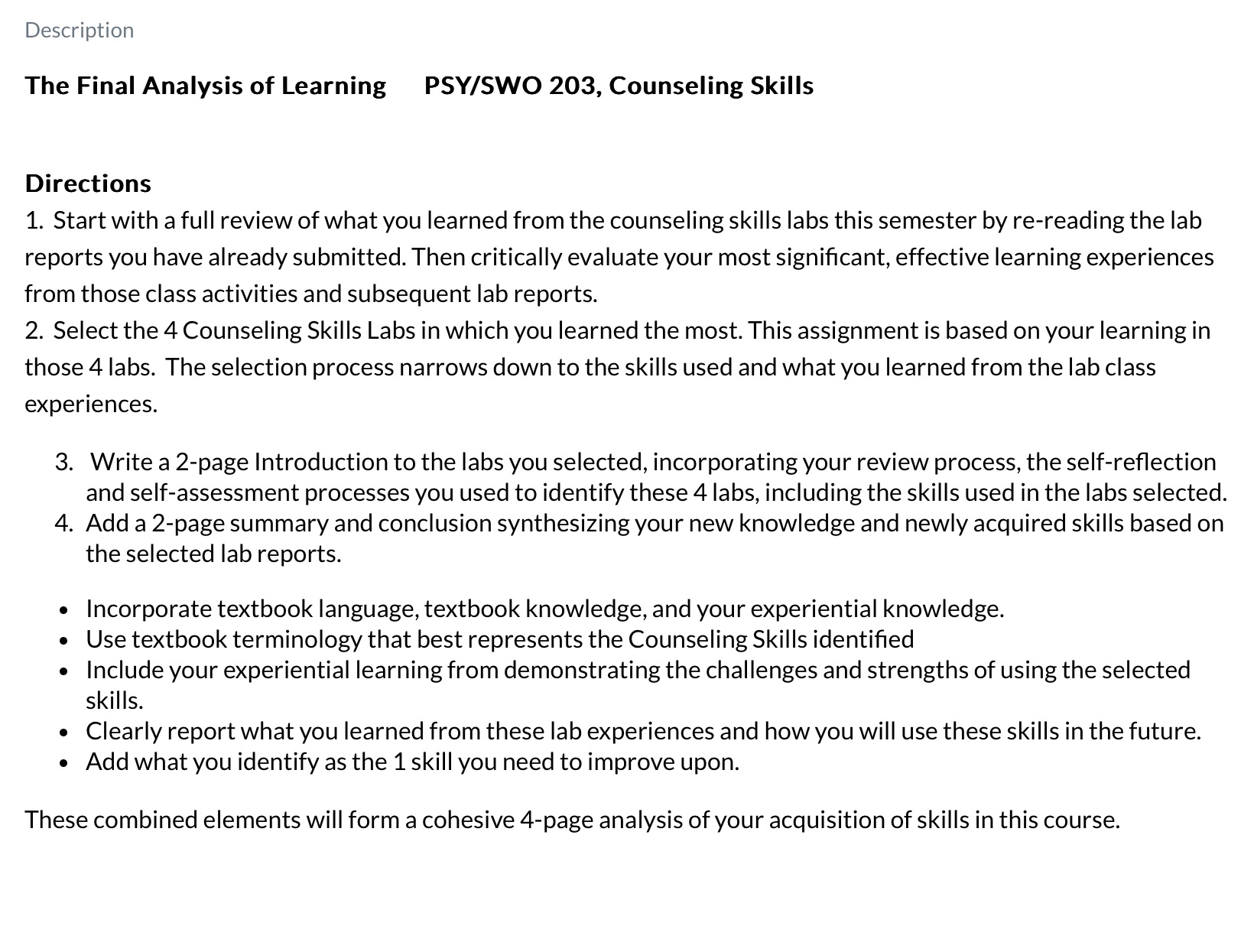
Question: Use this lab to answer this question Summarization provides focus throughout the interview, highlights important points and helps identify themes, patterns and insights. A summarization
Use this lab to answer this question Summarization provides focus throughout the interview, highlights important points and helps identify themes, patterns and insights. A summarization is not merely a "list"; rather, it is a composite of the most significant parts of the interview. It can be beneficial to ask the client to summarize at various points throughout the interview. It gives both the social worker and the client an appreciation for the client's point of view and can serve as a way to confirm the accuracy and the understanding of the message by both parties. The social worker can also clarify or ask open- ended questions to be certain a full understanding of the situation has been achieved. (Cummin & Sevel, 2018). As a social worker I can reflect on this situation by focusing on active listening to ensure I genuinely understand the client's perspective and encourage my client to summarize their thoughts, which helps me to confirm mutual understanding and clarify any misunderstanding by asking open-ended questions, ensuring that I understand the client's feelings and thoughts are captured correctly. By reflecting on these summaries, I can avoid injecting my own opinions and focus solely on what the client communicates. And by practicing this skill enhances communication and supports better outcomes in my work with clients. Confrontation is a skill that social workers use to address a discrepancy in the client's message ( Hepworth et al, 2013). This discrepancy can take two forms:) the client's behavior in contradiction to his statement or 2) the client's statement in contradiction to one another. should be used with professional discretion and always with the interests of the client in mind. Consider asking for the client reaction to the confrontation. Remember to attend to the client's reaction (both verbal and nonverbal) to the confrontation by offering a paraphrasing, reflection on feelings, or summarization responses. Leave enough time after offering confrontation for the client to talk about it and learn from it. When clients come to a new insight, awareness or realization, using the skills of interpretation, may be helpful in beginning to explore the rationale behind the action, thought, behavior or beliefs (Hills & o'Brien, 2014). It is important to note that the social worker may be confused by this apparent difference between the client's verbal and nonverbal messages and may need to explore this further. (Cummin & Sevel, 2018). As a social worker, recognizing and addressing discrepancies between a client's statements and behavior is crucial for growth and understanding for me. Reflecting on this chapter can help me identify when the client's words and actions don't align, for example if a client expresses a desire for going to the gym but continually misses visits, I can gently address this by not judging the client and encourage the client to reflect on the reasons behind their actions and work collaboratively to set actionable goals to align behaviors with their statements. Regular reflection on how to address these issues and the outcome can inform and improve my future practice as a social worker and also support my clients journey towards positive change. Reference Cummins, L. K., & Sevel, J. A. (2018). Social worker Skills for Beginning Direct Practice: Text, Workbook and multimedia interactive case studies. Pearson
Step by Step Solution
There are 3 Steps involved in it

Get step-by-step solutions from verified subject matter experts
 Study Help