







Question: Use this template for this question. (Reference how to complete assignments form a Google sheet template here if needed.) See the bottom of the assignment
-
Use this template for this question. (Reference how to complete assignments form a Google sheet template here if needed.) See the bottom of the assignment for spreadsheet tips.
You are considering two mutually exclusive investments. The projects expected net cash flows are as follows:
Expected Net Cash Flows
| Year | Project X | Project Z |
| 0 | $(45,000) | $(50,000) |
| 1 | (20,000) | 15,000 |
| 2 | 11,000 | 15,000 |
| 3 | 20,000 | 15,000 |
| 4 | 30,000 | 15,000 |
| 5 | 45,000 | 15,000 |
-
Construct NPV profiles for Projects X and Z (table AND line graph).
-
Calculate each projects IRR.
-
If the required rate of return for each project is 9 percent, which project should you select? If the required rate of return is 12 percent, what would be the proper choice? If the required rate of return is 15 percent, what would be the proper choice?
-
At what rate do the NPV profiles of the two projects cross?
-
Please see the income statement below - calculate:
-
Degree of operating leverage
-
Degree of financial leverage
-
Degree of total leverage
-
| Sales | $150,000 |
| Variable Operating Costs | (105,000) |
| Gross Profit | 45,000 |
| Fixed Operating Costs | (20,000) |
| Net Operating Income | 25,000 |
| Interest | (15,000) |
| Earnings before Taxes | 10,000 |
| Taxes (40%) | (4,000) |
| Net Income | $6,000 |
-
Given the information below, which of the following firms would be considered riskiest? Explain your answer.
| Company | DOL | DFL |
| Alps | 1.5x | 6.0x |
| Apex | 3.0x | 4.0x |
| Acme | 5.0x | 2.0x |
-
Assume that Wonka Industries has a $500,000 capital budget planned for the coming year and its net income is forecasted at $850,000. Wonka Industries has 300,000 shares outstanding. Determine the DPS the Wonka Industries will pay for the coming year if they apply the following policies:
-
Residual dividend policy
-
Stable, predictable dividend policy and they paid a dividend of $1 per share last year
-
Constant payout ratio of 55%
-
Low regular dividend of $0.75 plus 40% of earnings greater than $750,000
-
Spreadsheet tips for question 1:
For part A
-
Use the NPV function to complete the table.
= NPV(rate, range of values)
You should reference the rate and the range of values so that you can easily drag this formula to all the cells in the NPV profile. For the rate, you will want to use a dollar sign in front of the letter to lock the reference to that column. For the range of values, you will want to use a dollar sign in front of all the numbers to lock the references to the correct rows.
-
Make sure you create a line graph to illustrate the profiles. Project X and Z will be their own series and the rate will be the x-axis.
For part B - use the IRR function.
=IRR(range of cash flows)
For part D - to find the crossover rate, you need to find the IRR of the difference in cash flows of the two project for each year.
You can use a simple subtraction equation to find the difference in cash flows and drag this formula down to each year (=B2-C2). Then use the IRR formula. (See information on this in a footnote on page 152.)
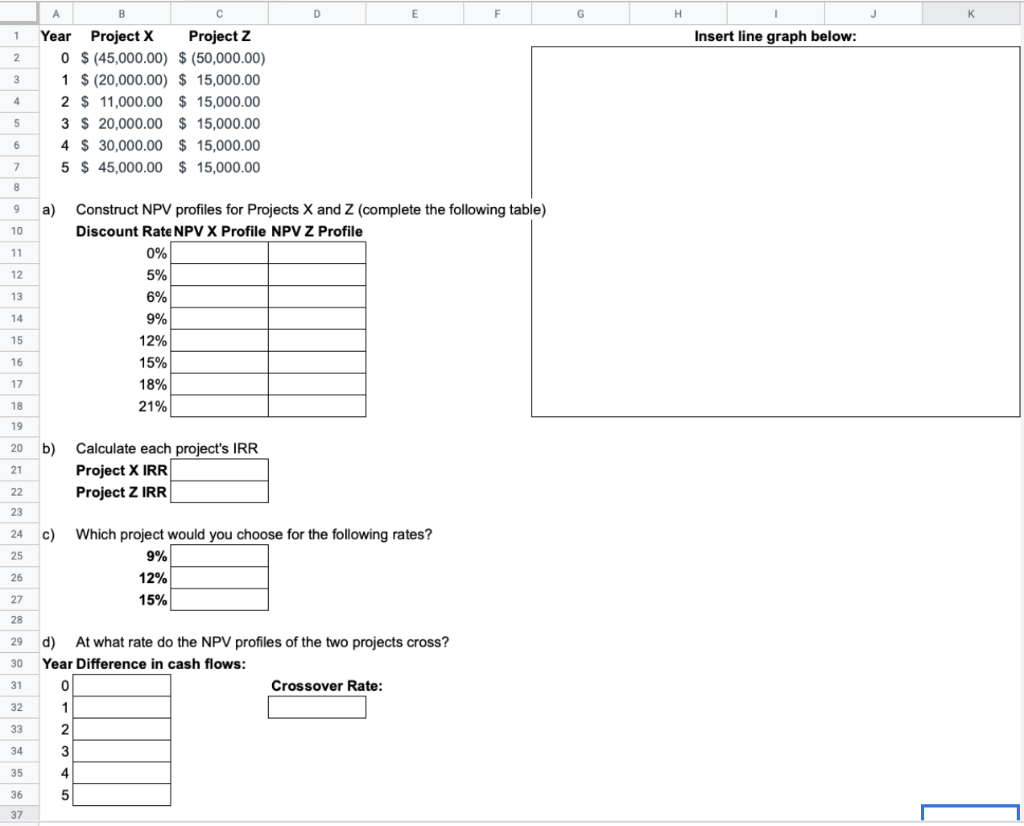
This is the aforementioned template
Thank you for your help!
a) Construct NPV profiles for Projects X and Z (complete the following tat Discount RateNPV X Profile NPV Z Profile b) Calculate each project's IRR Project X IRR Project Z IRR C) Which project would you choose for the following rates? d) At what rate do the NPV profiles of the two projects cross? Year Difference in cash flows: a) Construct NPV profiles for Projects X and Z (complete the following tat Discount RateNPV X Profile NPV Z Profile b) Calculate each project's IRR Project X IRR Project Z IRR C) Which project would you choose for the following rates? d) At what rate do the NPV profiles of the two projects cross? Year Difference in cash flows
Step by Step Solution
There are 3 Steps involved in it

Get step-by-step solutions from verified subject matter experts
 Study Help