







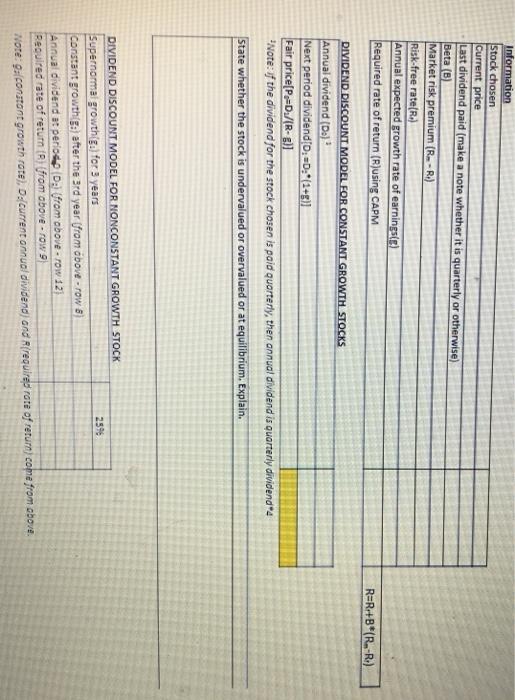
Question: use this templates please (first 2 pics) problem question begain stock valuation. Information Stock chosen Current price Last dividend paid (make a note whether it
 problem question begain stock valuation.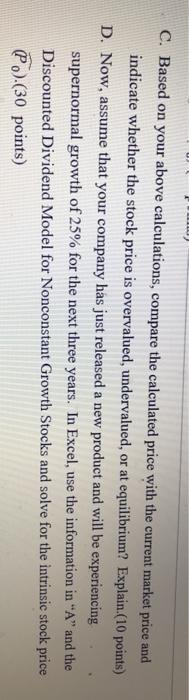
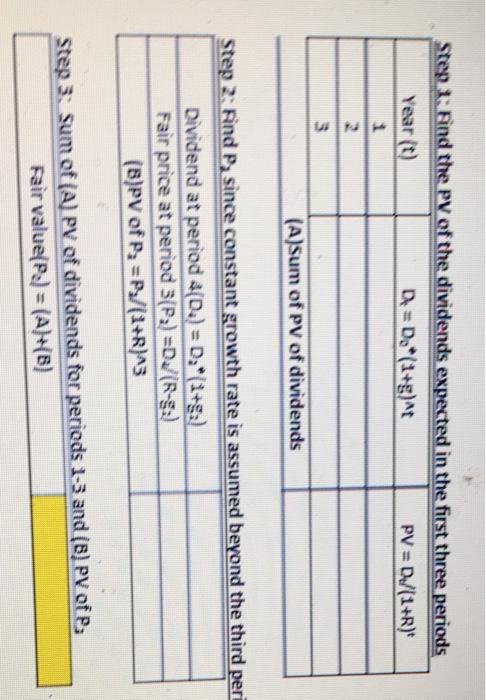
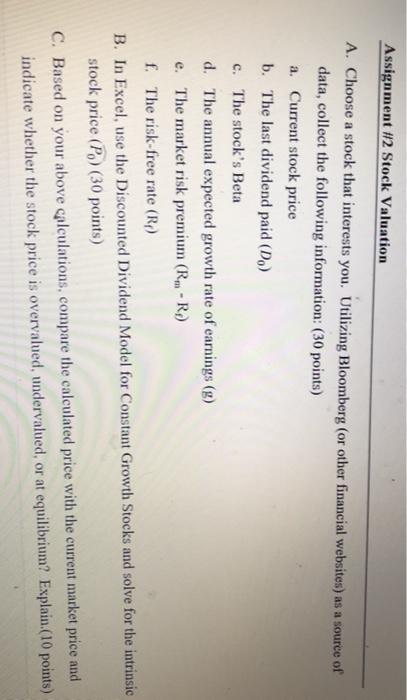
Information Stock chosen Current price Last dividend paid (make a note whether it is quarterly or otherwise) Beta (6) Market risk premium (R-R) Risk-free rate(R.) Annual expected growth rate of earnings e) Required rate of return (R]using CAPM R=R-4B*(R--R.) DIVIDEND DISCOUNT MODEL FOR CONSTANT GROWTH STOCKS Annual dividend (D) Next period dividendfO;=0;*(1+)] Fair price(Po=D://R-6)] Note: If the dividend for the stock chosen is paid quarterly, then annual dividend is quarterly dividend*4 State whether the stock is undervalued or overvalued or at equilibrium. Explain. DIVIDEND DISCOUNT MODEL FOR NONCONSTANT GROWTH STOCK Supernormal growth p.) for 3 years 2596 constant growth :) after the 3rd year (from obove-row 8 Annual dividend at period: from above-row 12 Required rate of return to (from above-row 9 Note: :constant growth rats), Oscurrent annual dividend and required rate of return) come from cbove. Step 1 Find the PV of the dividends expected in the first three periods Year (0) D = D.*(1+g)^t PV = D/(1+R)* 1 2 (A)Sum of PV of dividends Step 2: And P, since constant growth rate is assumed beyond the third peri Dividend at period 4(D.) = D.*(1+5:) Fair price at period (P) =D/(R-32) (B)PV of P, =P/(1+R}^3 Step 3: sum of (A) PV of dividends for periods 1-3 and (B) PV of e. Rair value(P.) = (A)(6) Assignment #2 Stock Valuation A. Choose a stock that interests you. Utilizing Bloomberg (or other financial websites) as a source of data, collect the following information: (30 points) a. Current stock price b. The last dividend paid (D) c. The stock's Beta d. The annual expected growth rate of earnings (g) le. The market risk premium ( R- RO) f. The risk-free rate (RP) B. In Excel, use the Discounted Dividend Model for Constant Growth Stocks and solve for the intrinsic stock price (Po) (30 points) C. Based on your above calculations, compare the calculated price with the current market price and indicate whether the stock price is overvalued, undervalued, or at equilibrium? Explain.(10 points) C. Based on your above calculations, compare the calculated price with the current market price and indicate whether the stock price is overvalued, undervalued, or at equilibrium? Explain.(10 points) D. Now, assume that your company has just released a new product and will be experiencing supernormal growth of 25% for the next three years. In Excel, use the information in "A" and the Discounted Dividend Model for Nonconstant Growth Stocks and solve for the intrinsic stock price P.) (30 points) Information Stock chosen Current price Last dividend paid (make a note whether it is quarterly or otherwise) Beta (6) Market risk premium (R-R) Risk-free rate(R.) Annual expected growth rate of earnings e) Required rate of return (R]using CAPM R=R-4B*(R--R.) DIVIDEND DISCOUNT MODEL FOR CONSTANT GROWTH STOCKS Annual dividend (D) Next period dividendfO;=0;*(1+)] Fair price(Po=D://R-6)] Note: If the dividend for the stock chosen is paid quarterly, then annual dividend is quarterly dividend*4 State whether the stock is undervalued or overvalued or at equilibrium. Explain. DIVIDEND DISCOUNT MODEL FOR NONCONSTANT GROWTH STOCK Supernormal growth p.) for 3 years 2596 constant growth :) after the 3rd year (from obove-row 8 Annual dividend at period: from above-row 12 Required rate of return to (from above-row 9 Note: :constant growth rats), Oscurrent annual dividend and required rate of return) come from cbove. Step 1 Find the PV of the dividends expected in the first three periods Year (0) D = D.*(1+g)^t PV = D/(1+R)* 1 2 (A)Sum of PV of dividends Step 2: And P, since constant growth rate is assumed beyond the third peri Dividend at period 4(D.) = D.*(1+5:) Fair price at period (P) =D/(R-32) (B)PV of P, =P/(1+R}^3 Step 3: sum of (A) PV of dividends for periods 1-3 and (B) PV of e. Rair value(P.) = (A)(6) Assignment #2 Stock Valuation A. Choose a stock that interests you. Utilizing Bloomberg (or other financial websites) as a source of data, collect the following information: (30 points) a. Current stock price b. The last dividend paid (D) c. The stock's Beta d. The annual expected growth rate of earnings (g) le. The market risk premium ( R- RO) f. The risk-free rate (RP) B. In Excel, use the Discounted Dividend Model for Constant Growth Stocks and solve for the intrinsic stock price (Po) (30 points) C. Based on your above calculations, compare the calculated price with the current market price and indicate whether the stock price is overvalued, undervalued, or at equilibrium? Explain.(10 points) C. Based on your above calculations, compare the calculated price with the current market price and indicate whether the stock price is overvalued, undervalued, or at equilibrium? Explain.(10 points) D. Now, assume that your company has just released a new product and will be experiencing supernormal growth of 25% for the next three years. In Excel, use the information in "A" and the Discounted Dividend Model for Nonconstant Growth Stocks and solve for the intrinsic stock price P.) (30 points)
Step by Step Solution
There are 3 Steps involved in it

Get step-by-step solutions from verified subject matter experts
 Study Help